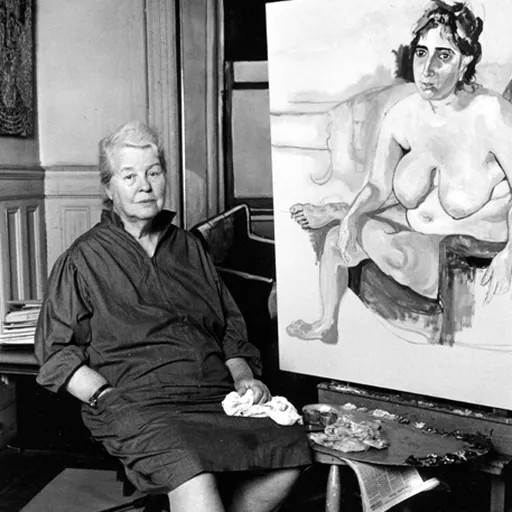
About Alice Neel
Lived 1900 – 1984 (aged 84). Alice Neel was an American painter, draftsperson, lithographer, sculptor, photographer and visual artist.
Alice Neel (January 28, 1900 – October 13, 1984) was an American visual artist. Recognized for her paintings of friends, family, lovers, poets, artists, and strangers, Neel is considered one of the greatest American portraitists of the 20th century. Her career spanned from the 1920s to 1980s.
Her paintings have an expressionistic use of line and color, psychological acumen, and emotional intensity. She pursued a career as a figurative painter during a period when abstraction was favored, and she did not begin to gain critical praise for her work until the 1960s. This is done by depicting women through a female gaze, illustrating them as being consciously aware of the objectification by men and the demoralizing effects of the male gaze. in Merion Square, Pennsylvania. Her father was George Washington Neel, an accountant for the Pennsylvania Railroad, and her mother was Alice Concross Hartley Neel. In mid-1900 her family moved to the rural town of Colwyn, Pennsylvania. Her oldest brother, Hartley, died of diphtheria shortly after she was born. He was eight years old. She was raised in a straight-laced, lower-middle-class family during a time when there were limited expectations and opportunities for women. Her mother had said to her: "I don't know what you expect to do in the world, you're only a girl." From a young age Alice wanted to be an artist, even with little exposure to art.
In 1918, after graduating from high school, she took the civil service exam and got a high-paying clerical position in order to help support her parents. After three years of work, taking art classes by night in Philadelphia, Neel enrolled in the fine art program at the Philadelphia School of Design for Women (now Moore College of Art & Design) in 1921. In her student works she rejected impressionism, the popular style at the time, and instead embraced the Ashcan School of Realism. It is believed this influence came from one of the most prominent figures of the Ashcan School, Robert Henri, who also taught at Philadelphia School of Design for Women. At Philadelphia School of Design for Women, she won honorable mention in her painting class for the Francisca Naiade Balano Prize two years in a row. In 1925 Neel received the Kern Doge Prize for Best Painting in her life class. She graduated from Philadelphia School of Design for Women in 1925.
Cuba In 1924, Neel met Carlos Enríquez, an upper-class Cuban painter, at the Chester Springs summer school run by PAFA. Neel later said she had her first solo exhibition in Havana, but there are no dates or locations to confirm this. In March 1927, Neel exhibited with her husband in the 12th Salon des Bellas Artes. This exhibition also included Eduardo Abela, Víctor Manuel García Valdés, Marcelo Pogolotti, and Amelia Peláez who were all part of the Cuban Vanguardia Movement. During this time, she had seven servants and lived in a mansion.
Mourning the loss of her husband and daughter, Neel had a nervous breakdown, was hospitalized, and attempted suicide. At the end of 1933, Neel was offered $30 a week to participate in the Public Works of Art Project (PWAP) during an interview at the Whitney Museum. She had been living in poverty.
She consorted with artists, intellectuals, and political leaders of the Communist Party, all of whom became subjects for her paintings.
One of Neel's best known early female nude portraits is of Ethel V. Ashton (1930 ). Neel depicted Ethel, her friend from the Philadelphia School of Design for Women (now part of Moore College of Art and Design), as many art historians described as "nearly crippled with self conscious by her own exposure". Ethel's body was exposed in a crouched seated position, where she was able to look the viewer directly in the eye. Ethel's eyes were commonly described as "soulful" and expressing a sense of fear. Neel painted her friend through a distorted scale that added to the idea of "vulnerability and fearfulness". Neel said of the image: "She's almost apologizing for living. And look at all the furniture she has to carry all the time." By furniture, the artist "referred to her heavy thighs, bulging stomach, and pendulous breasts." The formal elements of the painting, light and shadow, the brushstrokes, and the color are suggested to add pathos and humor to the work but they are done in a precise manner to convey a certain tone, which is vulnerability. The painting was exhibited 43 years later at the Alumni Exhibition, where it was severely criticized by many art critics and the general public. During this time, Neel would shoplift and was on welfare to help make ends meet. Between 1940 and 1950, Neel's art virtually disappeared from galleries, save for one solo show in 1944. In the 1950s, her friendship with Mike Gold and his admiration for her social realist work garnered her a show at the Communist-inspired New Playwrights Theatre. In 1959, Neel even made a film appearance after the director Robert Frank asked her to appear alongside a young Allen Ginsberg in his beatnik film, Pull My Daisy. The following year, her work was first reproduced in ARTnews magazine.
Pregnant female nudes By the mid-1960s, many of Neel's female friends had become pregnant which inspired her to paint a series of these women nude. The portraits truthfully highlight instead of hiding the physical changes and emotional anxieties that coexist with childbirth. When she was asked why she painted pregnant nudes, Neel replied,
Neel chose to paint the "basic facts of life" and strongly believed that this form of subject matter is worthy enough to be painted in the nudes, which was what distinguished her from other artists of her time. The pregnant nudes suggested by the art historian, Ann Temkin, allowed Neel to "collapse the imaginary dichotomy that polarizes women into the chaste Madonna or the specter of the dangerous whore" Margaret was painted while sitting on upright chair that forced her to expose her pregnant stomach even more, which became the central point in the canvas. Right behind the chair a mirror was placed which allowed the viewer to see the back of her head and neck. However, the mirrored reflection did not look anything like Margaret's frontal portrait. The motive behind this particular section of the painting remains unknown, but art historian Jeremy Lewison says the image is "an uncanny double of the sitter and the artist, presaging older age", and suggests that the reflection is of an older and wiser woman and perhaps a combination of Margaret and Neel's reflection. Pamela Allara says Neel has been accurately characterized as a "sort of artist–sociologist who revived and redirected the dying genre of ameliorative portraiture by merging objectivity with subjectivity, realism with expressionism. In visually interpreting a person's habitus, Neel understood that she could not be an objective observer, that her depictions would of necessity include her own response."
Neel's self-portrait and last paintings
Neel painted Kate Millett in 1970, using photographs of Millett to do so, because Millett had refused to pose for Neel. Kate Millett was the author of Sexual Politics, an important text of second-wave feminism. Alice Neel's career was given new life by the feminist art movement, and Kate Millett was a feminist icon of the time. Neel considered herself "a collector of souls" and she aimed to capture Millett's powerful aura. Neel painted this portrait at a time when many independent women, fighting for equal opportunities and being ignored, were looking for a mentor. In this painting, Kate Millett is directly looking at the viewer, and her stare is very commanding. Kate Millett was featured in the September 25, 2017 issue of Time magazine, in which Time referred to her as the "high priestess" of feminism and to Sexual Politics as the feminist bible.
Neel painted herself in her eightieth year of life, seated on a chair in her studio. She presented herself fully nude. She wore her glasses and held her paintbrush on her right hand and an old cloth on the other hand. The white color of her hair and the several creases and folds of her bare skin indicated her old age.
Her image is included in the iconic 1972 poster Some Living American Women Artists by Mary Beth Edelson.
By the mid-1970s, Neel had gained celebrity and stature as an important American artist. The American Academy and the Institute of Arts and Letters elected Neel in 1976.
Neel's life and works are featured in the documentary Alice Neel, which premiered at the 2007 Slamdance Film Festival and was directed by her grandson, Andrew Neel. The film was given a New York theatrical release in April of that year.
Her career was used in a 3-episode series of the Freakonomics podcast "The Hidden Side of the Art Market", illustrating that "the art market is so opaque and illiquid that it barely functions like a market at all".
Neel's work was included in the 2022 exhibition Women Painting Women at the Modern Art Museum of Fort Worth.
Exhibitions In 1943, Neel's female nude portrait of Ethel Ashton was exhibited at Alumni Exhibition for the very first time, 13 years after the painting was created, and received brutal criticisms from art critics and the general public.
In 1974, Neel's work was given a retrospective exhibition at the Whitney Museum of American Art,
In 2002, Neel's work was shown with Emily Carr and Frida Kahlo at the National Museum of Women in the Arts's exhibition Places of Their Own: Emily Carr, Georgia O’Keeffe, and Frida Kahlo.
In 2004, the first exhibition dedicated to Neel's works in Europe was held in London, at the Victoria Miro Gallery. Jeremy Lewison, who had worked at the Tate, was the curator of the collection.
In 2010, Jeremy Lewison and Barry Walker presented, for Museum of Fine Arts, Houston, Alice Neel: Painted Truths, on view from March 21 to June 15, 2010, which later went to the Whitechapel Gallery, London and Moderna Museet Malmö, Sweden.
In 2013, the first major presentation of the artist's watercolors and drawings, as Alice Neel: Intimate Relations, was on view at Nordiska Akvarellmuseet in Skärhamn, Sweden.
In 2016, the Ateneum, Helsinki presented Alice Neel: Painter of Modern Life, which later went to the Kunstmuseum Den Haag, The Hague, the Fondation Vincent van Gogh Arles, France, and, in 2018, the Deichtorhallen, Hamburg, Germany, from October 10, 2017, to January 14, 2018.
In 2017, Hilton Als curated the exhibition "Alice Neel, Uptown" at the Victoria Miro Gallery in London (May 18 – July 29, 2017).
In 2021, a career-spanning retrospective of Neel's work opened at the Metropolitan Museum of Art. Titled "Alice Neel: People Come First", the exhibit featured more than 100 works and was the largest-ever show of Neel's work in New York and the first in two decades. That same year, Alice Neel: People Come First, a retrospective of her work, opened at the Guggenheim Bilbao before travelling to de Young Museum in 2022.
In 2023, Alice Neel: Hot Off The Griddle, the largest exhibition of her work to date in the UK, opened at The Barbican Centre Art Gallery in London.
In 2024, Alice Neel: At Home, curated by Hilton Als, was the first major exhibition to focus on queer communities and those who were part of her circle, opened at David Zwirner Gallery.
Alice Neel. I am the Century ran from the 31st of October 2025 to the 6th of April 2026 at the Pinacoteca Agnelli, Lingotto, Turin.
Collections Work by the artist is represented in major museum collections, including: Carnegie Museum of Art, Pittsburgh, Pennsylvania Cleveland Museum of Art Fine Arts Museums of San Francisco Hirshhorn Museum and Sculpture Garden, Washington, D.C. Honolulu Museum of Art Jewish Museum, New York Metropolitan Museum of Art, New York Moderna Museet, Stockholm Museum of Contemporary Art, Los Angeles Museum of Fine Arts, Boston Museum of Fine Arts, Houston Museum of Modern Art, New York National Gallery of Art, Washington, D.C. National Museum of Women in the Arts, Washington, D.C. National Portrait Gallery, Washington, D.C. Philadelphia Museum of Art San Francisco Museum of Modern Art Speed Art Museum, Louisville, Kentucky St. Louis Art Museum, St. Louis Missouri Tate Modern, London The Menil Collection, Houston, Texas Wadsworth Atheneum, Hartford, Connecticut Whitney Museum of American Art, New York Worcester Art Museum, Massachusetts Yale University Art Gallery, New Haven, Connecticut
Art market In 2015, Xavier Hufkens began representing Neel's estate. In 2026, Victoria Newhouse sold Mother and Child (Nancy and Olivia), a 1967 portrait of the artist’s daughter-in-law and first grandchild, for $5.7 million with fees at Christie’s in New York.
Don’t just read it —
keep it.
Full-length biographies made to live with: read them, listen on the way to work, watch them tonight.
- E-book
- Audio
- Video
Instant download · yours to keep · every purchase keeps this site free
Important facts
People in Alice Neel's life
Named in this biography and alive at the same time






Related people
Same field, nearest in time


Contemporaries
People whose lives overlapped Alice Neel's




Frequently asked questions
Who was Alice Neel?
American visual artist (1900-1984)
When was Alice Neel born?
Alice Neel was born on 28 January 1900 in Gladwyne.
When did Alice Neel die?
Alice Neel died on 13 October 1984 in New York City.
What was Alice Neel's occupation?
Alice Neel was a painter, draftsperson, lithographer, sculptor, photographer and visual artist.
What nationality was Alice Neel?
Alice Neel was American.
Sources & further reading
Cite this page
APA: Biography.guide. (2026). Alice Neel. https://biography.guide/alice-neel/
MLA: "Alice Neel." Biography.guide, https://biography.guide/alice-neel/.
Chicago: "Alice Neel." Biography.guide. https://biography.guide/alice-neel/.
Data last updated: 2026-09-21 · Spot an error? Report a correction.
Portrait: Wikimedia Commons · author & licence
Page generated 2026-09-27 04:59 UTC