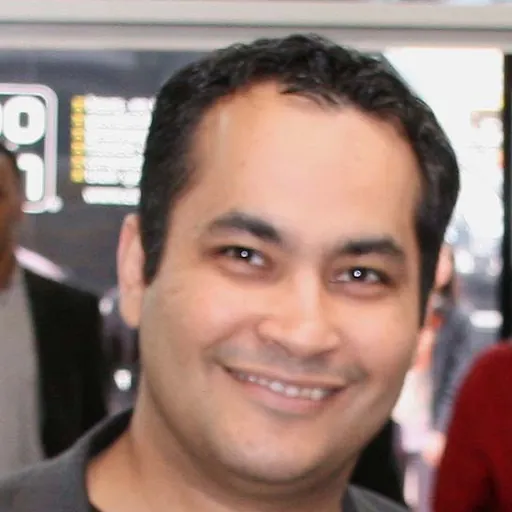
About Ali Khademhosseini
Born 1975. Ali Khademhosseini is a Canadian inventor, radiologist, scientist, university teacher and bioengineer.
Ali Khademhosseini (, born October 30, 1975) is an Iranian-born Canadian-American engineer and entrepreneur. He is currently the co-founder and CEO of a stealth startup in the area of AI and science .
Khademhosseini was the CEO of the Terasaki Institute for Biomedical Innovation (TIBI) in Los Angeles, California. Before that he held a multi-departmental professorship at the University of California, Los Angeles (UCLA), where he served as the Levi Knight Chair in Engineering and a professor in the departments of Bioengineering, Radiology, and Chemical and Biomolecular Engineering. He also served as the director of the Center for Minimally Invasive Therapeutics (C-MIT) at UCLA . He was principal scientist at Amazon during his transition between UCLA to TIBI.
Prior to joining UCLA, he was a faculty member at Harvard Medical School and a core faculty member at the Wyss Institute for Biologically Inspired Engineering from 2005 to 2017. In addition to his academic roles, Khademhosseini briefly worked at Amazon Inc., contributing to biomedical technology initiatives during a one-year tenure.
Khademhosseini has published approximately 1,000 scientific articles, which have collectively been cited over 165,000 times. As of January 2026, his h-index is 210. His work spans biomaterials, tissue engineering, microfluidics, and biofabrication, with key contributions to the development of Gelatin Methacryloyl (GelMA) hydrogels and multi-organ-on-a-chip platforms.
In addition to his academic career, Khademhosseini is also active in technology translation and entrepreneurship. He has contributed to the development of commercial products in the biomedical space, including surgical sealants, wearable sensors, and embolic materials.
Early life and education Khademhosseini was born in Tehran, Iran. His family migrated to Canada in 1987 and he grew up in Toronto, Canada. He received his Ph.D. in bioengineering from Massachusetts Institute of Technology under the supervision of Robert S. Langer (2005), and MASc (2001) and BSc (1999) degrees from the University of Toronto both in chemical engineering. He was first introduced to bioengineering by working as an undergraduate researcher in the laboratory of Michael Sefton who is a professor at University of Toronto. For his masters he worked in a joint project between the laboratory of Peter Zandstra and Sefton on stem cell bioengineering.
Contributions to Biomedical Innovation Ali Khademhosseini has contributed to the development of personalized biomedical technologies using micro- and nanoscale platforms for applications in organ failure, cardiovascular disease, and oncology. He played a key role in advancing the use of gelatin methacryloyl (GelMA)-based biomaterials in tissue engineering and clinical applications, including surgical sealants and hemostatic agents. GelMA is derived from gelatin that has been chemically modified to allow photocrosslinking, and it has gained widespread use due to its biocompatibility and biodegradability. Numerous studies have shown that various cell types maintain functionality when encapsulated in GelMA, and it has become a commonly used bioink for 3D biofabrication applications. Khademhosseini's team also developed conductive and tunable hydrogels by incorporating nanomaterials such as gold nanoparticles and carbon-based compounds into GelMA formulations.
He has also contributed to the development of multi-organ-on-a-chip platforms with integrated in-line sensors for real-time monitoring. These systems represent a next generation of organ-on-a-chip technologies with potential applications in drug testing and disease modeling. His earlier research included the development of electrochemical biosensors with regeneration capability, as well as physical microfluidic sensors for continuous biomonitoring within microphysiological systems.
Another area of innovation has been smart wound healing patches that integrate sensing and therapeutic functions within a single device.
Khademhosseini has also contributed to the design of hydrogel-based surgical materials, including bioadhesives and tissue sealants. Among these innovations is a shear-thinning embolic agent designed for vascular applications such as aneurysm treatment. This material combines nanosilicate (Laponite) with gelatin to form a hybrid nanocomposite, which adapts to the geometry of blood vessels during injection. The technology led to the commercial development of the Obsidio embolic material.
Translational efforts Khademhosseini is an academic entrepreneur who has started companies to translate the findings of his research into products. He co-founded Obsidio Medical to use a hydrogel made out of silicate nanoparticles with gelatin to engineer shear-thinning materials for the embolization of blood vessels in the peripheral vasculature. The technology was approved by U.S. Food and Drug Administration, and Obsidio Medical was acquired by Boston Scientific in August 2022.
He also founded Omeat Inc., aiming to produce cultivated meat in a scalable and affordable manner. Omeat is a vertically integrated meat company that also produces humane and cost effective fetal bovine serum replacement.
Other appointments and international interactions Khademhosseini was on sabbatical in 2011 as a Harrington fellow at the University of Texas-Austin with Prof. Nicholas Peppas.
Khademhosseini was also affiliated with Tohoku University, WPI - AIMR program in Sendai, Japan.
In 2019 and early 2020 he was on sabbatical at Amazon Inc. in Seattle.
Teaching and notable students Khademhosseini is a recipient of the Massachusetts Institute of Technology Outstanding Undergraduate mentor award. His notable students include Akhilesh Gaharwar.
Awards and honors Khademhosseini's interdisciplinary research has been recognized over 70 major national and international awards. He is a recipient of the Massachusetts Institute of Technology Outstanding Undergraduate mentor award. He has also received the American Chemical Society's Viktor K. Lamer award, the Unilever award,
Selected Awards
Materials Research Society Mid Career Research Award (2025) AICHE Acrivos Award for Professional Progress (2024) Biomaterials Global Impact Award (2024) Technology Innovation and Development Award - Society for Biomaterials (2024) Research.com Best Scientist Award (2022, 2023, 2024) Research.com Materials Science in United States Leader Award (2023, 2024) Thompson Reuters - Highly Cited Researcher (every year from 2014 through 2024) Biotechnology Progress award for Excellence in Publication (2022) Mustafa Prize (2019) Acta Biomaterialia Silver Medal (2018) Clemson Award of the Society for Biomaterials (2017) Sr. Scientist Award of Tissue Engineering and Regenerative Medicine Society-Americas (TERMIS-AM) (2017) Pioneers of Miniaturization Prize from the Royal Society of Chemistry (2016) IEEE EMBS William J. Morlock Award (2016) AIChE Nanoscale Science & Engineering Forum Young Investigator Award (2014) International Union of Materials Research Societies (IUMRS) Singapore Young Researcher Award (2014) ACS Kavli Foundation Emerging Leader in Chemistry (2014) Presidential Early Career Award for Scientists and Engineers (PECASE) by President Barack Obama, the highest honor given by the US government for early-career investigators (2011) Young investigator award, Society for Biomaterials (2008) Young investigator award, Tissue Engineering and Regenerative Medicine International Society. Fellow, International Academy of Medical and Biological Engineering Fellow, Canadian Academy of Engineering Fellow, Royal Society of Canada Fellow, American Institute for Medical and Biological Engineering (AIMBE) Fellow, Biomedical Engineering Society (BMES) Fellow, Royal Society of Chemistry Fellow of Biomaterials Science and Engineering (FBSE) Fellow, Materials Research Society (MRS) Fellow, American Association for the Advancement of Science (AAAS) Sr Member, IEEE
Don’t just read it —
keep it.
Full-length biographies made to live with: read them, listen on the way to work, watch them tonight.
- E-book
- Audio
- Video
Instant download · yours to keep · every purchase keeps this site free
Important facts
People in Ali Khademhosseini's life
Named in this biography and alive at the same time

Related people
Same field, nearest in time

Contemporaries
People whose lives overlapped Ali Khademhosseini's



Frequently asked questions
Who is Ali Khademhosseini?
Iranian scientist
When was Ali Khademhosseini born?
Ali Khademhosseini was born on 30 October 1975 in Iran, Tehran.
What is Ali Khademhosseini's occupation?
Ali Khademhosseini is an inventor, radiologist, scientist, university teacher and bioengineer.
What nationality is Ali Khademhosseini?
Ali Khademhosseini is Canadian.
Sources & further reading
· Wikipedia: Ali Khademhosseini
Cite this page
APA: Biography.guide. (2026). Ali Khademhosseini. https://biography.guide/ali-khademhosseini/
MLA: "Ali Khademhosseini." Biography.guide, https://biography.guide/ali-khademhosseini/.
Chicago: "Ali Khademhosseini." Biography.guide. https://biography.guide/ali-khademhosseini/.
Data last updated: 2026-09-20 · Spot an error? Report a correction.
Page generated 2026-09-27 05:10 UTC