
About Alfred Rosenheim
Lived 1859 – 1943 (aged 84). Alfred Rosenheim was an American architect.
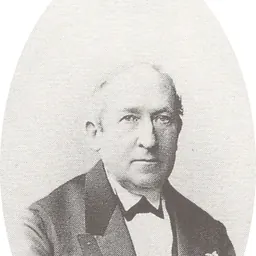
Alfred Faist Rosenheim, F.A.I.A. (June 10, 1859 – September 9, 1943) was an American architect. A Fellow of the American Institute of Architects, he was one of the leading architects in Los Angeles in the early part of the 20th century. His major works include the Hellman Building, Hamburger's Department Store, Second Church of Christ, Scientist, and the Eugene W. Britt House.
Education and early career Rosenheim was born in St. Louis to a Jewish family in St. Louis, Missouri, the son of immigrants from Germany. After attending public schools in St. Louis, he studied in Frankfurt am Main, Germany from 1872 to 1875. When he returned from Germany, Rosenheim was a student at Washington University in St. Louis from 1876 to 1879. He next attended the Massachusetts Institute of Technology, from 1879 to 1881.
Rosenheim began his career as a draftsman working for Charles K. Ramsay of Boston from 1881 to 1883. In early 1884, he joined the practice of Major Francis D. Lee, then the leading architect in St. Louis. When Major Lee died in 1885, Rosenheim took over the practice. In 1894, he formed a partnership with T. C. Link and William B. Ittner that lasted until 1897. From 1897 to 1899, he worked in a partnership with his younger brother, Samuel F. Rosenheim, with Alfred working in Boston and Samuel in St. Louis. During this time, the Rosenheim firm designed Farragut Chambers, a ten-story apartment house in Washington, D.C., and various structures in Boston and Worcester, Massachusetts. In 1899, Rosenheim returned to St. Louis, where he remained until 1903. the Chapman block (at the southeast corner of Fifth and Los Angeles streets), and the buildings occupied by the Farmers & Merchants Bank and the Security-First National Trust and Savings Bank. The brick mansion he designed as his own residence in 1910, located at 1120 Westchester Place, was considered "one of the finest homes in Los Angeles."
Rosenheim's last major commission was the Hollenbeck Junior High School in 1937. The Hollenbeck school was a departure for Rosenheim, considered "modern" by many at the time. Rosenheim was reluctant to acknowledge the school as modern and wrote the following in the April 1939 issue of The Architect and Engineer:"I do not consider the buildings particularly 'modern' although the administration and assembly hall units may possess something akin to the so-called 'contemporary' style. Personally, I do not hesitate to express the fervent hope that 'modernistic' architecture is not a permanent trend. I have a strong feeling that the bulk of modern work we see the country over has very little claim to architectural beauty. In fact I am inclined to doubt whether it can strictly be regarded as architecture. ... But whatever one chooses to call the style of my Hollenbeck School, it seemed to appeal to the Board of Education and its architect."
Arts Commission scandal and later life Rosenheim became a Fellow of the A.I.A. in 1889 and served as the President of its Southern California chapter. After several years serving as the Secretary of the Los Angeles Municipal Arts Commission, Rosenheim was removed following a widely publicized scandal in 1921. After the commission rejected a proposal by a jeweler to erect an ornamental clock on the sidewalk, Rosenheim offered, for a fee of $250, to prepare drawings that he could "safely guarantee" would be approved by the commission. The Rosenheim-drafted plans were then approved at a special meeting of the commission held in Rosenheim's office on a Saturday morning. Rosenheim insisted he had done nothing improper, but the City Council unanimously voted to remove him, and the local branch of the American Institute of Architects recommended a term of suspension from its ranks.
Rosenheim died of heart disease at California Hospital in 1943 at age 84.
Don’t just read it —
keep it.
Full-length biographies made to live with: read them, listen on the way to work, watch them tonight.
- E-book
- Audio
- Video
Instant download · yours to keep · every purchase keeps this site free
Important facts
Related people
Same field, nearest in time




Contemporaries
People whose lives overlapped Alfred Rosenheim's

Frequently asked questions
Who was Alfred Rosenheim?
American architect
When was Alfred Rosenheim born?
Alfred Rosenheim was born on 10 June 1859 in St. Louis.
When did Alfred Rosenheim die?
Alfred Rosenheim died on 9 September 1943 in Los Angeles.
What was Alfred Rosenheim's occupation?
Alfred Rosenheim was an architect.
What nationality was Alfred Rosenheim?
Alfred Rosenheim was American.
Sources & further reading
Cite this page
APA: Biography.guide. (2026). Alfred Rosenheim. https://biography.guide/alfred-rosenheim/
MLA: "Alfred Rosenheim." Biography.guide, https://biography.guide/alfred-rosenheim/.
Chicago: "Alfred Rosenheim." Biography.guide. https://biography.guide/alfred-rosenheim/.
Data last updated: 2026-09-20 · Spot an error? Report a correction.
Page generated 2026-09-27 05:27 UTC