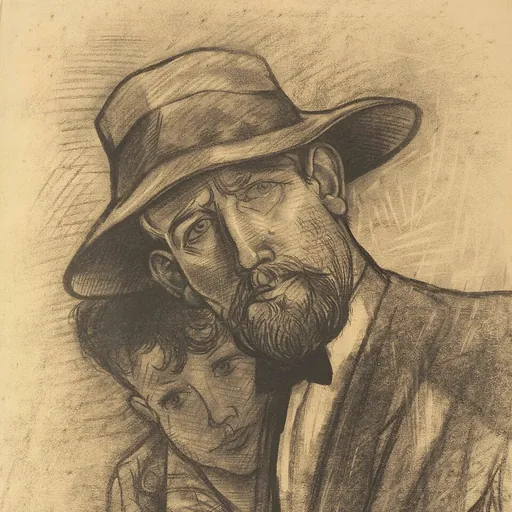
About Alfred Ahner
Lived 1890 – 1973 (aged 83). Alfred Ahner was a German painter.
Alfred Ahner (13 August 1890 - 12 November 1973) was a German painter and designer.
Life
Born in Wintersdorf, he took an apprenticeship in lithography in Gera from 1905 to 1910 before working as a lithographer. Drawing classes at Sunday school in Gera brought him into contact with Otto Dix and Kurt Günther. From 1911 to 1913 he studied in Munich at a private school run by Wladimir Magidey (born 1881) and at the Akademie der bildenden Künste under Peter Halm and Carl Johann Becker-Gundahl. During this period he met Erich Mühsam, Frank Wedekind and Roda Roda.
In 1913 and 1914 Ahner studied at the Kgl. Akademie der bildenden Künste in Stuttgart under professors Heinrich Altherr and Adolf Hölzel, until the First World War put an abrupt end to his education and turned him into a medical orderly in the army on the Western Front. There Ahner artistically captured what he saw and what moved him: doctors, dogs carrying medical supplies, exploding grenades, transporting the wounded, superiors, comrades, villages, landscapes and French children and villagers. Between 1914 and 1919 he created around 170 drawings and sketches of such subjects. After the First World War, he worked as a pump attendant in the brown coal mine in his hometown of Wintersdorf and joined the KPD.
From 1922 until his death, he lived and worked as a freelance artist in Weimar, where he also died, and became close friends with the Gera painter Alexander Wolfgang. From 1924 to 1933 he was a constant visitor to the Thuringian Landtag, where he created around a hundred drawings of ministers, representatives, visitors and employees. From the Nazi seizure of power in 1933 until the end of the Second World War he went into 'internal emigration', only exhibiting once during that time, in a show with Johanna Salzmann organised by the Thuringian Exhibition Association of Visual Artists in Weimar in 1940. He continued several satirical and mocking works such as the watercolour Street Scene, which was confiscated from the Weimar Castle Museum by the Nazi authorities in 1937 as 'degenerate art'.
He was conscripted as an army medical orderly again in 1944-1945 and after the war his inner circle of friends in Weimar included Dora Wentscher and Johannes Nohl. At that time his work inspired the painters and miniaturists Gerhard Bätz and Manfred Kiedorf, who began their careers in the 1950s. The new German Democratic Republic required artists to portray working people and in that context in 1952 Ahner began working with his fellow painters Erwin Görlach, Gerhard Ströch and Martin Spröte (1916–1977) at the newly founded Agricultural Production Cooperative in Merxleben. He also went to make studies in the lignite-mining area in Meuselwitz.
Marriage and issue Alfred Ahner married the horticulture teacher Erna Oschatz. His two children, Karl-Hermann and Maria-Erika, were born in 1923 and 1925. Their son died in Russia in the Second World War at the age of 20.
Honours 1960: Goethe Medal and Schiller Medal of the City of Weimar 1962: Honorary citizenship of Wintersdorf Dresden Sächsische Landesbibliothek, Staats- und Universitätsbibliothek Kupferstichkabinett Dresden Erfurt, Angermuseum 1994: „Alfred Ahner – Künstler und Chronist“, Kunstkabinett am Goetheplatz Weimar 1999: „Alfred Ahner – ein Maler im Thüringer Landtag“, Kabinettausstellung im Lindenau-Museum Altenburg 2001/02: „Alfred Ahner – Pastelle, Zeichnungen, Gemälde“. Kunsthaus Apolda; Stadtmuseum Groß-Gerau. 2002: „Landtagszeichnungen 1924–1933“. Thüringer Landtag, Erfurt. 2003: „Sehenden Auges“ – Alfred Ahner und das Ende von Weimar; Ausstellung der Stiftung Gedenkstätten Buchenwald; Kunsthalle „Harry Graf Keßler“, Weimar. 2008–2009: „Am feinsten ist’s im Café …!“ Zeichnungen und Pastell. Kunsthalle Harry Graf Kessler, Weimar. Ausstellung aus Anlass der Gründung der Alfred-Ahner-Stiftung. 2008–2009: „Bildchronist und Zeitzeuge – Der schriftliche Nachlaß des Weimarer Künstlers Alfred Ahner.“ Sächsische Landesbibliothek, Staats- und Universitätsbibliothek Dresden. 2008–2009: „Altenburger Bilder“ von Alfred Ahner, H. Burkhardt, Erich Dietz. Lindenau-Museum Altenburg 2009: „Alles Liebe“, Thüringer Freilichtmuseum Hohenfelden. 2010: „Alles Liebe“, Stadtmuseum Weimar. 16. August–12. November 2013, Kirms-Krackow-Haus Weimar: „Alfred Ahner (1890–1973) – Lebensbilder“ – Kabinett-Ausstellung zum 40. Todestag des Malers. 29. Juli bis 23. August 2013, Erfurt, Sparkasse am Fischmarkt: „Alfred Ahner – ausgewählte Meisterwerke in Pastell“ 2014: Freilichtmuseum Hohenfelden, Hohenfelden („... dass dieses Morden bald ein Ende hat“) 1968: Halle/Saale, Staatliche Galerie Moritzburg („Sieger der Geschichte“) 1974: Erfurt, Bezirkskunstausstellung 1974: Dresden, Kupferstichkabinett („Zeichnungen in der Kunst der DDR“) 1974: Weimar, Galerie im Schloss („Kunst für uns“) 1977: Weimar, Kunsthalle am Theaterplatz („Das Aquarell in fünf Jahrhunderten. Schätze der Kunstsammlungen zu Weimar“) 1979: Berlin, Altes Museum („Weggefährden – Zeitgenossen. Bildende Kunst aus 3 Jahrzehnten “) 1985: Erfurt, Gelände der Internationalen Gartenbauausstellung („Künstler im Bündnis“)
Don’t just read it —
keep it.
Full-length biographies made to live with: read them, listen on the way to work, watch them tonight.
- E-book
- Audio
- Video
Instant download · yours to keep · every purchase keeps this site free
Important facts
People in Alfred Ahner's life
Named in this biography and alive at the same time

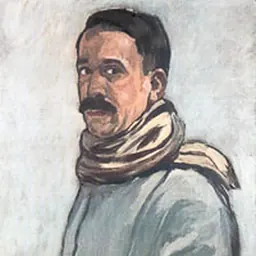

Related people
Same field, nearest in time


Contemporaries
People whose lives overlapped Alfred Ahner's



Frequently asked questions
Who was Alfred Ahner?
German painter (1890-1973)
When was Alfred Ahner born?
Alfred Ahner was born on 13 August 1890 in Wintersdorf.
When did Alfred Ahner die?
Alfred Ahner died on 12 November 1973 in Weimar.
What was Alfred Ahner's occupation?
Alfred Ahner was a painter.
What nationality was Alfred Ahner?
Alfred Ahner was German.
Sources & further reading
· DBpedia: Alfred Ahner (painter)
Cite this page
APA: Biography.guide. (2026). Alfred Ahner. https://biography.guide/alfred-ahner/
MLA: "Alfred Ahner." Biography.guide, https://biography.guide/alfred-ahner/.
Chicago: "Alfred Ahner." Biography.guide. https://biography.guide/alfred-ahner/.
Data last updated: 2026-09-22 · Spot an error? Report a correction.
Portrait: Wikimedia Commons · author & licence
Page generated 2026-09-27 05:02 UTC