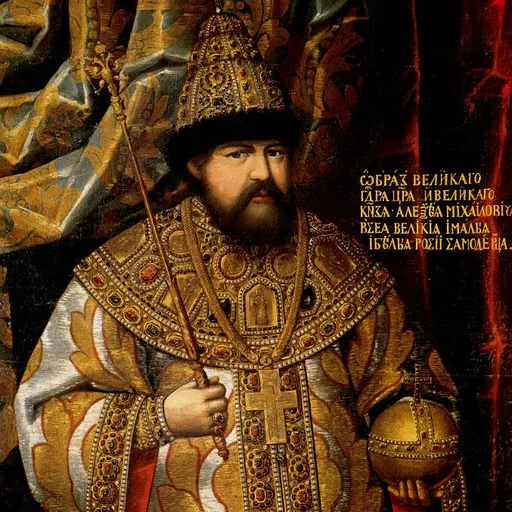
About Alexei I of Russia
Lived 1629 – 1676 (aged 46). Alexei I of Russia was a Russian monarch.
Alexei Mikhailovich (, ; – ), also known as Alexis, was Tsar of all Russia from 1645 until his death in 1676. He was the second Russian tsar from the House of Romanov.
While finding success in foreign affairs, his reign saw several wars with Iran, Poland (from whom left-bank Ukraine and Smolensk were annexed) and Sweden, as well as internal instabilities such as the Salt Riot in Moscow and the Cossack revolt of Stenka Razin in southern Russia. At the time of his death, Russia spanned almost .
Early life and reign
Alexis was born on , At the age of sixteen, he acceded to the throne after his father's death on 12 July 1645. In August, the Tsar's mother died, and following a pilgrimage to Sergiyev Posad he was crowned on 28 September in the Dormition Cathedral. He was committed to the care of his tutor Boris Morozov, a shrewd boyar open to Western ideas.
Morozov pursued a peaceful foreign policy, securing a truce with the Polish–Lithuanian Commonwealth and carefully avoiding complications with the Ottoman Empire. His domestic policy aimed at limiting the privileges of foreign traders and abolishing useless and expensive court offices. On 17 January 1648, Morozov procured the marriage of the tsar with Maria Miloslavskaya, himself marrying her sister Anna ten days later; These regiments formed the backbone of the new army of Tsar Alexis. To fulfill the reform goals, a large number of European military specialists were hired for service. This became possible because of the end of the Thirty Years' War, which created a colossal surplus of military professionals in Europe.
Rebellions
Throughout his reign, Alexis faced rebellions across Russia. After resolving the 1648 Salt Riot Alexis faced rebellions in 1650 in the cities of Pskov and Great Novgorod. Alexis put down the Novgorod rebellion quickly, but was unable to subdue Pskov, and was forced to promise the city amnesty in return for surrender. The Metropolitan Nikon distinguished himself at Great Novgorod and in 1651 became the Tsar's chief minister.
By the 1660s, Alexis's wars with Poland and Sweden had put an increasing strain on the Russian economy and public finances. In response, Alexis's government had begun minting large numbers of copper coins in 1654 to increase government revenue but this led to a devaluation of the ruble and a severe financial crisis. As a result, angry Moscow residents revolted in the 1662 Copper Riot, which was put down violently.
Schism with the Old Believers
In 1653, Patriarch Nikon established a series of reforms that aimed to bring the practices of the Russian Orthodox Church into line with its Greek counterpart. Most notably, the church began to mandate the use of three fingers instead of two in making the sign of the cross. This resulted in significant dissent among the church community. Nevertheless, Alexis continued to support Nikon until 1658, when Nikon abandoned his post due to a personal insult, leaving the seat of the patriarch vacant.
In 1666, the tsar convened the Great Moscow Synod, which was attended by Patriarch Macarius III Ibn al-Za'im and Patriarch Paisius of Alexandria, in order to address the problems caused by Nikon. The synod agreed to formally depose Nikon, and also decided to excommunicate all who opposed the reforms of the church; those opponents broke away from the official Russian Orthodox Church to form the Old Believers movement.
Several old believers fled to the monastery of Solovki which had revolted in the Solovetsky Monastery uprising. The monastery would be besieged for seven years until 22 January 1676 which was a few days before Alexis's death on 8 February 1676.
Assessment
According to the Encyclopædia Britannica Eleventh Edition: It is the crowning merit of the Tsar Alexei that he discovered so many great men (like Fyodor Rtishchev, Ordin, Matveyev, the best of Peter's precursors) and suitably employed them. He was not a man of superior strength of character, or he would never have submitted to the dictation of Nikon. But, on the other hand, he was naturally, if timorously, progressive, or he would never have encouraged the great reforming boyar Matveyev. His last years, notwithstanding the terrible rebellion of Stenka Razin, were deservedly tranquil.
Personal description
In 1666, his doctor Samuel Collins described Alexis (then aged 37) as having "a sanguine complexion with light brown hair, his beard uncut. He is tall and fat of a majestical deportment, severe in his anger, bountiful, charitable".
Title The full title of Alexis in 1667 was:
Family and children Tsar Alexei chooses his bride, painting by Grigory Sedov, 1882. The winner of the tsardom-wide contest organized by Boris Morozov was his relative Maria Miloslavskaya.
Alexis's first marriage to Miloslavskaya was harmonious and felicitous. They had 13 children (five sons and eight daughters) in 21 years of marriage, and she died only weeks after her thirteenth childbirth. Four sons survived her (Alexei, Fyodor, Semyon and Ivan), but within six months of her death, two of these were dead, including Alexei, the 15-year-old heir to the throne. The couple's children were: Dmitri Alexeevich (1648–1649); crown prince; died in infancy Yevdokia Alekseevna (1650–1712) Marfa Alekseyevna (1652–1707) Alexei Alexeevich (1654–1670); crown prince; died unmarried aged 15 Anna Alexeevna (23 January 1655– 8 May 1659); died in infancy Sofia Alexeevna (1657–1704), regent of Russia (1682–1689) for her two younger brothers; never married Ekaterina Alexeevna (1658–1718) Maria Alexeevna (1660–1723) Fyodor III (1661–1682); succeeded his father as Tsar of Russia; died childless Feodosia Alexeyevna (1662–1713) Simeon Alexeyevich (1665–1669); died in infancy Ivan V (1666–1696); was co-ruler along with his younger half-brother Peter, father of Empress Anna Yevdokia Alexeevna (1669–1669)
Alexis remarried on 1 February 1671 to Natalya Kirillovna Naryshkina (1 September 1651 – 4 February 1694). She had been brought up in the house of Artamon Matveyev, whose wife was the Scottish-descended Mary Hamilton. Their children were: Peter I (1672–1725), later known as "Peter the Great", Tsar and first Emperor of Russia Natalya Alexeevna (1673–1716) Fyodora Alexeevna (1674–1678)
Ancestry
Don’t just read it —
keep it.
Full-length biographies made to live with: read them, listen on the way to work, watch them tonight.
- E-book
- Audio
- Video
Instant download · yours to keep · every purchase keeps this site free
Important facts
Family & relationships
People in Alexei I of Russia's life
Named in this biography and alive at the same time

Related people
Same field, nearest in time
Contemporaries
People whose lives overlapped Alexei I of Russia's


Frequently asked questions
Who was Alexei I of Russia?
Tsar of Russia (1645–1676)
When was Alexei I of Russia born?
Alexei I of Russia was born on 19 March 1629 in Moscow.
When did Alexei I of Russia die?
Alexei I of Russia died on 29 January 1676 in Moscow.
What was Alexei I of Russia's occupation?
Alexei I of Russia was a monarch.
What nationality was Alexei I of Russia?
Alexei I of Russia was Russian.
Sources & further reading
· Wikipedia: Alexei I of Russia
Cite this page
APA: Biography.guide. (2026). Alexei I of Russia. https://biography.guide/alexei-i-of-russia/
MLA: "Alexei I of Russia." Biography.guide, https://biography.guide/alexei-i-of-russia/.
Chicago: "Alexei I of Russia." Biography.guide. https://biography.guide/alexei-i-of-russia/.
Data last updated: 2026-09-30 · Spot an error? Report a correction.
Portrait: Wikimedia Commons · author & licence
Page generated 2026-10-04 14:29 UTC