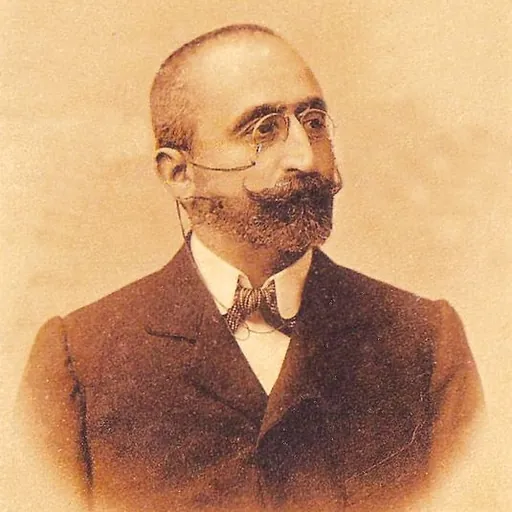
About Alexandru C. Cuza
Lived 1857 – 1947 (aged 89). Alexandru C. Cuza was a politician, journalist, economist, university teacher, antisemite and jurist.
Alexandru Constantin Cuza (8 November 1857 – 3 November 1947), also known as A. C. Cuza, was a Romanian fascist politician, economist, professor, poet, prose writer and epigramist.
Early life Cuza was born in Iași into a family of mixed Armenian-Greek origins. He was the grandson of Moldavian landowner Gheorghe Cuza (1780–1835), Domnitor Alexandru Ioan Cuza's uncle. He attended secondary school in his native city and in Dresden, Saxony, Germany, then studied law at the University of Paris, the Friedrich-Wilhelms-Universität Berlin, and the Université Libre de Bruxelles. He took doctorates in political and administrative sciences (1882), as well as law (1886).
Activism and developing antisemitism Upon his return to Romania, Cuza became active in the socialist circle formed around Constantin Mille. He attended meetings of the Junimea literary society, contributing to its magazine Convorbiri Literare. In 1890, he engaged in the political aspect of Junimea, serving briefly as deputy mayor of Iași; in 1892, he was elected to the Chamber of Deputies (serving until 1895). Cuza moved on to the Conservatives, and was yet again deputy – until a split generated by his virulent antisemitism.
Romania in Cuza's time was one of the most Francophile nations in the entire world and the Romanian intelligentsia tended to be powerfully influenced by intellectual currents from France. One particular French intellectual fascinated Cuza, namely Arthur de Gobineau whose theories of an ancient Aryan "master race" that created European civilization and of subsequent racial degeneration caused by miscegenation formed the basis of all of Cuza's thinking about race. Cuza's thesis about the Jews as the "plague" upon Romania were based upon Gobineau's theories, but Cuza elaborated by presenting Jews as a biologically different "race" that was poisoning Romania by their sheer existence. Unlike the völkisch antisemites in Germany — many, but not all of whom were indifferent, if not actively hostile to Christianity — Cuza made a point of stressing the basis of his ideology in the teachings of the Orthodox Church. At the same time, Cuza's insistence that the Jews were a biologically separate "race" meant that he rejected conversion to Orthodoxy as the solution to the "Jewish Question" as he argued that converted Jews were still racially Jews, and led him to advocate the total expulsion of all Jews from Romania as the only solution to the "Jewish Question". In an 1899 essay, Cuza wrote that the Jews were "instinctively" working for Romania's destruction, by which Cuza meant that evil was embedded within the genes of the Jews, and that because of these alleged genetic reasons the Jews would not stop trying to destroy Romania.
The swastika is linked to the cult of the sun. It appears in the countries inhabited by the Pelasgic race, which we find from the very beginning in our lands. In general, the swastika is the distinctive sign of the Aryan race, signs were found on our soil... Being here since ancient times, the swastika therefore is, in the first place, ours, Romanian by its descent from the Thracian Aryans... The swastika is our national emblem. The cross is the emblem of our faith, just as it is with all Christian peoples. It is only together that the Swastika and the Cross display our entire being, our body and soul. We are Aryans and Christians.
Cuza's movement took shape in the same year, when it transformed into the "violently antisemitic" National-Christian Defense League with the help of young Corneliu Zelea Codreanu (already a good friend of Cuza's). The purpose of the National Christian Defense League was "to fight with all legal means in order to support economic, political and social interests against the Jews". For the Iron Guard to kill and/or to be killed in the service of the cause were the only positive values-for Codreanu nothing else mattered. After the elections of 1937, the intervention of King Carol II (a Fascist sympathizer who was however wary of the Iron Guard) brought the National Christians to government, with Goga as Prime Minister and Cuza as minister of state. Alongside the overt persecution of Jews, the government adopted Corporatism. In a paradoxical turn, Cuza agreed to have the Party turn towards paramilitary activism: his government created its answer to the armed Iron Guard, the Lăncieri ("Lance-bearers").
The Goga-Cuza government was not able to lift Romania from crisis: as a minority rule that was meant to satisfy the King, it only managed to alienate the public. In February 1938, after several attempts at forming a national government, Carol dismissed it and replaced it with a personal dictatorship. In 1939, Cuza held his last political post as member of the Crown Council.
A. C. Cuza and his son, Gheorghe A. Cuza, endorsed the World War II German war effort.
Gallery
Don’t just read it —
keep it.
Full-length biographies made to live with: read them, listen on the way to work, watch them tonight.
- E-book
- Audio
- Video
Instant download · yours to keep · every purchase keeps this site free
Important facts
People in Alexandru C. Cuza's life
Named in this biography and alive at the same time


Related people
Same field, nearest in time





Contemporaries
People whose lives overlapped Alexandru C. Cuza's





Frequently asked questions
Who was Alexandru C. Cuza?
Romanian politician (1857-1947)
When was Alexandru C. Cuza born?
Alexandru C. Cuza was born on 8 November 1857 in Iași.
When did Alexandru C. Cuza die?
Alexandru C. Cuza died on 3 November 1947 in Sibiu.
What was Alexandru C. Cuza's occupation?
Alexandru C. Cuza was a politician, journalist, economist, university teacher, antisemite and jurist.
What nationality was Alexandru C. Cuza?
Alexandru C. Cuza's recorded nationality: Principality of Moldavia, United Principalities of Moldavia and Wallachia, Kingdom of Romania.
Sources & further reading
· Wikipedia: Alexandru C. Cuza
Cite this page
APA: Biography.guide. (2026). Alexandru C. Cuza. https://biography.guide/alexandru-c-cuza/
MLA: "Alexandru C. Cuza." Biography.guide, https://biography.guide/alexandru-c-cuza/.
Chicago: "Alexandru C. Cuza." Biography.guide. https://biography.guide/alexandru-c-cuza/.
Data last updated: 2026-09-20 · Spot an error? Report a correction.
Portrait: Wikimedia Commons · author & licence
Page generated 2026-09-27 04:58 UTC