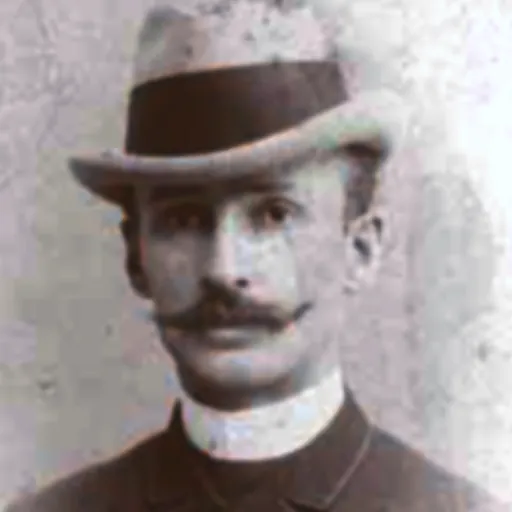
About Alexandru Al. Ioan Cuza
Lived 1863 – 1890 (aged 27). Alexandru Al. Ioan Cuza was a Romanian politician.
Alexandru Al. Ioan Cuza (also known as Alexandru A. Cuza, A. A. Cuza, or Sașa Cuza; 1862 or 1864 – April 4, 1890) was a Romanian aristocrat and politician. He was the eldest of the sons adopted by Domnitor Alexandru Ioan Cuza and his consort, Elena Rosetti-Cuza. Public opinion and historians generally agree that both Cuza brothers were Cuza's natural sons from his mistress Maria Catargi-Obrenović, though another hypothesis has them as born to Maria from her liaison with Cezar Librecht, the Postmaster General and spy chief. His biological and his adoptive mother both belonged to the boyar aristocracy of Moldavia. Through Catargi, Alexandru and Dimitrie were half-brothers of Milan I Obrenović, the King of Serbia, and of General Radu Catargi. During his brief political activity, Alexandru was repeatedly described as a Russophile or more specifically an agent of the Russian Empire, resembling in this Maria and her father, Costin Catargi.
Alexandru Ioan's reign marked the first political union between the two Danubian Principalities (Moldavia and Wallachia), which was to form the Kingdom of Romania in 1881. In the 1860s, his father made a conscious attempt at establishing a Cuza dynasty—this, together with his dissolute lifestyle, helped coalesce the "monstrous coalition", which fought to have him deposed. When Alexandru Ioan was ousted and replaced with Carol of Hohenzollern (February 1866), Alexandru Al. Ioan followed him into exile, graduating from the University of Paris. He settled back in Romania after his father's death, attempting to create a current of opinion against Carol, and being presented, by his partisans and adversaries alike, as a competitor for the throne. He rallied with the opposition Conservatives for the election of January 1888, winning a Third-College seat in the Assembly of Deputies, whereupon he resigned. In mid 1888, he helped journalists Alexandru Beldiman and Grigore Ventura found an anti-Carlist newspaper, Adevărul.
Alexandru stepped back from politics shortly after the peasant riots of 1888, having been identified as their inspiration, and possibly co-instigator. Also that year, when Dimitrie Cuza died, he was the last surviving direct male heir of the Cuzas, and the sole landowner of Ruginoasa. Gravely ill and allegedly incapable of fathering children of his own, he disinherited his adoptive mother, while favoring his young wife, Maria Moruzi. After his death in Madrid, the Cuza estate, including Ruginoasa manor, passed through his widow onto the Moruzis and the Brătianus. The dying out of the Cuza line remained contested into the 20th century, with inaccurate reports that "Cuza's son" was leading the peasants' revolt of March 1907, and with new claimants appearing in both France and Chile.
Biography
Adoption scandal According to most accounts, Sașa Cuza and his younger brother Dimitrie were born from a liaison between the Domnitor and his mistress Maria, the Moldavian boyaress, previously married into the House of Obrenović. Their maternal grandfather was Costin Catargi(u), a great landowner and Moldavian separatist, who had opposed Cuza's arrival to the throne in 1859. Through Maria, the two Cuza boys were also half-brothers of Milan, the future Serbian King, who was Maria's eldest son. On the Catargi side, their uncle Alexandru and cousin Alexis were noted career diplomats, while another uncle, George, was Domnitor Cuza's aide-de-camp.
Through Alexandru Ioan, Sașa descended from a matrimonial alliance of Moldavian boyars and Phanariotes. His paternal grandmother, Sultana Cozadini, was the niece of Moldavian Prince Nicholas Mavrogenes. The Cozadini family was an Italo–Greek branch of the Bolognese Gozzadinis—who had owned parts of Kea under the Duchy of the Archipelago, afterwards merging into the Phanariote community of Istanbul. Memoirist and social historian Radu Rosetti, who was also a relative of Cuza's wife Elena "Doamna", claims that there was no actual blood connection between Alexandru Ioan and his purported sons. He believes that their actual father was Maria's other lover—Cezar Librecht, the Belgian-born Postmaster General of Romania. By 1864, Librecht was presiding upon a quasi-legal secret service, which ran political errands for Cuza Sr.
Domnitor Cuza's legal marriage, meanwhile, produced no heirs. He and Elena were virtually separated by 1866, and, sources attest, were at best friendly to each other. Maria Obrenović was allegedly a Russophile, like her father, and rumors spread that, as part of this political intrigue, she intended to have Cuza divorce her rival. Instead, the boys were successively adopted by Elena: Alexandru on (that is, shortly after the Domnitor had effected a coup, deposing his critics in Parliament), Dimitrie on November 17/5, 1865. As noted by scholar Mihaela Mudure, "Elena never complained about her husband's filandering, nor about her inability to birth a child, who would have consolidated her marital relationship with Alexandru Ioan Cuza. [...] She records the appearance of two children, born to her husband's mistress, as a normal occurrence. In the adoption papers, they are mentioned as 'bereft of parents'". Both boys were baptized Romanian Orthodox, having as their godfathers the Domnitors associates, Librecht and Iordache Lambrino.
Their acceptance into the family came just as Cuza's authoritarian reign descended into administrative chaos, and as the monarch himself was calming his nervous states with alcohol and womanizing. The adoption act was especially alarming for the growing camp of anti-Cuzists, many of whom were dedicated supporters of rule by a foreign prince. As noted by scholar Frederick Kellogg: "On some Romanian palates, Cuza's amorous affair smacked of a scheme to establish a native dynasty with bastards as heirs to the crown." The fledgling Romanian state was still under tutelage by a consortium of European powers—of these, the Ottoman and Russian Empires strongly objected when the Domnitor issued documents formally addressing the newly adopted Sașa as Principe or Beizadea ("Prince"). Among those who suggest that Cuza intended to make Sașa his successor is researcher Alexandru Lapedatu, who also concluded that, at the time, Cuza was overreaching, isolated, "surrounded and adored by his favorites". According to historian Barbara Jelavich, while some in Cuza's party did look to Maria Obrenović's sons as the natural successors to the throne, "there was so much opposition to the idea of a native prince, as well as to Cuza himself, that this alternative had little chance of success." She continues: "By 1865 Cuza had won a formidable array of opponents on both the right and left." The truth concerning Sașa's birth was a matter of public record, and a subject of great irritation for Elena's clan, the Rosettis. Cuza remained adamant that the boys had "no known parents"—this definition is preserved in his testament of January 1873, whereby Elena and the two male heirs are each granted a third of the Cuza family estate. The document nominated Metropolitan-Primate Calinic Miclescu and Efrem Ghermani as, respectively, caretaker of the estate and tutor of the Cuza boys.
Claimant With Elena's acquiescence, Maria had been by Alexandru Ioan's side during much of his career, and was found with him when, in February 1866, a "monstrous coalition" conspiracy deposed and exiled Cuza. By contrast, George Catargi was involved in the conspiracy on its Masonic side, having joined the Wise Men of Heliopolis Lodge. During Cuza's arrest, the conspirators separated Cuza and Maria from Elena, who was left with the two boys. Seen as especially dangerous, Librecht was imprisoned by the 1st Chasseurs Battalion. He was subject to several quick trials over charges of embezzlement, and, though eventually acquitted, was asked to leave the country. In parallel, the deposed monarch was also pressured into exile. Elena decided to join him, even as the Rosettis (some of whom had participated in the coup), asked her to sue for a divorce. Later in 1866, Romanian representatives had selected Carol I as the Domnitor, and had agreed to a dynastic rule under his House of Hohenzollern. Although Cuza Sr was no longer welcomed in Romania, his wife and the two boys made occasional returns to their domain at Ruginoasa. In mid-1867, Carol visited Elena in Ruginoasa, reportedly informing her that he did not oppose Alexandru Ioan's return as a loyal subject. Maria Obrenović followed the Cuzas into exile, accompanied by her nephew Efrem Ghermani. In Vienna, she gave birth to another son, Radu. Purportedly fathered by a Russian officer (Konstantinovich), he was given the family name Catargi, and grew up to become a Romanian Land Forces general. In August of that year, French Prime Minister Albert de Broglie reported to his ambassadors that Carol was meeting the opposition of "extreme parties", and that "hostile newspapers have no shame in publicly advancing as a candidate one of Cuza's sons, for whom a Regency seems to have been already created." In 1875, a Bondrea Cuza and a Mrs. Figa opened a legal case against the adoption at the Suceava County court, and implied that they were going to expose Sașa and Dimitrie's true parentage; in the end, the plaintiffs failed to attend the procedures, and the case was annulled. During those years, her Obrenović son (married to the Romanian Natalia Keșco) had taken power in the Principality of Serbia, replacing his assassinated uncle Mihailo III; Milan himself ultimately abdicated in 1889. Meanwhile, Elena Cuza continued to care for her husband's progeny, creating a family home for them at Ruginoasa, where they were often joined by her relatives, the Lambrino family. In the mid-1870s, the Cuza children again left Ruginoasa to pursue their studies abroad. Alexandru Al. Ioan himself graduated from the University of Paris Faculty of Law, and took some additional lectures in History.
Alexandru Al. Ioan Cuza, obeying his adoptive mother's wish, eventually entered politics. A macaronic diary note by culture critic Titu Maiorescu reads: Der ältere Cuza-Sohn hat gărgăuni im Kopf seit er hier sein Freiwilligenjahr und viel mit Măria-Ta angeredet ("The older Cuza son has had a bee in his bonnet ever since he took here [in Romania] his one-year military service as a volunteer, and they often referred to him as Your Highness"). His younger brother, who suffered a debilitating disease of the lungs, was living in Paris, and showed no interest in politics. He soon after relinquished his seat. This decision is attributed by Chiper to political adversity: "the name he carried was a danger for his father's enemies who [...] launched on a furious campaign against his person". On March 4, his election was ruled legitimate by the Assembly, though his resignation was also recorded. Deputy Mihail Kogălniceanu, who had been Alexandru Ioan's long-time political associate, welcomed Sașa's resignation as a wise gesture, which "has spared this Chamber much embarrassment." He also noted that it was natural for the peasant electorate to appreciate both Cuzas, since the Domnitor had "made them into landowners." A later assessment in O Século daily noted that the young Cuza was in fact below the legal age for holding political office, and that his letters, including one he sent to Kogălniceanu, simply illustrated his "wish to abstain."
In August 1888, Cuza financed Adevărul, an anti-Hohenzollern sheet that had first seen print in 1871. Published by Alexandru Beldiman and Grigore Ventura, it stated as its main goal the removal of the "foreign dynasty", demanding an elective monarchy and the universal male suffrage. The newspaper venture was reviewed with skepticism by those farther on the left, which identified Cuza as more directly involved in printing Adevărul. A notice in Le Parti Ouvrier, the French socialist paper, read: "The director of this rag is Alexandre Couza, son of the prince Couza, who was dethroned in 1866." It called Adevărul a "reactionary, Russophile" gazette. The Romanian republican publicist, George Panu, similarly alleged that Cuza intended to set up his own "camarilla" in lieu of Carol's, and also called out his and Beldiman's agenda as "Russian politics". In October, writer Jacques Saint-Cère depicted Sașa as the "accredited representative" of a "Russophile party", and a "docile organ of Russian influence." One peasant rebel, who escaped into the Principality of Bulgaria, spoke about a shady connection between the Cuzas, as proponents of deeper land reform, and Russian interests in Romania. He claimed that: "Cuza's son has visited the Tsar of Russia and the latter ordered him to write to all villages so that they should kill their boyars and demand their rights [...]. Russia's emperor [...] gave money to Cuza's son, who went and bought two storage rooms full of wheat in Călărași, that the inhabitants were supposed to divide among them, but the boyars hid [that wheat]." As noted by O Século, a "small group of those whom they call 'Cuzists'" was helping Alexandru to advance his vague claim to the throne; however, any proof as to whether he was actually involved in the incidents, if it existed, was made a state secret by the intervention of government officials. As the one surviving son, Alexandru enjoyed ownership over most of Ruginoasa and the traditional Cuza demesne of Barboși, Shortly after Alexandru married fellow aristocrat Maria Moruzi (born 1863). The beautiful daughter of Alecu Moruzi and Adela (a Sturdza noblewoman), she was described by her contemporaries as a prototype of 19th-century Moldavian aristocracy. She drew his attention while they were both attending a party at Colonel Gheorghe Rosnovanu's place; their marriage was officiated at Ruginoasa on October 1, 1889, with Rosnovanu and his wife as the godparents.
Alexandru bequeathed to Maria his entire share in the Cuza estate. The decision was controversial, not least of all because Maria's ancestor, an 18th-century Moldavian Prince by the name of Constantine Mourousis, had put to death Sașa's own forebear, Ioniță Cuza. Some accounts suggest that Elena herself opposed the arrangement; Already diagnosed with heart trouble, Alexandru fell ill with tuberculosis. According to some, his disease was a quickly progressing form, contracted during his wedding voyage. A. C. Cuza provides additional detail, noting that the young pretender had a "chronic heart disease" and was sexually impotent.
The main Cuza line was abruptly ended when Alexandru Al. Ioan died, on the morning of April 4, 1890 [O. S. March 23]. Various sources note that this was six months into his marriage, occurring while the couple was visiting the Kingdom of Spain—more precisely, in Madrid. Madrid's correspondent for Le XIXe Siècle newspaper reported that, by March 30, the Prince was "in mortal danger", and that Elena Cuza was traveling there to see him a final time. She received the news of his death while still en route; the task of recovering his body fell on his brother-in-law, Sebastian Moruzi. In the immediate aftermath, Elena asked to be handed her adoptive son's private papers, but Maria and Sebastian Moruzi refused to relinquish them: "[Maria] could not hand over Alexandru's documents without creating suspicion that she was only out to get his fortune."
Posterity As noted in 1938 by publicist Theodor Rășcanu (a distant relative of the figures involved), Sașa Cuza made little or no effort to provide for Elena Cuza, and never "returned in kind her mother's love". and then took her to court over the validity of Alexandru's last will. The former consort of the Domnitor died in 1909, having spent her final years in Piatra Neamț town. Although the Cuzas' agnatic line was entirely extinguished with all collateral relatives dying childless, During the rural insurgency of March 1907, some samples of black propaganda presented Crown Prince Ferdinand and "Cuza's son" as rebel sympathizers. In elections in November 1919 (the first ones to be held in Greater Romania and under universal male suffrage), A. C. Cuza ran as a Democratic Nationalist in Dorohoi County, and soundly defeated the Progressive Conservatives. As a partisan of the latter, Constantin A. Stoeanovici complained that: "[the Nationalists] presented themselves in elections by promising free land to the peasants, tax exemptions, and that their [...] candidates are descendants of Domnitor Cuza, who had given land to the peasants."
Another public scandal involving Maria Moruzi took place ca. 1897, when it became known that she was pursuing an affair with the young engineer Ion I. C. Brătianu (later a major political figure). This controversy had its own political connotations: Brătianu's father, Ion Brătianu, was a National Liberal representative in the 1866 conspiracy to topple Cuza. In the 1990s, a Chilean man, Abraham Orlando Decebal Cuza Hernández, publicized his claim to descent from the Domnitor, but failed to clarify which of the brothers was his ancestor.
Don’t just read it —
keep it.
Full-length biographies made to live with: read them, listen on the way to work, watch them tonight.
- E-book
- Audio
- Video
Instant download · yours to keep · every purchase keeps this site free
Important facts
People in Alexandru Al. Ioan Cuza's life
Named in this biography and alive at the same time


Related people
Same field, nearest in time





Contemporaries
People whose lives overlapped Alexandru Al. Ioan Cuza's



Frequently asked questions
Who was Alexandru Al. Ioan Cuza?
Romanian Noble
When was Alexandru Al. Ioan Cuza born?
Alexandru Al. Ioan Cuza was born on 12 March 1863 in Bucharest.
When did Alexandru Al. Ioan Cuza die?
Alexandru Al. Ioan Cuza died on 29 March 1890 in Madrid.
What was Alexandru Al. Ioan Cuza's occupation?
Alexandru Al. Ioan Cuza was a politician.
What nationality was Alexandru Al. Ioan Cuza?
Alexandru Al. Ioan Cuza was Romanian.
Sources & further reading
· Wikipedia: Alexandru Al. Ioan Cuza
· DBpedia: Alexandru Al. Ioan Cuza
Cite this page
APA: Biography.guide. (2026). Alexandru Al. Ioan Cuza. https://biography.guide/alexandru-al-ioan-cuza/
MLA: "Alexandru Al. Ioan Cuza." Biography.guide, https://biography.guide/alexandru-al-ioan-cuza/.
Chicago: "Alexandru Al. Ioan Cuza." Biography.guide. https://biography.guide/alexandru-al-ioan-cuza/.
Data last updated: 2026-09-21 · Spot an error? Report a correction.
Portrait: Wikimedia Commons · author & licence
Page generated 2026-09-27 04:58 UTC