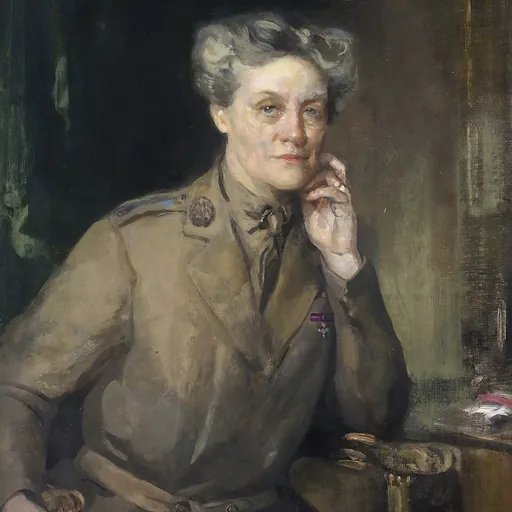
Alexandra Chalmers Watson
Medical practitioner and head of the Women's Army Auxiliary Corps
About Alexandra Chalmers Watson
Lived 1872 – 1936 (aged 64). Alexandra Chalmers Watson was an Indian physician.
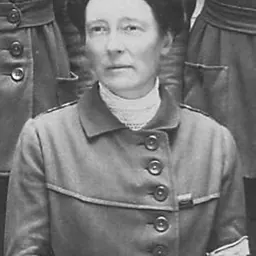
Alexandra Mary Chalmers Watson CBE (née Geddes; 31 May 1872 – 7 August 1936), known as Mona Chalmers Watson, was a British physician and head of the Women's Army Auxiliary Corps. The first woman to receive an MD from the University of Edinburgh, she helped found the Elsie Inglis Hospital for Women, was the first president of the Edinburgh Women's Citizen Association, a staff physician and later senior physician at the Edinburgh Hospital and Dispensary for Women and Children, and co-edited the Encyclopaedia Medica with her husband, Douglas Chalmers Watson. At the time of her death in 1936, she was president of the Medical Women's Federation, having been elected May 1935.
Early life and education Alexandra Mary Campbell Geddes was born in India on 31 May 1872, a daughter of Auckland Campbell Geddes (1831–1908), a civil engineer, and Christina Helen MacLeod Geddes (née Anderson; 1850–1914). Chalmers Watson was the eldest of five children in the Geddes family; among her siblings were Eric Geddes and Auckland Geddes, 1st Baron Geddes. From 1888 to 1890 she was educated at St Leonard's School in St Andrews, Scotland. When she turned her focus towards the study of medicine, it was the latest in a lengthy familial interest in the profession: her mother supported Christian Guthrie Wright and Louisa Stevenson in the foundation of the Edinburgh School of Cookery and Domestic Economy (later Queen Margaret University), and been an early campaigner on behalf of the cause of medical education for women. Through her mother Chalmers Watson also claimed kinship to Elizabeth Garrett Anderson, the first woman to qualify as a doctor in England, and her maternal aunt, Mary Marshall (née Anderson) had been one of the original women admitted to study medicine alongside Sophia Jex-Blake at the University of Edinburgh in 1871, later qualifying in Paris.
Chalmers Watson began her medical education in 1891 at the Edinburgh College of Medicine for Women, which had been established by Elsie Inglis, later a noted suffragist, and her father John Inglis. She graduated MB CM from the University of Edinburgh in 1896. she also spent six months working at Dr Barnardo's Homes in Kent.
Chalmers Watson's experience working in Plaistow, where her record consisted of more than 1000 confinements with a mortality rate of just over 1 per 1000, informed the topic of her MD thesis when she returned to Edinburgh the following year. from the University of Edinburgh's Medical College, the first woman to do so;
The Chalmers Watsons edited the Encyclopaedia Medica, a 15 volume work, the first edition of which appeared in 1900. As well as helping edit the encyclopaedia, she had contributed an article on the feeding of invalids. and treated suffragette prisoners on release from hunger strike and force-feeding in Perth Prison.
Women's Army Auxiliary Corps The Women's Army Auxiliary Corps in France during the First World War. From the beginning of the First World War, women in Scotland typically worked in the nursing or munitions industries, occasionally running field hospitals and soup canteens or driving ambulances with the First Aid Nursing Yeomanry, which was established in 1907. By 1916, Chalmers Watson advocated for the creation of a corps of women volunteers who could undertake additional ancillary, non-combatant duties. At this time, Chalmers Watson's brother, Brigadier-General Sir Auckland Geddes, was the Director of Recruiting at the War Office, and he arranged for Chalmers Watson to meet with Sir Nevil Macready, the adjutant-general, on 26 January 1917 and the Ladies' Pictorial on 20 February 1918 said she had "nobly done her bit". Chalmers Watson was a cousin of suffragette doctor, Louisa Garrett Anderson and whilst in London, was a follower of Millicent Fawcett, and then herself served as a doctor for the suffragette prisoners in Perth, with over 538 women doctors supporting the right to vote, and only 15 against. Later in her life Chalmers Watson put politics aside when working on improving health care in Scotland, with anti-suffragist Kitty Murray, who went on to become a Conservative M.P.
Chalmers Watson was a director of the Time and Tide Publishing Company.
When the Representation of the People Act, 1918 gave the vote to 8.4 million women, Chalmers Watson became the first president of the Edinburgh Women Citizens' Association, which strongly advocated continuing to improve the scope of female suffrage, by 'extensive lobbying, campaigning and educational work and a remarkable breadth of interests, including straightforwardly ‘equality’ issues such as women’s representation in local and central government, the extension of the franchise to women on the same terms as men,'.
Chalmers Watson was also closely involved in the establishment of the Women's United Services Club in Drumsheugh Gardens, Edinburgh, and at the time of her death in 1936, she was its president. Chalmers Watson had been one of the founders of the Child Assault Protest Committee (1920). She had been involved in the Queen Mary Nursing Home and the founding of the Elsie Inglis Hospital for Women as well as the Patriotic Emergency Food League and the Women's Emergency Corps., the latter as honorary secretary.
Three years later, this oversight was to some extent redressed when Chalmers Watson's co-Chief Controller at the WAAC, Dame Helen Gwynne-Vaughan, formally opened a gateway to the Elsie Inglis Memorial Maternity Hospital commemorating Chalmers Watson's life and services to medicine and her country.
A Scotsman article about the opening ceremony noted that immediately after the ribbon was cut, the gateway was "consecrated" by the birth of a baby during an air raid warning; the article quoted Gwynne-Vaughan as saying, "In the old days, a new building was consecrated by the building in of a human being who had therefore died. This was consecrated yesterday by the birth of a baby!"
Don’t just read it —
keep it.
Full-length biographies made to live with: read them, listen on the way to work, watch them tonight.
- E-book
- Audio
- Video
Instant download · yours to keep · every purchase keeps this site free
Important facts
People in Alexandra Chalmers Watson's life
Named in this biography and alive at the same time




Related people
Same field, nearest in time




Contemporaries
People whose lives overlapped Alexandra Chalmers Watson's



Frequently asked questions
Who was Alexandra Chalmers Watson?
medical practitioner and head of the Women's Army Auxiliary Corps
When was Alexandra Chalmers Watson born?
Alexandra Chalmers Watson was born on 17 January 1872 in India, Mumbai.
When did Alexandra Chalmers Watson die?
Alexandra Chalmers Watson died on 7 August 1936 in Rolvenden, Tenterden.
What was Alexandra Chalmers Watson's occupation?
Alexandra Chalmers Watson was a physician.
What nationality was Alexandra Chalmers Watson?
Alexandra Chalmers Watson was Indian.
Sources & further reading
· Wikipedia: Alexandra Chalmers Watson
· DBpedia: Mona Chalmers Watson
Cite this page
APA: Biography.guide. (2026). Alexandra Chalmers Watson. https://biography.guide/alexandra-chalmers-watson/
MLA: "Alexandra Chalmers Watson." Biography.guide, https://biography.guide/alexandra-chalmers-watson/.
Chicago: "Alexandra Chalmers Watson." Biography.guide. https://biography.guide/alexandra-chalmers-watson/.
Data last updated: 2026-09-22 · Spot an error? Report a correction.
Page generated 2026-09-27 05:10 UTC