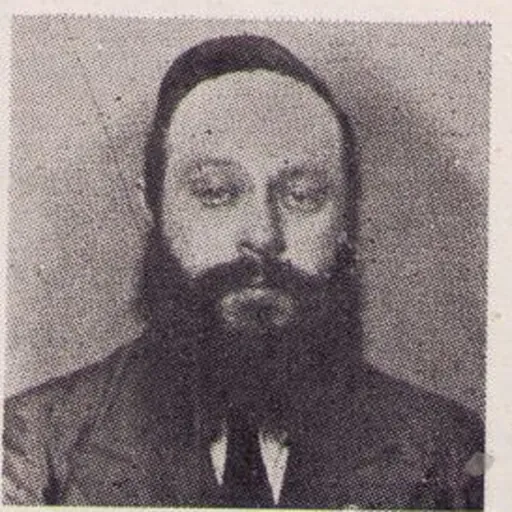
About Alexander Zusia Friedman
Lived 1897 – 1943 (aged 46). Alexander Zusia Friedman was a Polish rabbi and journalist.
Alexander Zusia Friedman (; 9 August 1897 – November 1943) was a prominent Polish Orthodox Jewish rabbi, communal activist, educator, journalist, and Torah scholar. He was the founding editor of the first Agudath Israel Hebrew journal, Digleinu (Our Banner), and author of Ma'ayanah shel Torah (Wellsprings of Torah), an anthology of commentaries on the weekly Torah portion, which is still popular today. He was incarcerated in the Warsaw Ghetto and deported to the Trawniki concentration camp, where he was selected for deportation to the death camps and murdered around November 1943.
Early life Friedman was born in Sochaczew (Sochatchov), Poland in 1899. His father, Aharon Yehoshua Friedman, was a poor shamash (synagogue caretaker); his mother supplemented the family income by selling wares in various fairs and markets. Alexander Zusia, their only son, proved himself to be an illui (exceptional student) at a very young age. When he was 3, he knew the entire Book of Genesis by heart. When he was 9, his melamed informed his father that he had nothing left to teach him. His father then arranged for him to learn with a Talmudic scholar who had been brought from another town by three wealthy families to teach their gifted sons. The tuition was three rubles each per week, a huge sum in those days. When these families heard that Alexander Zusia would join their group, they offered to pay his father the three rubles for the privilege of having Alexander Zusia learn with and motivate their sons. But his father insisted on paying the tuition himself, which amounted to his entire week's wages. He wrote many articles for the religious press expounding the Torah point of view.
Warsaw Ghetto
On 20 November 1939 Friedman was arrested together with 21 other Polish Jewish leaders and jailed for one week to prevent them from resisting the construction of the Warsaw Ghetto.
At a general political meeting in the Warsaw Ghetto on 25 July 1942, attended by members of the Joint, the Bund, General Zionists, Left-wing Zionists, communists, Jewish socialists, and members of Agudath Israel, Friedman was one of the only Jewish leaders who advised against armed resistance. He said, "God will not permit His people to be destroyed. We must wait and a miracle will certainly occur". Historians believe that this position grew out of Agudath Israel's belief that armed opposition would cause the Germans to liquidate the Ghetto.
With the beginning of mass deportations, the Joint ceased its activities in the Ghetto and Friedman lost his financial support for his activities. With much effort, he procured a job as a shoemaker in the large Shultz factory, where he worked a 12-hour shift. Other Torah leaders who worked in the same factory were Rabbi Kalonymus Kalman Shapira, the Piasetzener Rebbe; Rabbi Moshe Betzalel Alter, brother of the Gerrer Rebbe; Rabbi Avraham Alter, Rav of Pabianice; and Rabbi David Alberstadt, Rav of Sosnowiec. When the Joint resumed its operations clandestinely between October 1942 and January 1943, Friedman rejoined the organization to assist religious Jews. combines insights from classic and Hasidic Torah commentators with Friedman's own chiddushim (novel Torah ideas) on the weekly Torah portion and Haftarah. Friedman wrote this work in Yiddish rather than Hebrew, and in a lighter, easy-to-understand style of short teachings, to appeal to the many Jews who were no longer versed in the difficult language and concepts of Hebrew sefarim.
Other published works include Kesef Mezukak (Refined Silver) (1923), a book of chiddushim on the principles of Talmudic study, and Kriah LeIsha Yehudit (Readings for the Jewish Woman) (1921). Friedman also published several textbooks for religious schools, including Iddish Lashon (Yiddish Language), a Yiddish primer. He wrote many other pamphlets and collections of chiddushim – including a collection on the Talmudic tractates of Gittin, Kiddushin, and Yoma that he titled Avnei Ezel (Guiding Stones) – which were lost in the war.
Don’t just read it —
keep it.
Full-length biographies made to live with: read them, listen on the way to work, watch them tonight.
- E-book
- Audio
- Video
Instant download · yours to keep · every purchase keeps this site free
Important facts
People in Alexander Zusia Friedman's life
Named in this biography and alive at the same time

Related people
Same field, nearest in time



Contemporaries
People whose lives overlapped Alexander Zusia Friedman's



Frequently asked questions
Who was Alexander Zusia Friedman?
Polish rabbi (1897-1943)
When was Alexander Zusia Friedman born?
Alexander Zusia Friedman was born on 9 August 1897 in Sochaczew.
When did Alexander Zusia Friedman die?
Alexander Zusia Friedman died on 3 November 1943 in Trawniki concentration camp.
What was Alexander Zusia Friedman's occupation?
Alexander Zusia Friedman was a rabbi and journalist.
What nationality was Alexander Zusia Friedman?
Alexander Zusia Friedman was Polish.
Sources & further reading
· Wikipedia: Alexander Zusia Friedman
· DBpedia: Alexander Zusia Friedman
Cite this page
APA: Biography.guide. (2026). Alexander Zusia Friedman. https://biography.guide/alexander-zusia-friedman/
MLA: "Alexander Zusia Friedman." Biography.guide, https://biography.guide/alexander-zusia-friedman/.
Chicago: "Alexander Zusia Friedman." Biography.guide. https://biography.guide/alexander-zusia-friedman/.
Data last updated: 2026-09-20 · Spot an error? Report a correction.
Page generated 2026-09-27 05:10 UTC