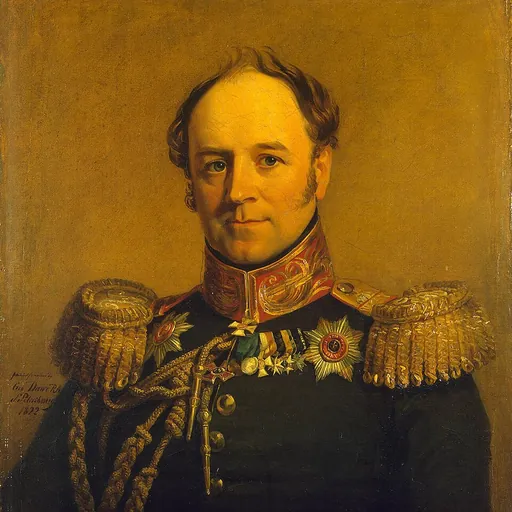
Alexander von Benckendorff
Russian general and statesman of Baltic German origin (1780s-1844)
About Alexander von Benckendorff
Lived 1781 – 1844 (aged 63). Alexander von Benckendorff was a Russian politician, military personnel and land owner.
Konstantin Alexander Karl Wilhelm Christoph Graf von Benckendorff (, – ) was a Russian cavalry general and statesman of Baltic German descent. He was also the adjutant general of Alexander I and a commander of partisan (Kossak irregular) units during the French invasion of Russia. He is most frequently remembered for his later role, under Nicholas I, as the founding head of the Gendarmes and the secret police in Russia known as the Third Section.
Family and career Alexander von Benckendorff was born into the Benckendorff family of the Baltic German nobility in Reval (present-day Tallinn, Estonia), son of General Baron (Friedrichsham, 12 January 1749 – Kolga, 10 June 1823), who served as the military governor of Livonia, and of his wife Baroness Anna Juliane Charlotte Schilling von Canstatt (Thalheim, 31 July 1744 – Riga, 11 March 1797), who held a high position at the Romanov court as senior lady-in-waiting and best friend of Empress Maria Fyodorovna (the second wife of the Emperor Paul). His paternal grandparents were Johann Michael von Benckendorff and his wife Sophie von Löwenstern. Alexander von Benckendorff's younger brother Konstantin von Benckendorff (1785–1828) became a general and diplomat, and his sister Dorothea von Lieven (1785–1857) a socialite and political force in London and Paris. His other sister, Maria von Benckendorff (1784–1841), married Ivan Georgievitch Sevitsch.
Having received his education at a Jesuit boarding school, Benckendorff started military service in 1798 in the Semyonovsky Life-Guards Regiment. Benckendorff then served as aide-de-camp to the czar. In 1803, while bearing the rank of Colonel he arrived in the Septinsular Republic. He was tasked with raising the nucleus of the Greek Legion, becoming the first commander of the unit. He then became the commander of the Souliote Legion component of the Greek Legion until his return to Russia in March 1805. Benckendorff had developed an amiable relationship with his Souliot subordinates, requesting the czar to be sent back to his previous unit. His request was denied, but Benckendorff remained a philhellene until the end of his life.
During Napoleon's invasion of Russia in 1812, Benckendorff led the Velizh offensive, taking three French generals prisoner and more than 6000 lower ranks. When the Grande Armée left Moscow (October 1812), he became the commander of its garrison. In the foreign campaigns following, he defeated a French contingent at Tempelberg and became one of the first Russians to enter Berlin. He further distinguished himself at the Battle of Leipzig. On 2 November 1813 he arrived at Bad Bentheim. In 22 November he crossed the IJssel with a vanguard regiment from Bashkortostan (under Prince Fyodor Fyodorovich Gagarin). On 27 November he left Harderwijk to cross the Zuiderzee by boat. He consulted Krayenhoff. On 2 December he was received the townhall by William I of the Netherlands, the provisional king. Benckendorff passed Loevestein when he went to Tilburg and Breda. After British and Prussian forces arrived to succeed him, his unit proceeded to take Louvain and Mechelen, liberating 300 imprisoned Englishmen captured in Spain. On 1 February they surrounded Brussels. It seems he went to Düsseldorf alone. In his rôle as Chief Censor, he became involved in the tragic death (1837) of Alexander Pushkin in an unnecessary duel, an involvement that for long made him an unmentionable in Russian historiography.
Yet by temperament, he was the very opposite of a proto-Dzerzhinsky or a proto-Beria. He suffered from a bizarre tendency to forget his own name, and periodically had to be reminded of it by consulting his own visiting card. From the mid-1830s, his family seat was the Gothic Revival manor, Schloss Fall (now Keila-Joa) near Tallinn in present-day Estonia. He died in Hiiumaa.
In 1817 Alexander von Benckendorff married Elisaveta Andreyevna Donets-Zacharzhevskaya (11 September 1788 – Berlin, 7 December 1857). The couple had three daughters:
Countess Anna Alexandrovna Benckendorff (11 September 1818 – Lengyel, 19 November 1900), married to Count Rudolf Appony de Nagy-Appony Countess Maria Alexandrovna Benckendorff (Saint Petersburg, 24 May 1820 – Rome, 4 November 1880) married in Saint Petersburg on 12 January 1838 as his first wife Prince (Saint Petersburg, 28 March 1808 – Menton (Nice), 7 May 1882) Countess Sophia Alexandrovna Benckendorff (Keila-Joa, 2 August 1825 – Paris, 5 March 1875), married to and to Prince .
Benckendorff's notes A recent Russian publication reveals his own view of his early life: Zapiski Benkendorfa: Otechestvennaia voina; 1813 god: Osvobozhdenie Niderlandov (Benkendorff's Notes. The Patriotic War; 1813: The Liberation of the Netherlands): Yaziki slavyanskikh kul'tur, Moscow, 2001. . This book reproduces two sections of Benckendorff's private notes that had not seen publication since 1903, very lively on the events of the Napoleonic war, correspondences with his contemporaries, Bagration and others, and associated regimental histories.
According to that book, Benckendorff kept personal notes and diaries throughout his life. One additional source for his notes, in this case from the late 1830s, can be found in volume 91 of the journal Istoricheskii vestnik for 1903.
Don’t just read it —
keep it.
Full-length biographies made to live with: read them, listen on the way to work, watch them tonight.
- E-book
- Audio
- Video
Instant download · yours to keep · every purchase keeps this site free
Important facts
People in Alexander von Benckendorff's life
Named in this biography and alive at the same time
Related people
Same field, nearest in time



Contemporaries
People whose lives overlapped Alexander von Benckendorff's


Frequently asked questions
Who was Alexander von Benckendorff?
Russian general and statesman of Baltic German origin (1780s-1844)
When was Alexander von Benckendorff born?
Alexander von Benckendorff was born on 23 June 1781 in Tallinn.
When did Alexander von Benckendorff die?
Alexander von Benckendorff died on 23 September 1844 in Baltic Sea.
What was Alexander von Benckendorff's occupation?
Alexander von Benckendorff was a politician, military personnel and land owner.
What nationality was Alexander von Benckendorff?
Alexander von Benckendorff was Russian.
Sources & further reading
· Wikipedia: Alexander von Benckendorff
· DBpedia: Alexander von Benckendorff
Cite this page
APA: Biography.guide. (2026). Alexander von Benckendorff. https://biography.guide/alexander-von-benckendorff/
MLA: "Alexander von Benckendorff." Biography.guide, https://biography.guide/alexander-von-benckendorff/.
Chicago: "Alexander von Benckendorff." Biography.guide. https://biography.guide/alexander-von-benckendorff/.
Data last updated: 2026-09-20 · Spot an error? Report a correction.
Portrait: Wikimedia Commons · author & licence
Page generated 2026-09-27 05:19 UTC