
About Alexander Truslit
Lived 1889 – 1971 (aged 81). Alexander Truslit was a musicologist and director.
Alexander Truslit's motion curve to the Eb Rondo of C. Ph. E. Bach
Alexander Truslit (1889–1971) was a German-Russian music teacher, music researcher and pioneer in musician's medicine. He focussed on the connection between music and movement and developed his own musical body methodology. At the centre of his method is the kinaesthetics of music perception and music-making, which he illustrated with a graphic notation in the form of curved lines. He used his approach to treat many musicians' playing problems. Alexander Truslit's work has had a major influence on international performance research.
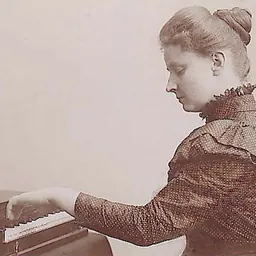
Life Alexander Truslit was born in Riga in 1889. He studied law, piano and medicine. He was the most important pupil of the Berlin pianist Elisabeth Caland, who is known as a pioneer of physiological-anatomical piano methodology. In 1929, he became director of the Elisabeth Caland School and the associated Research Institute for Artistic Piano Playing, where he focussed on human anatomy, auditory physiology and the relationship between musical and physical movement. He conducted research at the Charité in Berlin and published articles in journals. In 1938, his main written work 'Gestaltung und Bewegung in der Musik' was published (reprinted in 2015). In 1942, he produced the study film 'Musik und Bewegung' about his practical methodology (released on DVD with English subtitles in 2015).
Truslit taught his method at the conservatory in Luxembourg and tried to found his own school. In 1936 he met Elizabeth Duncan in Berlin and since then expanded the teaching at the Elizabeth Duncan School with his method. A Duncan student remembers the connection: 'Since the music is the basis for the Duncan dance, we should be enabled by the curves [of Alexander Truslit] to better recognise the music's own movement in order to make it visible in the dance interpretation.'
Alexander Truslit was also acquainted with Eugen Herrigel and Karlfried Graf Dürkheim and studied Zen and the art of archery with them. He went blind in the early 1950s and was no longer able to pursue his approach on a larger scale. However, he continued to teach and treat many musicians. Alexander Truslit died in Munich in 1971.
Music is Motion Open, closed and winding basic movements of Alexander Truslit. At the centre of his method are three so-called primal or basic movements from whose combinations larger musical sequences are composed. They convey the sense of movement of musical motifs and entire phrases and are linked to the temporal development of an expressive musical performance. Accordingly, Truslit's main work is entitled 'Shaping and Motion in Music'.
As physical exercises, the movements develop a basic holistic disposition for artistic music-making. Anatomically, wringing is achieved by a minimal counter-rotation of the upper arm and forearm. This involves muscle chains from the fingertips to the deep trunk muscles, which also involve breathing. by Christian Larsen.
The connection between musical composition and kinaesthetics can be seen in the execution of movements to music that is heard or imagined. This connection was sought and developed in Truslit's courses. The aim was to experience music more physically and to become more aware of its movement patterns: 'In this process, movement sensations of round lines and corresponding patterns of physical tensions are linked to musical tension patterns. ... Musicians in particular develop a holistic self use through the exercises, through which muscular tensions and movements of the trunk and the body can later be ideally integrated into music-making." Alexander Truslit's book from 1938 with supplemental material. Additionally, three shellac discs were delivered. The book was published in 1938 with extensive music sheets and pictures of curves as well as three shellac discs with music recordings discussed in the book.
Modern body technique and theory of learning Truslit's methodology is quite modern in comparison with today's music physiology and has parallels with modern learning theory. In accordance with implicit learning theory, Truslit did not teach a specific instrumental technique, but trusted that it would develop more easily and correctly through an external focus on the kinaesthetics of musical phrasing. This approach enabled him to treat playing difficulties caused by unfavourable playing habits of musicians.
While other body techniques, such as the Alexander Technique or the Feldenkrais Method, develop a healthy use of the self independently of music, what is special about Truslit's approach is that body technique and music are linked from the outset.
Scientific analysis of the perceived motion in music Truslit appeared to be especially open-minded regarding technical innovations of his time, which he strived to utilize for development of his methodology.
Reception The violinist Hanna Struck described her own lessons with Alexander Truslit (Hanna Struck ) in her music education thesis. He helped her to overcome her playing difficulties and thus enabled her to become a successful orchestral musician. Together with Truslit's study film, her work is the most detailed source of his practical teaching.
The major rediscovery of Truslit took place within international performance research, a branch of empirical music psychology. Bruno Repp published a short English excerpt from Truslit's book in 1993, and since then references to it can be found in countless studies. It is no coincidence that Truslit's 'hypotheses about the organisation of music and movement according to general, physical principles have had a lasting influence on current theories.' Jörg Langner and Werner Goebl, like Truslit, investigated the tempo and dynamic shaping of various interpretations and illustrated them in diagrams. It turned out that interpretations with a more rounded shape were valued as more expressive by musical experts.
In 2012, Hans Brandner published an extensive monograph on the entire work and life of Alexander Truslit ) and came to the discovery that his work was not only a theory of music, but was based on decades of successful musical practice in the teaching and therapy of professional musicians. He described Truslit's approach as body musicality and kinaesthesia of music and has since published essays primarily on practical aspects of music. He created an experimental app for OSX with which you can record motion lines to music.
Michael Haverkamp researched about the synaesthetic aspect of Truslit's work. In 2015, he and Hans Brandner published Alexander Truslit's main work and, for the first time, his study film 'Music and Motion' with English subtitles as well as all the music and illustrative material for Truslit's book in a high-quality reprint.
Very similar to Alexander Truslit is the approach of Alexandra Pierce, who recommends tracing melodic contours with the arms in order to promote musicality. Her method is not as far-reaching as Truslit's in terms of physical technique and systematic approach.
Don’t just read it —
keep it.
Full-length biographies made to live with: read them, listen on the way to work, watch them tonight.
- E-book
- Audio
- Video
Instant download · yours to keep · every purchase keeps this site free
Important facts
People in Alexander Truslit's life
Named in this biography and alive at the same time




Related people
Same field, nearest in time

Contemporaries
People whose lives overlapped Alexander Truslit's



Frequently asked questions
Who was Alexander Truslit?
music teacher and researcher
When was Alexander Truslit born?
Alexander Truslit was born on 9 December 1889 in Riga.
When did Alexander Truslit die?
Alexander Truslit died on 7 August 1971 in Munich.
What was Alexander Truslit's occupation?
Alexander Truslit was a musicologist and director.
Sources & further reading
· Wikipedia: Alexander Truslit
Cite this page
APA: Biography.guide. (2026). Alexander Truslit. https://biography.guide/alexander-truslit/
MLA: "Alexander Truslit." Biography.guide, https://biography.guide/alexander-truslit/.
Chicago: "Alexander Truslit." Biography.guide. https://biography.guide/alexander-truslit/.
Data last updated: 2026-09-20 · Spot an error? Report a correction.
Page generated 2026-09-27 05:04 UTC