About Alexander Stoddart
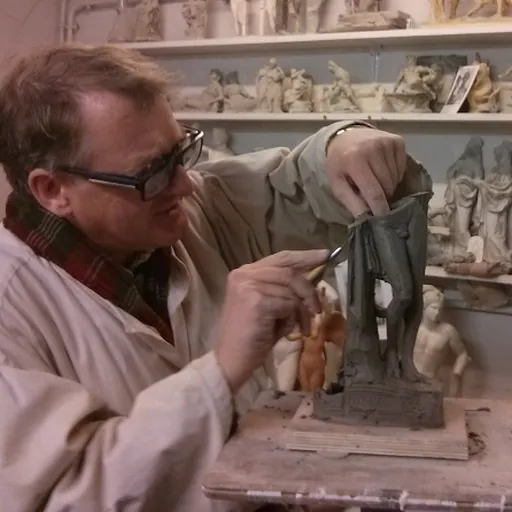
Born 1959. Alexander Stoddart is a British sculptor.
Alexander "Sandy" Stoddart (born 1959) is a Scottish sculptor, who, since 2008, has been the Queen's Sculptor in Ordinary in Scotland and is now the King's Sculptor in Ordinary. He works primarily on figurative sculpture in clay within the neoclassical tradition. Stoddart is best known for his civic monuments, including bronze statues of David Hume and Adam Smith, philosophers during the Scottish Enlightenment, on the Royal Mile in Edinburgh, and others of James Clerk Maxwell, William Henry Playfair and John Witherspoon. Stoddart says of his own motivation, "My great ambition is to do sculpture for Scotland", primarily through large civic monuments to figures from the country's past. He was born in Edinburgh, though his father, also an artist, moved the family to the village of Elderslie in Renfrewshire, where the young Stoddart immediately noticed the monument there at William Wallace's purported birthplace. Today, Stoddart lives and works in nearby Paisley. At school Stoddart became interested in music (and remains so) but decided he was not good enough to become a professional. Stoddart graduated in 1980 with a Bachelor of Arts degree, first class, though he was demoralised by his peers' ignorance of art history: "the name Raphael meant nothing to them". He went on to read History of Art at the University of Glasgow. On 30 December 2008, it was announced that Stoddart had been appointed Her Majesty's Sculptor in Ordinary in Scotland.
Aesthetic viewpoint Stoddart is deeply critical of modernism and contemporary art, and scornful of "public art", a phrase which makes him search for "a glass of whisky and a revolver". He argued that an equestrian statue of the Mariner King, William IV, should be placed on the fourth plinth in Trafalgar Square, as originally intended.
Stoddart works within the neo-classical tradition of art, and believes that greatness and respect for posterity are important considerations. In 2010 he rebuffed a query about his interest in sculpting a memorial to Bill McLaren, a rugby union broadcaster: "I do not do sportsmen and I certainly do not do sports commentators. I do artists, philosophers and poets", he said, warning that memorials are often hastily erected. Advocates of the memorial described the remarks as insensitive. Despite their idiomatic differences, Raymond McKenzie argues that the works of both Finlay and Stoddart combine formal and intellectual elegance with sharp, sometimes satirical critiques of contemporary society.
Although Stoddart is apprehensive of modern and contemporary art, he considers his work to be part of a more broadly-construed "Modernist" tradition.
Works
Civic monuments
In his own work, Stoddart has developed "heroic-realist" neo-classical representations of historical figures.
He has made sculptures of David Hume and Adam Smith, philosophers of the Scottish Enlightenment, which stand in the Royal Mile in Edinburgh. Hume is depicted in a philosopher's toga, representing the timelessness of philosophical thought, a decision which was criticised as atavistic after the unveiling in 1996, though Stoddart remained stoic, "So here I discovered that the right thing, done in public, will often earn one great disapproval: a lesson for life – in the modern age at least."
Smith is, by contrast, depicted in contemporary attire, showing his concern for the practical matters of economic activity, a gown draped over his shoulder retains the connection to philosophy and academia. Smith's economic ideas are also encoded into the statue: the plough behind him represents the agrarian economics he supplanted, the beehive before, is a symbol of the industry he predicted would come. His hand, resting on a globe, is obscured by the gown: a literal presentation of Smith's famous metaphor of the invisible hand. The life-and-a-half size statue of Smith, is cast in bronze from a plaster model by the sculptor and was unveiled in 2008. It was funded by private subscriptions organised by the Adam Smith Institute.
Stoddart's statue of James Clerk Maxwell stands in George Street in Edinburgh and a memorial to Robert Louis Stevenson is on Corstorphine Road.
There are several pieces by Stoddart in Glasgow's Merchant City quarter. Italia, a 2.6 metre, glass re-in-forced polymer statue on top of Ingram Street represents the contribution of Italian traders to the area. Classical in style, the female form is swathed in a chiton and carries symbols of ancient Italy: a palm branch in her right hand and an inverted cornucopia in her left. On John Street, a trio of figures, Mercury, Mercurius and Mercurial form a triangle. The first two, identical figures, sit above the John St. façade of the Italian centre; their English and Roman names signify the two different manifestations of the deity in Roman mythology. Here, they embody a "dialogue" between ancient lore and modern city life. Opposite, on a plinth on the street, stands Mercurial, cast in bronze and with the adjectival form of the name, it complements the duality of the other two with an underlying unity.
Putative projects include a monument to Willie Gallacher, the Paisley-born Communist MP, championed by Tony Benn and funded by a public appeal and "Oscar", an amphitheatre carved into the rock on the Scottish coast dedicated to Ossian, the mythical Scot bard.
In 2019 Stoddart made a statue of Leon Battista Alberti for Walsh Family Hall of Architecture of the University of Notre Dame, in the United States, his single tallest work.
Busts, cabinet displays and architectural sculpture
During 2000 to 2002 the Queen's Gallery at Buckingham Palace was renovated in the neo-classical style under the direction of John Simpson, envisioned as "building visible history". For the walls in the two-storied entrance hall, Stoddart made architectural friezes which interpret Homeric themes in twentieth century Britain. For the Sackler Library in Oxford University, he made a bronze frieze, depicting an allegory of traditionalist and modernist values. Stoddart has also worked on busts of living figures whom he admires, often fellow-classicists including philosopher Roger Scruton, architects Robert Adam and John Simpson, architectural historian David Watkin, and politician Tony Benn.
Gallery
Honours and awards In 2012, he was elected a Fellow of the Royal Society of Edinburgh.
Don’t just read it —
keep it.
Full-length biographies made to live with: read them, listen on the way to work, watch them tonight.
- E-book
- Audio
- Video
Instant download · yours to keep · every purchase keeps this site free
Important facts
People in Alexander Stoddart's life
Named in this biography and alive at the same time





Related people
Same field, nearest in time


Contemporaries
People whose lives overlapped Alexander Stoddart's


Frequently asked questions
Who is Alexander Stoddart?
British artist (born 1959)
When was Alexander Stoddart born?
Alexander Stoddart was born in 1959 in Edinburgh.
What is Alexander Stoddart's occupation?
Alexander Stoddart is a sculptor.
What nationality is Alexander Stoddart?
Alexander Stoddart is British.
Sources & further reading
· Wikipedia: Alexander Stoddart
Cite this page
APA: Biography.guide. (2026). Alexander Stoddart. https://biography.guide/alexander-stoddart/
MLA: "Alexander Stoddart." Biography.guide, https://biography.guide/alexander-stoddart/.
Chicago: "Alexander Stoddart." Biography.guide. https://biography.guide/alexander-stoddart/.
Data last updated: 2026-09-22 · Spot an error? Report a correction.
Portrait: Wikimedia Commons · author & licence
Page generated 2026-09-27 05:02 UTC