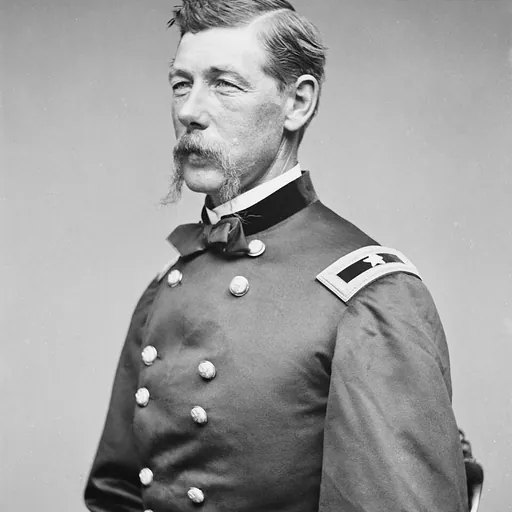
Alexander Shaler
Union Army general and Medal of Honor recipient
About Alexander Shaler
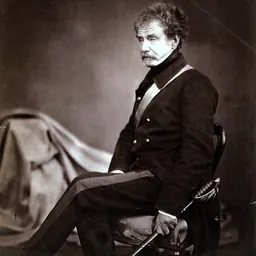
Lived 1827 – 1911 (aged 84). Alexander Shaler was an American military officer and politician.
Alexander Shaler (March 19, 1827 – December 28, 1911) was a Union Army general in the American Civil War. He received the United States military's highest decoration, the Medal of Honor, for his actions at the Second Battle of Fredericksburg. After the war, he was at various times the head of the New York City Fire Department, president of the National Rifle Association, and Mayor of Ridgefield, New Jersey, from 1899 to 1901. (Joseph Eldridge Hamblin became colonel of the regiment in his place.) Shaler led the brigade at the Second Battle of Fredericksburg, also known as the Second Battle of Marye's Heights, on May 3, when VI Corps, under Major General John Sedgwick drove Jubal Early's division away from the Heights. At a crucial moment, Shaler seized a flag and led his men into the Confederate defenses. In 1893, he received the Medal of Honor for this act. His brigade also participated in the Battle of Salem Church.
In the Battle of Gettysburg, VI Corps served as a reserve for the Army of the Potomac. Shaler's brigade was sent to the right flank early on July 3, 1863. There it helped XII Corps hold Culp's Hill. Shaler's brigade usually was in reserve, but units went to the front line to help in resisting Confederate attacks. About 3:30 that afternoon, Shaler's brigade was sent to the center of the army as a reserve around the time of the repulse of Pickett's Charge.
Shaler commanded the prisoner of war camp at Johnson's Island on the shores of Lake Erie in the winter of 1863–1864, with his regiment serving as prison guards. He was back with his brigade in 1864 in time to participate in the Overland Campaign. VI Corps had been reorganized, and Shaler's brigade served in General Horatio Wright's first division. This brigade was on the army's right flank in the Battle of the Wilderness on May 6, 1864. At first, it was in a "refused" position facing north, thus protecting the rest of the corps. Then it was drawn into the main line of battle, supporting its fight with LG Richard S. Ewell's corps. As a result, Shaler's brigade was flanked by Confederate troops led by Brigadier General John Brown Gordon that had swung northward to attack the Union right flank. Shaler and Brigadier General Truman Seymour were among the Union soldiers captured in his foray. Shaler was trying to rally his men when he was made a captive. He was sent to Libby Prison, in Richmond, Virginia and then to Macon, Georgia. In the summer of 1864 he was placed under the fire of Union batteries bombarding Charleston, South Carolina.
American Civil War: Service in the West After being exchanged, Shaler was transferred West where he served in the Department of the Gulf, briefly commanding third brigade, second division XIX Corps, from November 3 to December 3, 1864. Then he served in Arkansas, where he led the second division in VII Corps, December 28, 1864 – August 1, 1865, under Major General Joseph J. Reynolds. This division was based in DeValls Bluff in east central Arkansas. It most was engaged in occupation of the region and minor skirmishes with Confederate forces. In June 1865, as the war was ending, Shaler cooperated in the efforts of Major General Grenville Dodge, commanding the Department of Missouri, to parole the irregular forces of Brigadier General M. Jeff Thompson.
Shaler was mustered out of the volunteers on August 24, 1865.
Post-war life After the war, Shaler served as commissioner of the New York City Fire Department from 1867 to 1873. He was active in veterans' affairs, including heading the New York Commandery of the Loyal Legion. He also became major general of the state militia in 1867, commanding the first division. His tenure was not always peaceful. One of his officers accused the general of incompetence. Later, in 1885, he was arrested and charged with corruption, especially connected with the choice of sites for armories. Shaler was not convicted in two trials, because in both cases the jury could not reach agreement. Nonetheless, he had to step down from his militia position; and the city removed him from the Board of Health. The general had become chair of the Board of Health in 1883. He also served as President of the Soldiers' Business Messenger and Dispatch Company incorporated in 1867 which helped infirmed vets in good standing and orphans of vets lost during the war find employment as trusted messengers in New York City. Shaler is credited with being a founder of the National Rifle Association, serving as a director and its president in 1876. Shaler served as president of the Automatic Signal Telegraph Company, where his tenure was also stormy. In an altercation with William B. Watkins, the inventor of the fire alarm telegraph system the company marketed, Shaler had Watkins arrested for trying to remove certain papers from the premises of the company. This dispute culminated in a trial. The court ruled on April 15, 1885, that Shaler's charge of fraud against Watkins was unfounded, but the general was able to retain the shares in the company he had received as compensation for his work as president even after the company sold itself to the Watkins Automatic Telegraph Company, run by many of the same people.
Shaler moved to Ridgefield, New Jersey, possibly to escape past disputes, though he also maintained a residence in New York City, at 126 Riverside Drive. He served as Mayor of Ridgefield, New Jersey, from 1899 to 1901. Shaler died at his New York home on December 28, 1911. He was buried in Ridgefield in the cemetery of the Dutch Reformed Church in the English Neighborhood.
His only son, Ira Alexander Shaler, a major in the Spanish-American War, was put in charge of building the first subway tunnel through the Murray Hill neighborhood of Manhattan. Major Shaler died in 1902 at age 39 two weeks after his back was broken when a subway tunnel collapsed on him.
Don’t just read it —
keep it.
Full-length biographies made to live with: read them, listen on the way to work, watch them tonight.
- E-book
- Audio
- Video
Instant download · yours to keep · every purchase keeps this site free
Important facts
People in Alexander Shaler's life
Named in this biography and alive at the same time


Related people
Same field, nearest in time

Contemporaries
People whose lives overlapped Alexander Shaler's






Frequently asked questions
Who was Alexander Shaler?
Union Army general and Medal of Honor recipient
When was Alexander Shaler born?
Alexander Shaler was born on 19 March 1827 in Haddam.
When did Alexander Shaler die?
Alexander Shaler died on 28 December 1911 in New York City.
What was Alexander Shaler's occupation?
Alexander Shaler was a military officer and politician.
What nationality was Alexander Shaler?
Alexander Shaler was American.
Sources & further reading
Cite this page
APA: Biography.guide. (2026). Alexander Shaler. https://biography.guide/alexander-shaler/
MLA: "Alexander Shaler." Biography.guide, https://biography.guide/alexander-shaler/.
Chicago: "Alexander Shaler." Biography.guide. https://biography.guide/alexander-shaler/.
Data last updated: 2026-09-21 · Spot an error? Report a correction.
Portrait: Wikimedia Commons · author & licence
Page generated 2026-09-27 05:00 UTC