
About Alexander Nowell
Lived 1507 – 1602 (aged 94–95). Alexander Nowell was an English cleric and politician.
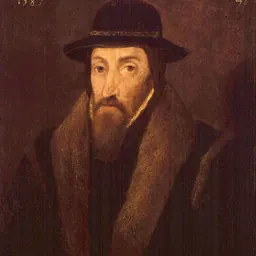
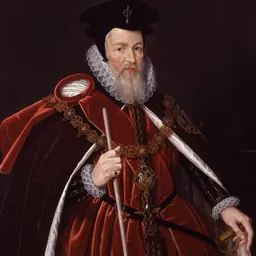
Alexander Nowell (13 February 1602), also known as Alexander Noel, was an Anglican priest and theologian who served as Dean of St Paul's during much of Elizabeth I's reign, and is now remembered for his catechisms, written in Latin.
Early life Alexander Nowell was the eldest son of John Nowell of Read Hall, Read, Lancashire, by his second wife Elizabeth Kay of Rochdale, and was the brother of Laurence Nowell, who became Dean of Lichfield. Another brother, Robert Nowell, became Attorney of the Court of Wards.
Nowell was educated at Middleton, near Rochdale, Lancashire and at Brasenose College, Oxford where he is said to have shared rooms with John Foxe the martyrologist. He was awarded his B.A. in 1536, M.A. in 1540, later a D.D. in 1578 and was elected fellow of Brasenose in 1526, spending some 13 years in Oxford.
In the Convocation of 1563 Nowell played a prominent part. On its opening day, 12 January, he preached in Westminster Abbey the sermon for the opening of the concurrent Parliament. In it, he gave offence to the Queen, when he called on her to marry. It was said that she never spoke a friendly word to him again. On the following day, Matthew Parker nominated him as prolocutor of the Lower House of Convocation. Elected to the post, he was used to keeping the two Houses, the Upper consisting of bishops, in touch with each other. In 1594 he was appointed Canon of the eleventh stall at St George's Chapel, Windsor Castle, a position he held until 1602.
Death and legacy Nowell held the deanery of St Paul's for 42 years, until his death on 13 February 1602; and was buried within his cathedral. With his brother Robert, a lawyer, he re-established the free school at Middleton; and made other benefactions for educational purposes at Brasenose College. "Without offence it may be remembered, that leaving a bottle of ale, when fishing, in the grass, he found it some days after, no bottle, but a gun, such the sound at the opening thereof : and this is believed (casualty is mother of more inventions than industry) the original of bottled ale in England."
He was also a keen angler, and Izaak Walton says, "this good man was observed to spend a tenth part of his time in angling; and also (for I have conversed with those which have conversed with him) to bestow a tenth part of his revenue, and usually all his fish, amongst the poor that inhabited near to those rivers in which it was caught; saying often, 'that charity gave life to religion'".
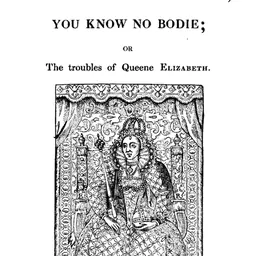
He is a character in the drama 'If You Know Not Me, You Know Nobody' by Thomas Heywood, where he plays the role of a conciliator in a land dispute between Sir Thomas Gresham and Sir Thomas Ramsey.
Works Nowell is now remembered for his work on catechisms. His Latin Catechismus puerorum, in manuscript, gained the support of the Lower House in the Convocation of 1563. It was printed in 1570, as Catechismus, sive, Prima institutio disciplinaque pietatis Christianae, with Matthew Parker's approval. It was officially required to be used in schools, in 1571, and Thomas Norton translated it into English, as A Catechism, or, First instruction of Christian religion (1570). Abridged versions appeared: the "middle" catechism (1572) and the "shorter" catechism (1573).
Family Nowell was twice married, but left no children; his first wife was Jane Mery, widow of Thomas Bowyer, the uncle of Francis Bowyer, and his second Elizabeth Hast, twice widow. He was also the uncle of the theologian William Whitaker, who translated the "middle" catechism into Greek.
Don’t just read it —
keep it.
Full-length biographies made to live with: read them, listen on the way to work, watch them tonight.
- E-book
- Audio
- Video
Instant download · yours to keep · every purchase keeps this site free
Important facts
People in Alexander Nowell's life
Named in this biography and alive at the same time




Related people
Same field, nearest in time



Contemporaries
People whose lives overlapped Alexander Nowell's

Frequently asked questions
Who was Alexander Nowell?
English theologian and clergyman (1517–1602)
When was Alexander Nowell born?
Alexander Nowell was born in 1507 in Read.
When did Alexander Nowell die?
Alexander Nowell died on 13 February 1602.
What was Alexander Nowell's occupation?
Alexander Nowell was a cleric and politician.
What nationality was Alexander Nowell?
Alexander Nowell was English.
Sources & further reading
Cite this page
APA: Biography.guide. (2026). Alexander Nowell. https://biography.guide/alexander-nowell/
MLA: "Alexander Nowell." Biography.guide, https://biography.guide/alexander-nowell/.
Chicago: "Alexander Nowell." Biography.guide. https://biography.guide/alexander-nowell/.
Data last updated: 2026-09-20 · Spot an error? Report a correction.
Page generated 2026-09-27 05:25 UTC