
About Alexander Kazankin
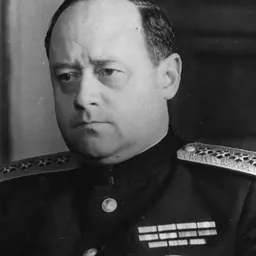
Lived 1900 – 1955 (aged 54). Alexander Kazankin was a Russian military personnel.
Alexander Fyodorovich Kazankin (; 15 April 1900 – 20 March 1955) was a Red Army Lieutenant general who commanded the Soviet airborne. He fought in the Russian Civil War and graduated from the Frunze Military Academy in 1934. Kazankin led the 4th Airborne Corps during the Vyazma airborne operation. He later commanded the 1st Guards Airborne Division, 16th Guards Airborne Division, 12th Guards Rifle Corps and 39th Guards Rifle Corps. Kazankin became the Soviet airborne commander in October 1947, but was demoted to deputy commander in December 1948. After briefly becoming airborne forces commander again between January and March 1950, Kazankin successively became inspector general of the airborne forces and then deputy airborne forces inspector general before his death on 20 March 1955. His father was a tailor. In February 1939, he became the chief of staff of the 214th Airborne Brigade, with which he fought in the Winter War. From March to May 1940, Kazankin studied at the higher commanders refresher courses. In May 1941, he was transferred to Belarus and became the chief of staff of the 4th Airborne Corps with the rank of colonel. Between 27 January and 2 February, three battalions of the corps' 8th Airborne Brigade, the 201st Airborne Brigade of the 5th Airborne Corps and the 250th Separate Rifle Regiment were paradropped in the German rear near the village of Ozrechnya. The rest of the 4th Airborne Corps, composed of the 9th Airborne Brigade and 214th Airborne Brigade was dropped from 18 to 24 February west of Yukhnov with its objective to cut the Warsaw road and link up with the 50th Army.
On 15 July, he was recommended for the title Hero of the Soviet Union but instead only received the Order of Lenin. In August, the 4th Airborne Corps became the 38th Guards Rifle Division. After recovering in the hospital, Kazankin took command of the corps' second formation in Ivanovo, where it conducted parachute training. On 8 December, the corps became the 1st Guards Airborne Division. In February 1943, the division became part of the 68th Army on the Northwestern Front. In March, the division broke through German lines on the Lovat River. In June, the division was transferred to the 34th Army, with which it fought around Staraya Russa in July and August. In September, the division was transferred to the Steppe Front's 37th Army, where it fought in the Battle of the Dnieper, advancing towards Krivoy Rog. He became the commander of the 16th Guards Airborne Division on 23 December 1943.
Postwar In June 1946, Kazankin became the commander of the 39th Guards Rifle Corps.
Awards and honors
Don’t just read it —
keep it.
Full-length biographies made to live with: read them, listen on the way to work, watch them tonight.
- E-book
- Audio
- Video
Instant download · yours to keep · every purchase keeps this site free
Important facts
Related people
Same field, nearest in time





Contemporaries
People whose lives overlapped Alexander Kazankin's




Frequently asked questions
Who was Alexander Kazankin?
Soviet military personnel (1900-1955)
When was Alexander Kazankin born?
Alexander Kazankin was born on 15 April 1900 in Buinsk.
When did Alexander Kazankin die?
Alexander Kazankin died on 20 March 1955 in Moscow.
What was Alexander Kazankin's occupation?
Alexander Kazankin was a military personnel.
What nationality was Alexander Kazankin?
Alexander Kazankin was Russian.
Sources & further reading
· Wikipedia: Alexander Kazankin
Cite this page
APA: Biography.guide. (2026). Alexander Kazankin. https://biography.guide/alexander-kazankin/
MLA: "Alexander Kazankin." Biography.guide, https://biography.guide/alexander-kazankin/.
Chicago: "Alexander Kazankin." Biography.guide. https://biography.guide/alexander-kazankin/.
Data last updated: 2026-09-20 · Spot an error? Report a correction.
Page generated 2026-09-27 05:18 UTC