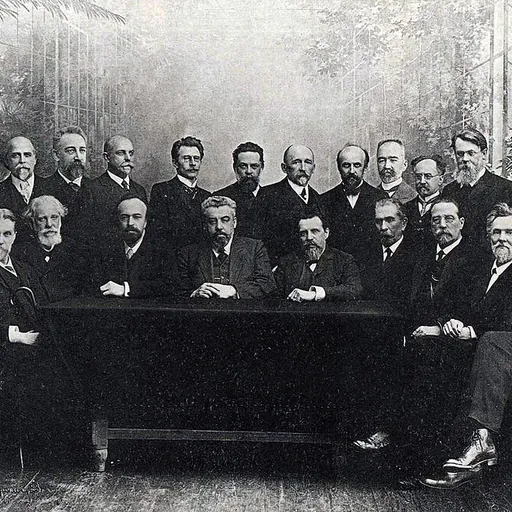
About Alexander Eichenwald
Lived 1863 – 1944 (aged 80). Alexander Eichenwald was a Russian physicist.
Alexander Alexandrovich Eichenwald ( 4 January 1864 – 12 September 1944) was a Russian experimental physicist who worked on electrodynamics. He conducted experiments on electromagnetism, electrical fields, and on the construction of instruments to measure magnetic fields. His most famous experiment, following those of Wilhelm Röntgen, examined the predictions of James Clerk Maxwell. Named after them as the Röntgen-Eichenwald experiment, this demonstrated that the movement of static charges was no different from electric currents in that they produced an electromagnetic field.
Eichenwald was born in St. Petersburg where his father was an artistic portrait photographer while his mother was a musician. An interest in music among the children made him interested in acoustics. While at high school he became a friend of P. N. Lebedev and graduated from Moscow University in physics and mathematics. He then joined the St Petersburg Railway Institute and studied engineering after which he went to the University of Strasbourg where he focused on experimental physics under K.F. Braun and on theoretical physics under Emil Cohn. His doctorate in 1897 was on the absorption of electrical waves by electrolytes. He worked at the Moscow Engineering College from 1897 where his work included a demonstration of the magnetic field created by moving electrical charges. He constructed a simple magnetometer in 1903. He became director of the Railway Engineers Institute from 1905 and also taught at the Moscow University from 1906. After the death of Lebedev he presided over the Moscow Physics Society and from 1917 he was involved in organizing higher education in physics. Diagnosed with cancer he moved to Milan and wrote a textbook on electricity that went through multiple editions. In 1903 he demonstrated that static charges on a disc that was rotated could generate a magnetic field.
Don’t just read it —
keep it.
Full-length biographies made to live with: read them, listen on the way to work, watch them tonight.
- E-book
- Audio
- Video
Instant download · yours to keep · every purchase keeps this site free
Important facts
People in Alexander Eichenwald's life
Named in this biography and alive at the same time



Related people
Same field, nearest in time



Contemporaries
People whose lives overlapped Alexander Eichenwald's


Frequently asked questions
Who was Alexander Eichenwald?
Russian physicist (1863-1944)
When was Alexander Eichenwald born?
Alexander Eichenwald was born on 23 December 1863 in Saint Petersburg.
When did Alexander Eichenwald die?
Alexander Eichenwald died on 12 September 1944 in Milan.
What was Alexander Eichenwald's occupation?
Alexander Eichenwald was a physicist.
What nationality was Alexander Eichenwald?
Alexander Eichenwald was Russian.
Sources & further reading
· Wikipedia: Alexander Eichenwald
· DBpedia: Alexander Eichenwald
Cite this page
APA: Biography.guide. (2026). Alexander Eichenwald. https://biography.guide/alexander-eichenwald/
MLA: "Alexander Eichenwald." Biography.guide, https://biography.guide/alexander-eichenwald/.
Chicago: "Alexander Eichenwald." Biography.guide. https://biography.guide/alexander-eichenwald/.
Data last updated: 2026-09-22 · Spot an error? Report a correction.
Portrait: Wikimedia Commons · author & licence
Page generated 2026-09-27 05:01 UTC