
Alexander Bickel
American legal scholar
About Alexander Bickel
Lived 1924 – 1974 (aged 49). Alexander Bickel was an American legal historian.
Alexander Mordecai Bickel (December 17, 1924 – November 7, 1974) was an American legal scholar who promoted a conservative interpretation of the United States Constitution. One of the most influential constitutional commentators of the twentieth century, his writings emphasize judicial restraint.
Life and career Bickel was born on December 17, 1924, in Bucharest, Romania, to Jewish parents, Solomo and Yetta Bickel. The family immigrated to New York City in 1939. He graduated Phi Beta Kappa from City College of New York in 1947 and summa cum laude from Harvard Law School in 1949.
Following law school, Bickel was a law clerk for federal Judge Calvert Magruder of the United States Court of Appeals for the First Circuit. In 1950, he went to Europe as a law officer of the US State Department, serving in Frankfurt, Germany, and with the European Defense Community Observer Delegation in Paris.
Contributions Bickel's most distinctive contribution to constitutional law was to stress what he called "the passive virtues" of judicial decision-making – the refusal to decide cases on substantive grounds if narrower grounds exist to decide the case. Bickel viewed "private ordering" and the voluntary working-out of problems as generally preferable to legalistic solutions.
In his books The Supreme Court and the Idea of Progress and The Morality of Consent, Bickel attacked the Warren Court for what he saw as its misuse of history, shoddy reasoning, and sometimes arbitrary results. Bickel thought that the Warren Court's two most important lines of decision, Brown v. Board of Education and Baker v. Carr, did not produce the results the court had intended. In his book The Least Dangerous Branch: The Supreme Court at the Bar of Politics, Bickel coined the term countermajoritarian difficulty to describe his view that judicial review stands in tension with democratic theory. The work contains the seeds of an unabated debate about the moral, political, and adjudicative roles of the Supreme Court.
Bickel envisioned the Supreme Court as playing a statesman-like role in national controversies, engaging in dialogue with the other branches of government. Thus he did not see the court as a purely passive body, but as one which should lead public opinion, albeit carefully.
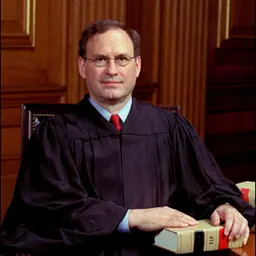
Bickel's writings addressed such varied topics as constitutionalism and Burkean thought, citizenship, civil disobedience, freedom of speech, moral authority and intellectual thought. Bickel has been cited by Chief Justice John Roberts and by Justice Samuel Alito
Relative to Alito's legal thinking and philosophy, one writer in 2011 looked particularly at Alito dissents in Snyder v. Phelps, Brown v. Entertainment Merchants Association, and United States v. Stevens, three First Amendment cases. The writer traced the influence of The Supreme Court and the Idea of Progress, The Morality of Consent and other Bickel writings both as they bore on Alito's developing thinking in college and as he chose to go to Yale (Bickel would die during Alito's third year there); and as the Bickel writings bore on the solitary or minority opinions Alito wrote in the three cases, here departing in cases even from other usually allied conservative members of the court.
Bickel was a gifted and easily accessible instructor. In 1971, he was elected a fellow of the American Academy of Arts and Sciences. He inaugurated the DeVane Lecture series at Yale in 1972 where he taught a large class mostly of Yale undergraduates.
Selected bibliography The Least Dangerous Branch (Bobbs-Merrill, 1962) Politics and the Warren Court (Harper & Row, 1965) The Supreme Court and the Idea of Progress (Harper & Row, 1970) The Morality of Consent (Yale University Press, 1975) History of the Supreme Court of the United States: The Judiciary and Responsible Government: 1910-1921 (vol. IX, Macmillan, 1984) SCOTUSblog Online Symposium on The Least Dangerous Branch (August 2012)
Don’t just read it —
keep it.
Full-length biographies made to live with: read them, listen on the way to work, watch them tonight.
- E-book
- Audio
- Video
Instant download · yours to keep · every purchase keeps this site free
Important facts
People in Alexander Bickel's life
Named in this biography and alive at the same time



Related people
Same field, nearest in time





Contemporaries
People whose lives overlapped Alexander Bickel's


Frequently asked questions
Who was Alexander Bickel?
American legal scholar (1924–1974)
When was Alexander Bickel born?
Alexander Bickel was born on 17 December 1924 in Bucharest.
When did Alexander Bickel die?
Alexander Bickel died on 8 November 1974 in New Haven.
What was Alexander Bickel's occupation?
Alexander Bickel was a legal historian.
What nationality was Alexander Bickel?
Alexander Bickel was American.
Sources & further reading
Cite this page
APA: Biography.guide. (2026). Alexander Bickel. https://biography.guide/alexander-bickel/
MLA: "Alexander Bickel." Biography.guide, https://biography.guide/alexander-bickel/.
Chicago: "Alexander Bickel." Biography.guide. https://biography.guide/alexander-bickel/.
Data last updated: 2026-09-20 · Spot an error? Report a correction.
Page generated 2026-09-27 05:02 UTC