
About Alessandro François
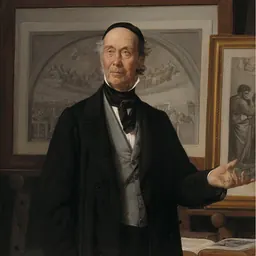
Lived 1796 – 1857 (aged 60–61). Alessandro François was an Italian art historian and archaeologist.
Excavations in Etruria François began exploring the ancient sites of Etruria in the early 1820s: in 1824 he identified the Etruscan settlement of Doganella in the Albegna valley, In the 1857 report he also described his working method, which included recording the location of the tombs, keeping the finds from each context separate, and sieving the excavated earth through wire screens so that even the smallest fragments were recovered.
The krater, 66 cm high and dated to about 570 BCE, bears the signatures of the potter Ergotimos and the painter Kleitias, and carries several superimposed friezes of Greek mythological scenes, notably from the Trojan War cycle. It was recognised from the moment of its discovery as a major monument of Greek ceramics. To protect the paintings he had a wall built across the entrance, which was later taken down to allow the painter Nicola Ortis, commissioned by des Vergers and Wilhelm Henzen, to copy the frescoes in the second half of May 1857. The use of the mythological and historical scenes as a means of self-representation by an Etruscan aristocratic family has been the subject of specific study.
In 1862–1863 the frescoes were detached from the walls by order of the landowner, Prince Alessandro Torlonia, divided into panels and transferred to Rome, where they were displayed at the Collegio Romano and later in the Torlonia museum on the Via della Lungara, before eventually reaching the Villa Albani.
Museum project and death François kept the finds from his excavations, from March 1856 united with the share ceded by the Bonaparte heirs, at his home in Livorno, intending them to form the nucleus of an Etruscan museum. His repeated attempts to establish such a museum in Florence failed, as did an appeal to the French government. In September 1856 he wrote to Migliarini of his intention to retire from grand-ducal service and devote himself entirely to archaeology, hoping to lay the foundations of a national museum of antiquities before his death.
Don’t just read it —
keep it.
Full-length biographies made to live with: read them, listen on the way to work, watch them tonight.
- E-book
- Audio
- Video
Instant download · yours to keep · every purchase keeps this site free
Important facts
People in Alessandro François's life
Named in this biography and alive at the same time

Related people
Same field, nearest in time





Contemporaries
People whose lives overlapped Alessandro François's





Frequently asked questions
Who was Alessandro François?
Italian art historian
When was Alessandro François born?
Alessandro François was born in 1796 in Florence.
When did Alessandro François die?
Alessandro François died in 1857 in Florence.
What was Alessandro François's occupation?
Alessandro François was an art historian and archaeologist.
What nationality was Alessandro François?
Alessandro François was Italian.
Sources & further reading
· Wikipedia: Alessandro François
· DBpedia: Alessandro François
Cite this page
APA: Biography.guide. (2026). Alessandro François. https://biography.guide/alessandro-francois/
MLA: "Alessandro François." Biography.guide, https://biography.guide/alessandro-francois/.
Chicago: "Alessandro François." Biography.guide. https://biography.guide/alessandro-francois/.
Data last updated: 2026-09-20 · Spot an error? Report a correction.
Page generated 2026-09-27 05:04 UTC