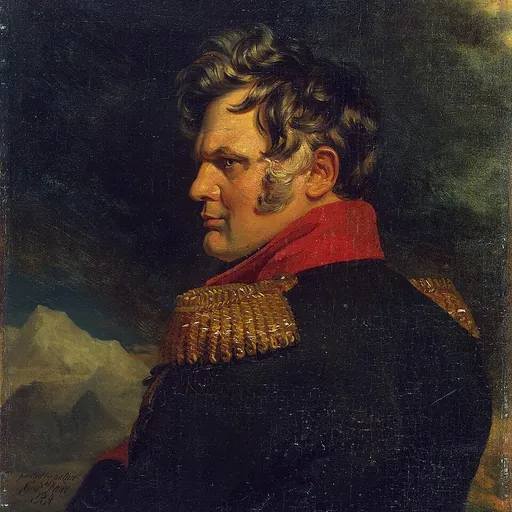
About Aleksey Petrovich Yermolov
Lived 1777 – 1861 (aged 83). Aleksey Petrovich Yermolov was a Russian linguist, military personnel, diplomat and politician.
Aleksey Petrovich Yermolov (, ; – ) was a Russian general of the 19th century who commanded Russian troops in the Caucasian War. He served in all the Russian campaigns against the French, except for the 1799 campaigns of Alexander Suvorov in northern Italy and Switzerland. During this time he was accused of conspiracy against Paul I and sentenced to exile. Two years later he was pardoned and brought back into service by Alexander I. Yermolov distinguished himself during the Napoleonic Wars at the Battles of Austerlitz, Eylau, Borodino, Kulm, and Paris.
Early life Yermolov was born on in Moscow to an old Russian noble family from the Oryol Governorate. His father, Pyotr Alekseyevich Yermolov, owned a small estate with 150 serfs in the Mtsensky Uyezd of the Oryol Governorate. According to the practice of the time, Yermolov was officially enrolled in the Preobrazhensky Life Guards Regiment as a child (for future service). He attended the boarding school of the Moscow University from 1784 to 1791. In 1791, he was promoted to lieutenant and transferred to the Nizhny Novgorod Dragoon Regiment with the rank of captain. For a short time in 1793, he taught at the Artillery and Engineer Cadet Corps. In 1794, he was sent to fight against the Polish rebellion. But first he had another, most urgent task: Yermolov had to travel on a mission to Tehran, to evade the execution of Alexander I's promise to restore to Fath-Ali Shah Qajar part of the territories acquired by Russia in the Treaty of Gulistan of 1813.
During his tenure as commander-in-chief in the Caucasus, Yermolov (by that time promoted to the rank of full artillery general) was responsible for robust Russian military policies there. He was appointed commander-in-chief of the Russian forces in Georgia and commander of the Independent Georgian Corps on 21 April 1816. He proved himself an able administrator and successfully negotiated with Persia in 1818, receiving promotion to general of infantry on 4 March 1818.
In 1817, he fortified a ford on the Sunzha river and founded the fortress of Grozny the following year. Under him new towns were built (he founded Pyatigorsk and Kislovodsk) and state funds were allocated to improve the existing ones, especially the cities of Transcaucasia; he started the reconstruction of Tiflis in the European style, as well as to improve and build communication routes (first of all, the Georgian Military Road).
Yermolov's career came to an abrupt end in 1827 and he was replaced with Nicholas I's favorite, Ivan Paskevich. The exact reasons are unclear, but he was disliked by Nicholas and was blamed for not keeping the tribes in check. As Moshe Gammer writes: Far from subduing the population, as his admirers up to the present have asserted, his activities rather intensified hatred to Russia, stiffened resistance to it and helped to enhance the role of Islam, in the form of the spread of the Naqshbandi tariqa (Sufi brotherhood) which would leave now resistance in the eastern part of the Caucasus and for some periods of time in some of its western parts too. Yermolov was discharged on 7 December 1827 with a full pension. However, four years later, Nicholas restored him in the rank (6 November 1831) and appointed him to the State Council; Yermolov's rank of general of infantry was confirmed in 1833.
Retirement
During the last 30 years of his life, Yermolov lived in seclusion at his manor near Oryol. He was asked to lead a peasant militia during the Crimean War but declined on account of poor health. He died on in Moscow and was buried at the Trinity Church in Oryol. He left memoirs of his service in 1796–1816. His Zapiski (Memoirs) are divided into three parts covering his early career, the Napoleonic Wars, and his service in the Caucasus. They were published posthumously in two volumes.
Awards
In addition to the decorations already mentioned, Yermolov was decorated with the Russian Orders of St. Andrew the First Called, of St. Vladimir (1st class), of St. Alexander Nevsky, of the White Eagle, and of St. Anna (1st class); foreign orders received included the Prussian Orders of the Red Eagle (1st class) and the Pour le Mérite, the Military Order of Maria Theresa (3rd class), the Baden Order of Karl Friedrich, the Persian Order of the Lion and the Sun, and two golden swords for courage (including one with diamonds).
Legacy In Russia, he was famous for military prowess, bravery and strategy. His charismatic leadership of imperial armies was romanticized in poems by Alexander Pushkin, Vasily Zhukovsky, and others.
However, in the Caucasus (with the exception of Ossetia), Yermolov is infamous for atrocities he had committed. As historian Charles King puts it:" was a quintessential frontier conqueror. He was the first to employ a comprehensive strategy for the subjugation of the Caucasus highlands, and his brutal methods would be used, in one form or another, by tsarists, Bolsheviks, and Russian generals into the twenty-first century. was the most celebrated and, at the same time, the most hated of Russian commanders in the Caucasus theater. To St. Petersburg society he was the gallant, Latin-quoting senior officer. For generations of indigenous mountaineers he was the dreaded "Yarmul" who razed villages and slaughtered families. Although he gained the supreme confidence of one Tsar, Alexander I, he was treated with suspicion by another, Nicholas I. He was responsible for implementing a series of policies that were at the time hailed as vehicles for civilizing the benighted Caucasus frontier but today might very well be called state-sponsored terrorism."
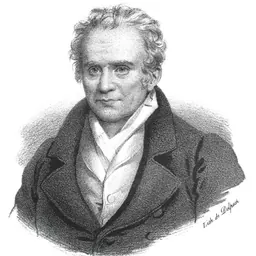
John F. Baddeley, author of Russian Conquest of the Caucasus (Chapter VI, 1908), described him in 1908:"In person no less than in character Yermolov impressed all who came near him as one born to command. Of gigantic stature and uncommon physical strength, with round head set on mighty shoulders and framed in shaggy locks, there was something leonine in his whole appearance, which, coupled with unsurpassed courage, was well calculated to excite the admiration of his own men and strike terror into his semi-barbarous foes. Incorruptibly honest, simple, even rude in his habit, and of Spartan hardihood, his sword was ever at his side, and in city as in camp he slept wrapped only in his military cloak, and rose with the sun."
Since 2000, Kalach-on-don has been operating a multi-purpose ship of the KC-104-02 project named after the hero of the Patriotic war of 1812 — "General Yermolov", as an object of intangible heritage that preserves the historical memory of the people.
Don’t just read it —
keep it.
Full-length biographies made to live with: read them, listen on the way to work, watch them tonight.
- E-book
- Audio
- Video
Instant download · yours to keep · every purchase keeps this site free
Important facts
People in Aleksey Petrovich Yermolov's life
Named in this biography and alive at the same time


Related people
Same field, nearest in time


Contemporaries
People whose lives overlapped Aleksey Petrovich Yermolov's



Frequently asked questions
Who was Aleksey Petrovich Yermolov?
Russian general (1777–1861)
When was Aleksey Petrovich Yermolov born?
Aleksey Petrovich Yermolov was born on 4 June 1777 in Moscow.
When did Aleksey Petrovich Yermolov die?
Aleksey Petrovich Yermolov died on 23 April 1861 in Moscow.
What was Aleksey Petrovich Yermolov's occupation?
Aleksey Petrovich Yermolov was a linguist, military personnel, diplomat and politician.
What nationality was Aleksey Petrovich Yermolov?
Aleksey Petrovich Yermolov was Russian.
Sources & further reading
· Wikipedia: Aleksey Petrovich Yermolov
Cite this page
APA: Biography.guide. (2026). Aleksey Petrovich Yermolov. https://biography.guide/aleksey-petrovich-yermolov/
MLA: "Aleksey Petrovich Yermolov." Biography.guide, https://biography.guide/aleksey-petrovich-yermolov/.
Chicago: "Aleksey Petrovich Yermolov." Biography.guide. https://biography.guide/aleksey-petrovich-yermolov/.
Data last updated: 2026-09-23 · Spot an error? Report a correction.
Portrait: Wikimedia Commons · author & licence
Page generated 2026-09-27 05:04 UTC