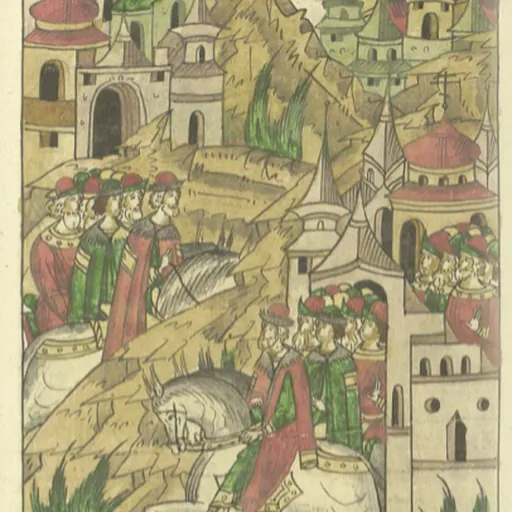
About Aleksandr Mikhailovich of Tver
Lived 1301 – 1339 (aged 38). Aleksandr Mikhailovich of Tver was a politician.
Aleksandr Mikhailovich (; 7 October 1301 – 28 October 1339) was Prince of Tver and Grand Prince of Vladimir from 1326 to 1327 and Grand Prince of Tver from 1338 until his death in 1339.
His reign was marked by a failed popular uprising against the Tatars, which led to him losing the grand princely throne. After a period of exile, he was reinstated as the prince of Tver before he was executed in Sarai by the Mongols, together with his son Fyodor. His death marked the end of a 35-year-long struggle with the princes of Moscow for the Grand Principality of Vladimir.
Early life Aleksandr was born in 1301. He was the second son of Mikhail of Tver by his wife, Anna of Kashin.
He is first mentioned in 1319, when he went with the boyars (nobles) of Tver to the city of Vladimir to see Yury of Moscow, who was the grand prince of Vladimir at the time.
The massacre inevitably led to Tatar reprisals. Indeed, the whole incident may have been a provocation by the Tatars to destroy Aleksandr and the princes of Tver. Özbeg dispatched a punitive force led by Ivan I of Moscow, the brother of Yury, to sack the city. Ivan was given 50,000 Tatar troops and was joined by Aleksandr Vasilyevich of Suzdal. After Novgorod refused to offer him asylum, Aleksandr fled to Pskov. For his role in leading the punitive expedition, Özbeg rewarded Ivan with the title of grand prince and shared the principality between him and Aleksandr of Suzdal. Novgorod and Kostroma went to Ivan, while Vladimir and the Volga district went to Aleksandr of Suzdal.
Exile Pskov not only granted Aleksandr sanctuary, but also appointed him to be their prince. Pskov signed an agreement with Aleksandr in which they swore "not to hand him over to the Russian princes". Afterwards, a joint Muscovite–Novgorodian delegation was sent to urge him to go to the Horde, as the ambassadors said that his refusal would lead to the destruction of Pskov by the Horde. Aleksandr initially agreed to go to the Horde and sacrifice himself "for all the Christian people", but he was persuaded by the Pskovites to not leave. According to John L. I. Fennell, it is "hard to conceive of any possible motive behind the Pskovites' show of bravado except the assurance of Lithuanian support".
Ivan moved his troops to the town of Opochka, situated about from Pskov, but decided against a direct attack on the city. Instead, Theognostos, the metropolitan of the Russian Orthodox Church, excommunicated Aleksandr and the city at the behest of Ivan. Aleksandr is alleged to have said: "O my brothers and friends, let not this curse and excommunication be upon you because of me. I shall leave your city, and your oath to me and my oath to you shall no longer be valid". After receiving assurances from Pskov that his wife would be cared for, Aleksandr left Pskov for Lithuania.
Return to Tver Aleksandr returned to Pskov from Lithuania in 1331 or 1332 with the ultimate aim of recovering his principality and the grand principality. In 1334 or early 1335, he sent his son Fyodor to the Horde, who returned to Tver in 1335 with a Tatar official. Aleksandr visited Tver in the winter of 1336, and the chronicles simply state that he brought his son back to Pskov; however, historians have suggested that he may have gone to Tver to make peace with his brother Konstantin or find out the attitude of the population.
Aleksandr prepared a trip to the Horde to discuss his reinstatement as prince, after being persuaded by Ivan that it was safe to do so. Aleksandr made contact with Theognostus and sent his boyars to the metropolitan "for the sake of his blessing and his prayers", as the chronicle says, though it is likely that he sought protection from the Russian Orthodox Church. Although the archbishop of Novgorod had warned him during his visit to not visit Sarai, Aleksandr "refused judgement" and the archbishop left the city "having anathematized Pskov", according to the Novgorodian chronicle.
At Sarai, Aleksandr was granted a full pardon and the right to return to Tver. Some historians have explained Aleksandr's reinstatement as an attempt to set up Tver against Moscow again. However, Fennell says that "the situation closely resembled that of 1326", in which Aleksandr "was permitted to return to Tver' in order that he might discredit himself in the eyes of the Tverites–and indeed of any other Russians who might witness his predicament–and thus ultimately bring about his own destruction". He also says that an immediate execution of Aleksandr would have antagonized Novgorod, Pskov and Lithuania. In the autumn of 1338, Aleksandr returned to Tver and he called for his spouse and children to return from Pskov. Aleksandr was also granted the title of grand prince by Özbeg, although the grand prince of Vladimir continued to be recognized as the senior leader, or the "grand prince over the grand princes".
Execution
Aleksandr sent his son Fyodor to Sarai as an envoy, and at the same time, Ivan went to the khan. As a result of accusations made by "lawless people" inspired by "that all-cunning wicked counsellor the devil", according to the chronicle, Özbeg sent an ambassador to Tver, who informed him that Özbeg would allow him to bring back his son. Aleksandr arrived at the Horde at the end of September, and both he and his son were executed on 28 October 1339, by the orders of Özbeg.
The execution of Aleksandr marked the end of a 35-year-long struggle between Moscow and Tver for supremacy and the start of the fragmentation of Tver into appanage principalities (udely). According to Fennell, "If Uzbek had not succeeded in bringing back Pskov into the orbit of the grand prince of Vladimir, he had at least removed from the political scene the most powerful ally of Gedimin in north-east Russia".
Family Aleksandr was married to Anastasia of Galicia, daughter of Yuri I of Galicia. He had eight children: Fyodor (died 1339); Lev (born 1321, date of death unknown); Mikhail (1333–1399), prince of Mikulin, married to Evdokia of Suzdal; Vsevolod (died 1364), prince of Kholm, married to Sophia of Ryazan; Andrey (died 1364); Vladimir (died 1364); Maria (died 1399), married to Simeon of Moscow; Uliana ( – 1392), married to Algirdas of Lithuania.
Don’t just read it —
keep it.
Full-length biographies made to live with: read them, listen on the way to work, watch them tonight.
- E-book
- Audio
- Video
Instant download · yours to keep · every purchase keeps this site free
Important facts
People in Aleksandr Mikhailovich of Tver's life
Named in this biography and alive at the same time



Related people
Same field, nearest in time

Contemporaries
People whose lives overlapped Aleksandr Mikhailovich of Tver's



Frequently asked questions
Who was Aleksandr Mikhailovich of Tver?
Russian Grand Prince
When was Aleksandr Mikhailovich of Tver born?
Aleksandr Mikhailovich of Tver was born on 7 October 1301 in Tver.
When did Aleksandr Mikhailovich of Tver die?
Aleksandr Mikhailovich of Tver died on 28 October 1339 in Sarai.
What was Aleksandr Mikhailovich of Tver's occupation?
Aleksandr Mikhailovich of Tver was a politician.
What nationality was Aleksandr Mikhailovich of Tver?
Aleksandr Mikhailovich of Tver's recorded nationality: Grand Principality of Vladimir.
Sources & further reading
· Wikipedia: Aleksandr Mikhailovich of Tver
Cite this page
APA: Biography.guide. (2026). Aleksandr Mikhailovich of Tver. https://biography.guide/aleksandr-mikhailovich-of-tver/
MLA: "Aleksandr Mikhailovich of Tver." Biography.guide, https://biography.guide/aleksandr-mikhailovich-of-tver/.
Chicago: "Aleksandr Mikhailovich of Tver." Biography.guide. https://biography.guide/aleksandr-mikhailovich-of-tver/.
Data last updated: 2026-09-20 · Spot an error? Report a correction.
Page generated 2026-09-27 05:10 UTC