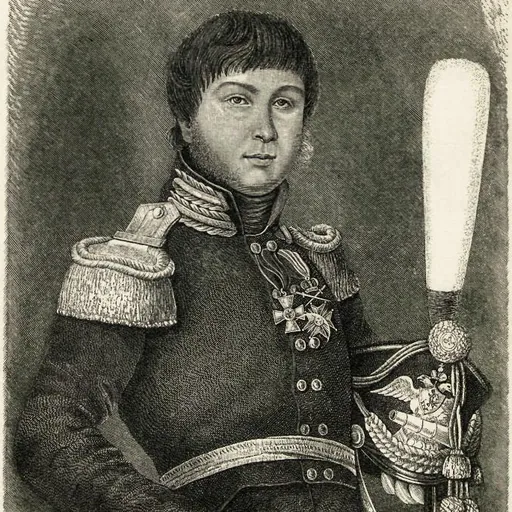
Aleksandr Figner
Russian partisan colonel of the Napoleonic Wars
About Aleksandr Figner
Lived 1787 – 1813 (aged 25–26). Aleksandr Figner was a military personnel and military officer.
Aleksandr Samoilovich Figner (, ; 1787 – 12 October 1813) was a Guards Colonel of the army of the Russian Empire, known as an organizer of partisan units during the 1812 Napoleonic invasion of Russia and later in Germany.
Early life A descendant of the ancient German Figner-von-Ruthmersbach family, he was born the son of the future Vice Governor of Pskov, Samuil Samoilovich Figner. The young Figner was educated in the 2nd Cadet Corps and in 1805 was commissioned as a Second Lieutenant of the Artillery. That same year, he took part in the Anglo-Russian expedition to the Mediterranean and, during his stay in Italy, learned Italian well, which later proved very useful. In 1810, Figner participated in the Russo-Turkish War and earned the Order of St. George, 4th Class, for the storming of Rusçuk. After this war, he retired and received a position as mayor of a city in the province of Tambov, but returned to military service as a Staff Captain of Artillery in 1812.
Napoleonic Wars His distinguished service at the Battle of the Strogani River earned Figner a promotion to Captain. When the Russian army left Moscow after the Battle of Borodino, Figner received permission to act independently as a partisan. He entered the city and committed sabotage there. According to some stories, he even planned to kill Napoleon. After that, he gathered a detachment of lagging soldiers and deserters and began to attack the retreating units of the Grande Armée. Figner's detachment became a notable force and participated in the capture of general Augereau's brigade near Lyakhovo. Figner managed to create a resounding glory for himself, becoming the most famous partisan leader at that time. He was distinguished by a passion for dressing up for reconnaissance among enemy units. For his exploits, his rank was raised to Lieutenant Colonel and he received 7,000 rubles.
Death He was distinguished by cruelty towards captured French prisoners, unusual even among the partisans of that time. Another famous partisan, Denis Davydov, severely criticized him for this. Other contemporaries, however, found in him traits of chivalrous nobility and generosity, and genuine religiosity, not hypocrisy. His sabre was found on the river bank.
Don’t just read it —
keep it.
Full-length biographies made to live with: read them, listen on the way to work, watch them tonight.
- E-book
- Audio
- Video
Instant download · yours to keep · every purchase keeps this site free
Important facts
People in Aleksandr Figner's life
Named in this biography and alive at the same time

Related people
Same field, nearest in time


Contemporaries
People whose lives overlapped Aleksandr Figner's



Frequently asked questions
Who was Aleksandr Figner?
Russian partisan colonel of the Napoleonic Wars
When was Aleksandr Figner born?
Aleksandr Figner was born in 1787.
When did Aleksandr Figner die?
Aleksandr Figner died on 12 October 1813.
What was Aleksandr Figner's occupation?
Aleksandr Figner was a military personnel and military officer.
Sources & further reading
Cite this page
APA: Biography.guide. (2026). Aleksandr Figner. https://biography.guide/aleksandr-figner/
MLA: "Aleksandr Figner." Biography.guide, https://biography.guide/aleksandr-figner/.
Chicago: "Aleksandr Figner." Biography.guide. https://biography.guide/aleksandr-figner/.
Data last updated: 2026-09-24 · Spot an error? Report a correction.
Portrait: Wikimedia Commons · author & licence
Page generated 2026-09-27 05:09 UTC