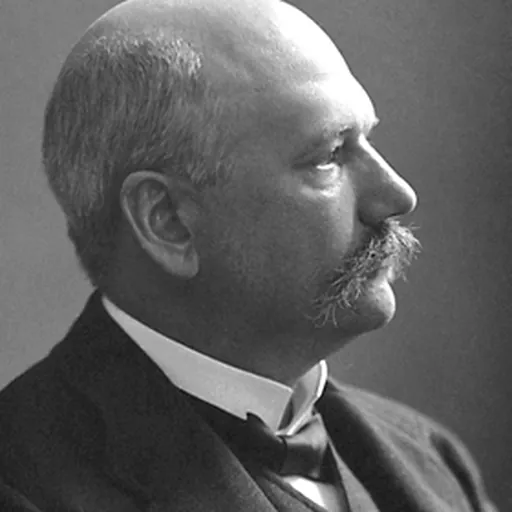
Albrecht Kossel
German biochemist and pioneer in the study of genetics
About Albrecht Kossel
Lived 1853 – 1927 (aged 73). Albrecht Kossel was a German chemist, physician, university teacher, physiologist and biochemist, known for Histidine, Histone and Nucleobases.
Ludwig Karl Martin Leonhard Albrecht Kossel (; 16 September 1853 – 5 July 1927) was a German biochemist and pioneer in the study of genetics. He was awarded the Nobel Prize for Physiology or Medicine in 1910 for his work in determining the chemical composition of nucleic acids, the genetic substance of biological cells.
Kossel isolated and described the five organic compounds that are present in nucleic acid: adenine, cytosine, guanine, thymine, and uracil. These compounds were later shown to be nucleobases, and are key in the formation of DNA and RNA, the genetic material found in all living cells.
Kossel was an important influence on and collaborator with other important researchers in biochemistry, including Henry Drysdale Dakin, Friedrich Miescher, Edwin B. Hart, and his professor and mentor, Felix Hoppe-Seyler. Kossel was editor of the Zeitschrift für Physiologische Chemie (Journal of Physiological Chemistry) from 1895 until his death. Kossel also conducted important research into the composition of protein, and his research predicted the discovery of the polypeptide nature of the protein molecule.
The Albrecht Kossel Institute for Neuroregeneration at the University of Rostock is named in his honor.
Early life and education Kossel was born in Rostock, Germany as the son of the merchant and Prussian consul Albrecht Karl Ludwig Enoch Kossel and his wife Clara Jeppe Kossel. As a youth, Kossel attended the Gymnasium at Rostock, where he evidenced substantial interest in chemistry and botany. A monograph describing this work was published shortly after his death.
The Albrecht Kossel Institute for Neuroregeneration at the University of Rostock is named in his honor.
Selected works Untersuchungen über die Nukleine und ihre Spaltungsprodukte ("Investigations into the nucleins and their cleavage products", 1881) Die Gewebe des menschlichen Körpers und ihre mikroskopische Untersuchung ("The tissues in the human body and their microscopic investigation", 1889–1891) Leitfaden für medizinisch-chemische Kurse ("Textbook for medical-chemical courses", 1888) Die Probleme der Biochemie ("The problems of biochemistry", 1908) Die Beziehungen der Chemie zur Physiologie ("The relationships between chemistry and physiology", 1913)
Don’t just read it —
keep it.
Full-length biographies made to live with: read them, listen on the way to work, watch them tonight.
- E-book
- Audio
- Video
Instant download · yours to keep · every purchase keeps this site free
Important facts
People in Albrecht Kossel's life
Named in this biography and alive at the same time



Related people
Same field, nearest in time



Contemporaries
People whose lives overlapped Albrecht Kossel's



Frequently asked questions
Who was Albrecht Kossel?
German biochemist and pioneer in the study of genetics
When was Albrecht Kossel born?
Albrecht Kossel was born on 16 September 1853 in Rostock.
When did Albrecht Kossel die?
Albrecht Kossel died on 5 July 1927 in Heidelberg.
What was Albrecht Kossel's occupation?
Albrecht Kossel was a chemist, physician, university teacher, physiologist and biochemist.
What was Albrecht Kossel known for?
Albrecht Kossel was known for Histidine, Histone, Nucleobases and Theophylline.
What nationality was Albrecht Kossel?
Albrecht Kossel was German.
Sources & further reading
Cite this page
APA: Biography.guide. (2026). Albrecht Kossel. https://biography.guide/albrecht-kossel/
MLA: "Albrecht Kossel." Biography.guide, https://biography.guide/albrecht-kossel/.
Chicago: "Albrecht Kossel." Biography.guide. https://biography.guide/albrecht-kossel/.
Data last updated: 2026-09-22 · Spot an error? Report a correction.
Portrait: Wikimedia Commons · author & licence
Page generated 2026-09-27 05:02 UTC