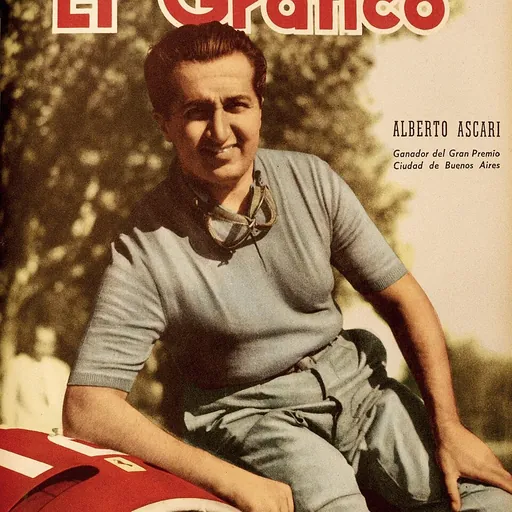
About Alberto Ascari
Lived 1918 – 1955 (aged 36). Alberto Ascari was an Italian formula One driver and motorcycle racer.
Alberto Ascari (13 July 1918 – 26 May 1955) was an Italian racing driver, who competed in Formula One from to . Ascari won two Formula One World Drivers' Championship titles, which he won in and with Ferrari, and won 13 Grands Prix across six seasons. In endurance racing, Ascari won the Mille Miglia in 1954 with Lancia.
Noted for careful precision and finely-judged accuracy, Ascari was a multitalented racer who competed in motorcycle racing before switching to cars. He won consecutive Formula One world titles in and for Scuderia Ferrari, becoming the first Ferrari-powered World Champion and breaking several records across both seasons. He remains the last Italian to win the World Drivers' Championship. This was sandwiched by an appearance in the 1952 Indianapolis 500, and winning the 1954 Mille Miglia.
As of 2025, Ascari and Michael Schumacher are Ferrari's only back-to-back World Champions, and Ascari remains Ferrari's sole Italian champion. As the first driver to win multiple World Championship titles, he held the record for most World Championship titles from 1952 to 1954, becoming one of four drivers to have held the record for most World Championship titles. Juan Manuel Fangio held the record from to (jointly with Ascari in 1954) and Schumacher has held the record since , although Schumacher also shares that record with Lewis Hamilton since .
When Ascari was a young child, his father Antonio Ascari, also a famous racing driver, died in an accident at the 1925 French Grand Prix. Ascari himself was later killed during a test session for Ferrari at the Autodromo Nazionale Monza in 1955.
Early life Born in Milan, Alberto Ascari was the son of Antonio Ascari, a talented Grand Prix motor racing star in the 1920s, racing Alfa Romeos. A fortnight before Ascari's seventh birthday, his father was killed while leading the 1925 French Grand Prix at the Autodrome de Linas-Montlhéry; the younger Ascari had an interest in racing in spite of this, and later came to dominate Grand Prix racing like no other before him. Ascari raced motorcycles in his earlier years. At the age of 19, he was signed to ride for the Bianchi team. In 1940, after he entered the prestigious Mille Miglia in an Auto Avio Costruzioni 815 supplied by his father's close friend Enzo Ferrari, Ascari eventually started racing on four wheels regularly. The pair survived a ship they were aboard carrying lorries capsizing in Tripoli harbour. He also took second place at the 1948 British Grand Prix, which was organised by the Royal Automobile Club and is generally considered the first British Grand Prix, at the Silverstone Circuit. Driving a Ferrari, he also won the third 1949 Buenos Aires Grand Prix.
The first Formula One World Championship season took place in . The Ferrari team made its World Championship debut at the 1950 Monaco Grand Prix, the second race of the season, with Ascari, Villoresi, and the famous French driver Raymond Sommer on the team. At Monaco, Ascari became the youngest driver to score points and a podium position in Formula One at 31 years, 312 days, finishing second one lap behind Juan Manuel Fangio. The team had a mixed year as the supercharged Ferrari 125 F1 was too slow to challenge the dominant Alfa Romeo team, so Ferrari began working on an unblown 4.5-litre car. Much of the year was lost as the team's 2-litre Formula Two engine was progressively enlarged. When the full 4.5-litre Ferrari 375 F1 arrived for the 1950 Italian Grand Prix, the final round of the championship, Ascari gave Alfa Romeo their sternest challenge of the year before retiring; he then took over teammate Dorino Serafini's car to finish second. The new Ferrari then won the non-championship 1950 Penya Rhin Grand Prix.
Throughout , Ascari was a threat to the Alfa Romeo team, although initially he was undone by unreliability. After winning the 1951 German Grand Prix at Nürburgring, he also won the 1951 Italian Grand Prix, and was only two points behind Fangio in the championship standings ahead of the climactic 1951 Spanish Grand Prix, where Fangio won the race and his first title as the 33-years-old Ascari became the youngest runner-up. Although Ascari had taken pole position, a disastrous tyre choice for the race saw the Ferraris unable to challenge Fangio; Ascari finished fourth.
For , the World Championship season switched to using the 2-litre Formula Two regulations, with Ascari driving the Ferrari 500. He missed the 1952 Swiss Grand Prix as he was qualifying for the 1952 Indianapolis 500, at the time a World Championship event. He was the only European driver to race at Indy in its eleven years on the World Championship schedule; his race ended after 40 laps without having made much of an impression, as a result of a wheel collapse. Returning to Europe, he then won the remaining six rounds of the series to clinch the world title (also taking five non-championship wins) and recording the fastest lap in each race. He scored the maximum number of points a driver could earn, since only the best four of eight scores counted towards the World Championship. Aged 34, Ascari became Formula One's new youngest champion until the 29-year-old Mike Hawthorn won it in ; Hawthorn had been Ascari's teammate in 1951.
Ascari won three more consecutive races to start the season, giving him nine straight championship wins (not counting Indy) before his streak ended when he finished fourth at the 1953 French Grand Prix, which proved to be highly competitive. He won twice more later in the year for a second consecutive World Championship, and once for Ferrari. Ascari also won the Mille Miglia that year, When the Lancia D50 was ready, Ascari took pole position on its debut, the 1954 Spanish Grand Prix, and led impressively early on and set fastest lap before retiring with a clutch problem, meaning a full season of competing against Fangio's previously dominant Mercedes was much anticipated. where the Lancias took on and beat the hitherto all-conquering Mercedes. During the 1955 Monaco Grand Prix on 22 May, Ascari crashed into the harbour through hay bales and sandbags late in the race after missing a chicane while leading, reportedly distracted by either the crowd's reaction to Stirling Moss' retirement or the close attentions of the lapped Cesare Perdisa behind. Whatever distracted him, he approached the chicane too quickly, and chose the only way out and took his D50 through the barriers into the sea, missing a substantial iron bollard by about 30 cm. Although his car sank, The reasons and circumstances of the accident, including why Ascari, who was well known for his attention to safety, drove another driver's car, and without his own lucky blue helmet (he had left it at home, and apparently reasoned that, after his accident in Monaco four days earlier, getting back to race driving as soon as possible was the best way to recover), never came to light. In 2014, the racing driver Ernesto Brambilla declared that he had seen the accident, confirming that the car spun around and overturned, excluding the hypothesis that the accident was caused by a spectator who crossed the track.
Motor racing fans from all over mourned, as Ascari was buried next to the grave of his father in the Cimitero Monumentale in Milan, to be forever remembered as one of the greatest racers of all time. More than a million people took to the streets in Milan for his funeral. Both Ascaris won 13 Grands Prix, drove car number 26, and were killed in similar circumstances. In 2016, unknown thieves stole the bronze busts, which were placed on the sides of the shrine, of Ascari and his father. Ascari's bust was the work of Michele Vedani, while that of his father was created by the sculptor Orazio Grossoni.
Legacy
Ascari was popular with fellow drivers and crowds because of his modesty and eagerness to praise the ability of his rivals; he is also considered one of the hardest drivers to pass. One criticism was the perceived lack of complete focus when he was chasing for the lead. For example, Enzo Ferrari said: "When he had to follow and pass an opponent, he evidently suffered, not from an inferiority complex, but from a nervousness that did not let him express his true class." In 1992, he was inducted into the International Motorsports Hall of Fame. The British sports car manufacturer Ascari Cars, founded in 1994, is named in his honour. Italian-born American racing legend Mario Andretti counts Ascari as one of his racing heroes, having watched him at the Monza circuit in his youth. Ascari was inducted into the FIA Hall of Fame in December 2017. He appears in Mark Sullivan's novel Beneath a Scarlet Sky.
In 34 entries and 32 race starts, Ascari had 13 wins, 17 podiums, 14 pole positions, and 12 fastest laps, and won two World Championships, making him the first double World Champion and the first back-to-back winner; it was not until Michael Schumacher's fourth World Championship (the second with Ferrari) in , the only other to do so, that a Ferrari driver won back-to-back titles. His rivalry with Juan Manuel Fangio was one of the greatest in Formula One; from 31 starts each, they combined for 27 wins, 30 pole positions, and 27 fastest laps, some of which were shared with others. Either Ascari or Fangio held the lead for at least one lap, often times it was both leading races and for more than a lap, in all except for two of the 37 Grands Prix (from the 1950 British Grand Prix to the 1955 Monaco Grand Prix). In total, they led 66.6% of 2,508 laps. Stirling Moss believed Fangio to be better but that Ascari was very close, while Denis Jenkinson of Motor Sport thought Ascari was better. Ascari was also called the prototype Jim Clark, as well as the last Italian Grand Prix star, being Ferrari's sole Italian World Champion and Italy's sole back-to-back champion. Ascari's rivals thought him faster than Fangio. With a win ratio of more than 40%, Ascari was second only to Fangio at the time. In 2012, the BBC listed Ascari as the 9th-greatest Formula One driver. Similar objective mathematical models, such as Eichenberger and Stadelmann (2009, 12th when the 40 races started criteria is dropped), original F1metrics (2014, 9th), FiveThirtyEight (2018, 19th), and updated F1metrics (2019, 5th), consistently put Ascari among the top 20 greatest Formula One drivers ever. Although Fangio did not take part in the 1952 season, Ascari's performance during that season is considered one of the best single-year performance of all time; he overwhelmingly beat several strong Ferrari teammates, including Giuseppe Farina, whom he beat 53.5 to 27 in total points. Based on a 2019 adjusted scoring-rate calculation, 1952 had the all-time largest margin between first and second in the championship standings, with 8.90 points per race for Ascari and 4.36 points per race for Mike Hawthorn. Ascari holds the records of most consecutive hat-tricks (4), most consecutive Grand Chelems (2, jointly held with Clark and Vettel), highest number of Grand Chelems in a season (3, jointly held with Clark, Mansell, and Hamilton), most consecutive fastest laps (7), most consecutive laps in the lead (304), most consecutive distance led (2,075 km), highest percentage of fastest laps in a season (75%), and highest percentage of possible championship points in a season (100%, jointly held with Clark). A 51-year record for most consecutive wins (7), which was held by Ascari, was first equalled by Schumacher in , then broken by Vettel (9) in , and broken again (10) by Max Verstappen in .
Racing record Career highlights
Complete Formula One World Championship results (key) (Races in bold indicate pole position; Races in italics indicate fastest lap) Indicates shared drive with Dorino Serafini Indicates shared drive with José Froilán González Indicates shared drive with Luigi Villoresi
Non-championship Formula One results (key) (Races in bold indicate pole position; Races in italics indicate fastest lap) Year Entrant Chassis Engine 1 2 3 4 5 6 7 8 9 10 11 12 13 14 15 16 17 18 19 20 21 22 23 24 25 26 27 28 29 30 31 32 33 34 1950 Scuderia Ferrari Ferrari 166 F2-50 Ferrari 166 F2 2.0 V12 PAU RIC BAR JER NED Ferrari 125 Ferrari 125 1.5 V12s SRM PAR EMP ALB NAT NOT ULS PES STT INT GOO Ferrari 375 Ferrari 375 4.5 V12 PEN 1951 Scuderia Ferrari Ferrari 375 Ferrari 375 4.5 V12 SYR PAU RIC SRM BOR INT PAR ULS SCO NED ALB PES BAR GOO 1952 Scuderia Ferrari Ferrari 500 Ferrari 500 2.0 L4 SYR PAU IBS MAR AST INT ELÄ NAP EIF PAR ALB FRO ULS MNZ LAC ESS MAR3* SAB CAE DMT COM1† NAT BAU MOD3‡ CAD SKA MAD AVU JOE NEW Ferrari 375 Ferrari 375 4.5 V12 VAL RIC LAV 1953 Scuderia Ferrari Ferrari 500 Ferrari 500 2.0 L4 SYR PAU LAV AST BOR INT ELÄ NAP ULS WIN FRO COR EIF Ferrari 375 Ferrari 375 4.5 V12 ALB PRI ESS MID ROU CRY AVU USF LAC BRI CHE SAB NEW CAD RED SKA LON MOD MAD JOE CUR 1955 Scuderia Lancia Lancia D50 Lancia DS50 2.5 V8 VAL PAU GLO BOR INT NAP ALB CUR COR LON DRT RED DTT OUL AVO SYR Indicates shared drive with Luigi Villoresi Indicates shared drive with André Simon Indicates shared drive with Sergio Sighinolfi
Complete 24 Hours of Le Mans results Year Team Co-Drivers Car Class Laps Scuderia Ferrari Luigi Villoresi Ferrari 250 S Berlinetta Vignale S3.0 DNF DNF Scuderia Ferrari Luigi Villoresi Ferrari 340 MM Pininfarina Berlinetta S5.0 229 DNF DNF
Complete 12 Hours of Sebring results Year Team Co-Drivers Car Class Laps 1954 Scuderia Lancia Co. Luigi Villoresi Lancia D24 S5.0 87 DNF DNF
Complete 24 Hours of Spa results Year Team Co-Drivers Car Class Laps 1953 Scuderia Ferrari Luigi Villoresi Ferrari 375 MM Pininfarina Berlinetta S 216 DNF DNF
Complete Mille Miglia results Year Team Co-Drivers Car Class 1940 Alberto Ascari Giovanni Minozzi Auto Avio Costruzioni 815 1.5 DNF DNF 1948 Scuderia Ambrosiana Guerino Bertocchi Maserati A6GCS S2./+2.0 DNF DNF 1950 Scuderia Ferrari Senesio Nicolini Ferrari 275 S Barchetta Touring S+2.0 DNF DNF 1951 Scuderia Ferrari Senesio Nicolini Ferrari 340 America Barchetta Touring S/GT+2.0 DNF DNF 1954 Scuderia Lancia Lancia D24 S+2.0 1st 1st
Complete Carrera Panamericana results Year Team Co-Drivers Car Class 1951 Centro Deportivo Italian Luigi Villoresi Ferrari 212 Inter Vignale IC 2nd 2nd 1952 Industrias 1-2-3 Giuseppe Scotuzzi Ferrari 340 Mexico Vignale Spyder S DNF DNF
Complete 12 Hours of Casablanca results Year Team Co-Drivers Car Class 1953 Scuderia Ferrari Casimiro de Oliveira Ferrari 375 MM S+2.0 DNS DNS Scuderia Ferrari Luigi Villoresi Ferrari 500 Mondial S2.0 2nd 1st
Indianapolis 500 results Year Chassis Engine Start Finish Team Ref 1952 Ferrari 375 Special Ferrari 19 31 Scuderia Ferrari
Formula One records Ascari holds the following Formula One records: Record Achieved Ref Most consecutive fastest laps 7 1952 Belgian Grand Prix – 1953 Argentine Grand Prix Highest percentage of fastest laps in a season 75% (, 6 out of 8) 1952 Most consecutive distance led 2,075 1952 Belgian Grand Prix – 1952 Dutch Grand Prix Most consecutive hat-tricks 4 1952 German Grand Prix – 1953 Argentine Grand Prix Most grand slams in a season 3 (1952) 1952 German Grand Prix – 1952 Dutch Grand Prix 1952 German Grand Prix – 1952 Dutch Grand Prix 1952 Footnotes
Don’t just read it —
keep it.
Full-length biographies made to live with: read them, listen on the way to work, watch them tonight.
- E-book
- Audio
- Video
Instant download · yours to keep · every purchase keeps this site free
Important facts
People in Alberto Ascari's life
Named in this biography and alive at the same time



Related people
Same field, nearest in time


Contemporaries
People whose lives overlapped Alberto Ascari's


Frequently asked questions
Who was Alberto Ascari?
Italian racing driver (1918–1955)
When was Alberto Ascari born?
Alberto Ascari was born on 13 July 1918 in Milan.
When did Alberto Ascari die?
Alberto Ascari died on 26 May 1955 in Monza.
What was Alberto Ascari's occupation?
Alberto Ascari was a formula One driver and motorcycle racer.
What nationality was Alberto Ascari?
Alberto Ascari was Italian.
Sources & further reading
Cite this page
APA: Biography.guide. (2026). Alberto Ascari. https://biography.guide/alberto-ascari/
MLA: "Alberto Ascari." Biography.guide, https://biography.guide/alberto-ascari/.
Chicago: "Alberto Ascari." Biography.guide. https://biography.guide/alberto-ascari/.
Data last updated: 2026-09-22 · Spot an error? Report a correction.
Portrait: Wikimedia Commons · author & licence
Page generated 2026-09-27 05:02 UTC