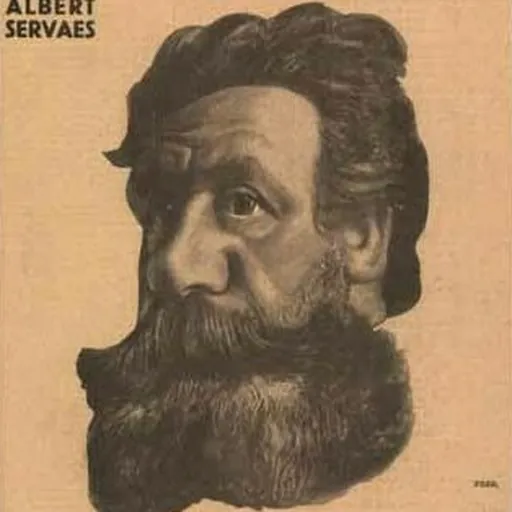
About Albert Servaes
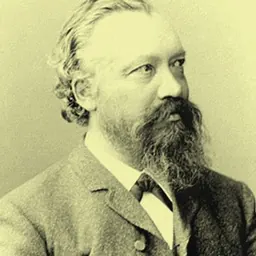
Lived 1883 – 1966 (aged 83). Albert Servaes was a Belgian and Swiss painter, artist, visual artist, draftsperson, illustrator and designer.
Albert Servaes (4 April 1883 – 19 April 1966) was a Belgian expressionist painter. He was associate with but not a member of the first Latem School of painting which focused on Mystical Realism. Servaes went in another artistic direction and became a founder of Belgian expressionism. He is known for his religious works, typically showing the suffering of Jesus Christ, which stirred a conflict within the Catholic Church. He also gained fame for his expressionist landscapes. After fleeing Belgium after World War II to escape retribution for collaborating with the German occupiers during the war, he lived in Switzerland and became a Swiss citizen.
Life and career Early career Albert Servaes was born in Ghent, Belgium in a middle class family engaged in retail activities. In line with his family's ambitions, he started his career as a travelling salesman for the family business. This did not stop him from painting from a young age and to look for opportunities to practice his art after working hours. He was mostly self-taught.
He moved in 1904 to the rustic village of Sint-Martens-Latem outside of Ghent. Here, a group of artists, later referred to as the first Latem School, had already taken up residence. The group included George Minne, Gustave van de Woestijne, Valerius De Saedeleer, and . The first Latem School comprised a group of artists which focused on mystical realism. This was a reaction to the Paris-based Impressionist art that had dominated the painting world for the previous half-century. From 1905 Servaes became interested in religion and mysticism while living in Sint-Martens-Latem and befriended members of a local church community. However, the subtle symbolism of the first Latem School did not appeal to Servaes and he chose another artistic path.
Servaes struggled to live off his paintings early in his career, but he gained fame and recognition in Ghent and Belgium during World War I. Several of his exhibitions near Ghent solidified his name in the regional art scene and allowed him to become financially secure.
Collaboration with the enemy and flight to Switzerland Before World War II, Servaes expressed his Flemish-nationalist feelings mainly through his art. He joined Verdinaso, a right wing authoritarian political party which had grown out of the Flemish Movement. During the German occupation, he openly showed his pro-German sympathies. He collaborated with the occupier in its control over the cultural life in Belgium. He was chairman of the Oost-Vlaamse Federatie voor Kunstenaars (East Flanders Federation of Artists) and a member of the Nederlandsche Kultuurkamer, an institution set up by the German occupier, which all artists, architects, writers, journalists, musicians, film actors and stage performers had to join in order to be allowed to work. He was also a member of the Duitsch-Vlaamsche Arbeidsgemeenschap (DeVlag) (German-Flemish Labor Community) which in May 1941 was incorporated in the occupier's SS structures.
In 1940, he led a delegation of Flemish artists to Germany were they met with the German propaganda minister Joseph Goebbels. After this trip to Germany, he thanked the "great cultural reformer Dr. Goebbels" in the name of his art brothers. On that occasion, he wished for Flanders "a leader with the genius of an Adolf Hitler (...) so that the Flemish-national socialist order may come here too". He also attended the German culture days in Cologne in May 1941, along with August Borms and Rob van Roosbroeck. Whereas in earlier letters he signed 'Heil Dinaso', from September 1941 he ended his letters with 'Heil Hitler'. He further participated in the Flemish-German culture days. He received favourable press releases and was able to participate in group exhibitions in Germany. He also made some clear pro-German statements and linked his art to the cultural propaganda of the New Order. The first postwar Servaes exhibition to be held in his home country in Bruges caused a stir as Evarist De Buck and some resistance groups protested vehemently against it by reason of the role he had played in the collaboration with the Germans.
Roman Catholic Church Controversy Servaes' 1919 Stations of the Cross of Luithagen was a collection of 14 charcoal drawings depicting religious figures, such as an emaciated Jesus Christ on the cross. These drawings depicted religious scenes in a raw and brutal expressionist style. The Catholic Church disapproved of this manner of depicting these scenes and as a result many of his works were removed from Belgian churches in 1921. In an effort to support and explore Servaes' spiritual vision, Dutch Carmelite friar Titus Brandsma had the images published in Opgang, a Catholic cultural magazine. Alongside each image, Brandsma added his own meditation. The controversy demonstrates how expressionist art was misunderstood at the time as the work was seen as distorting nature so as to lead away from beauty.
The fallout of the controversy left Servaes at a crossroads in his painting career. He focused on landscape paintings after the controversy and before World War II began. However, Servaes did not give up his grim exclusively-charcoal technique permanently. When he lived with the monks at Orval Abbey starting in 1927, he drew the residents there using his charcoal-expressionist style. By 1935, the public was more accepting of new art styles, and the monks commissioned Servaes to create a new series of the Stations of the Cross.
Don’t just read it —
keep it.
Full-length biographies made to live with: read them, listen on the way to work, watch them tonight.
- E-book
- Audio
- Video
Instant download · yours to keep · every purchase keeps this site free
Important facts
People in Albert Servaes's life
Named in this biography and alive at the same time


Related people
Same field, nearest in time

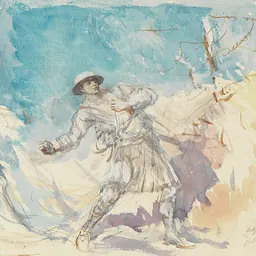
Contemporaries
People whose lives overlapped Albert Servaes's

Frequently asked questions
Who was Albert Servaes?
Belgian artist (1883-1966)
When was Albert Servaes born?
Albert Servaes was born on 4 April 1883 in Ghent.
When did Albert Servaes die?
Albert Servaes died on 19 April 1966 in Lucerne.
What was Albert Servaes's occupation?
Albert Servaes was a painter, artist, visual artist, draftsperson, illustrator and designer.
What nationality was Albert Servaes?
Albert Servaes was Belgian and Swiss.
Sources & further reading
Cite this page
APA: Biography.guide. (2026). Albert Servaes. https://biography.guide/albert-servaes/
MLA: "Albert Servaes." Biography.guide, https://biography.guide/albert-servaes/.
Chicago: "Albert Servaes." Biography.guide. https://biography.guide/albert-servaes/.
Data last updated: 2026-09-20 · Spot an error? Report a correction.
Portrait: Wikimedia Commons · author & licence
Page generated 2026-09-27 04:57 UTC