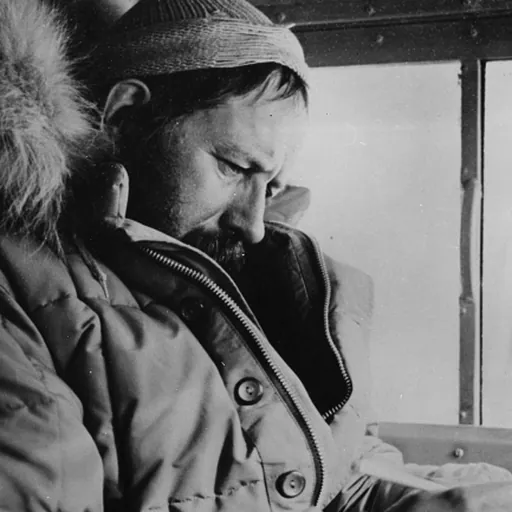
About Albert P. Crary
Lived 1911 – 1987 (aged 76). Albert P. Crary was an American glaciologist, geophysicist and earth scientist.
Albert Paddock Crary (July 25, 1911 – October 29, 1987), was an American pioneer polar geophysicist and glaciologist. The South Pole expedition set out from McMurdo Station on December 10, 1960, using three Snowcats with trailers. Crary was the seventh expedition leader to arrive at the South Pole by surface transportation (the six others before him were—in sequence—Amundsen, Scott, Hillary, Fuchs, a Russian expedition in 1959–60 from Vostok base, and Antero Havola). He was widely admired for his intellect, wit, skills and as a great administrator for polar research expeditions.
Biography Crary was born in 1911 into a farming family in northern New York State. He was the second oldest in a family of 7 children. He was a physics major and geology student at St. Lawrence University in Canton, New York. He graduated in 1931 Phi Beta Kappa from St. Lawrence University and then enrolled at Lehigh University to obtain a master's degree in physics. After spending years completing and facilitating research at both poles, Crary eventually settled in Bethesda, Maryland, with his wife and son.
Legacy In 1991, the National Science Foundation (NSF), which manages the U.S. Antarctic Program (USAP), honoured his memory by dedicating a state-of-the-art laboratory complex in his name, the Albert P. Crary Science and Engineering Center (CSEC) located in McMurdo Station. He was also honored by having the Crary Mountains (76 degrees 48' S, 117 degrees 40' W) and the Crary Ice Rise in Antarctica named for him as well.
Contributions Crary contributed in a variety of important ways to his field including:
Chief Scientist for Arctic T3, Fletcher's Ice Island, 1952–1955 Established the United States Geological Headquarters for the International Geophysical Year, 1955 Deputy Leader of United States science during the International Geophysical Year, 1957 Leader of the U.S. seismic traverse of Ross Ice Shelf, 1957–1958 Leader, geophysical traverse W from Little America V, up Skelton Glacier to the Victoria Land plateau and W along the 78 parallel to c. 13130E, 1958–1959 Leader, geophysical traverse from McMurdo Station via Skelton Glacier to the South Pole, 1960–1961 Chief Scientist, United States Antarctic Research Program, 1960–1968 Deputy then Director, Division of Environmental Sciences, National Science Foundation, 1969–1978 Member of ACAN, 1961–76 (Chairman, 1974–1976)
He worked with many notable scientists and famous institutions: Dr. Maurice Ewing of Columbia University and Woods Hole Oceanographic Institution Assisted Dr. James Peoples at MOGUL (Project Mogul) as the Field Operations Director using meteorological balloons to experiment with different types of equipment to collect and transmit sound waves in the upper atmosphere (Roswell incident- see Project Mogul)
Don’t just read it —
keep it.
Full-length biographies made to live with: read them, listen on the way to work, watch them tonight.
- E-book
- Audio
- Video
Instant download · yours to keep · every purchase keeps this site free
Important facts
People in Albert P. Crary's life
Named in this biography and alive at the same time

Related people
Same field, nearest in time




Contemporaries
People whose lives overlapped Albert P. Crary's






Frequently asked questions
Who was Albert P. Crary?
American geophysicist
When was Albert P. Crary born?
Albert P. Crary was born on 25 July 1911 in United States, Pierrepont.
When did Albert P. Crary die?
Albert P. Crary died on 29 October 1987 in Washington, D.C., George Washington University Hospital.
What was Albert P. Crary's occupation?
Albert P. Crary was a glaciologist, geophysicist and earth scientist.
What nationality was Albert P. Crary?
Albert P. Crary was American.
Sources & further reading
Cite this page
APA: Biography.guide. (2026). Albert P. Crary. https://biography.guide/albert-p-crary/
MLA: "Albert P. Crary." Biography.guide, https://biography.guide/albert-p-crary/.
Chicago: "Albert P. Crary." Biography.guide. https://biography.guide/albert-p-crary/.
Data last updated: 2026-09-20 · Spot an error? Report a correction.
Page generated 2026-09-27 05:09 UTC