
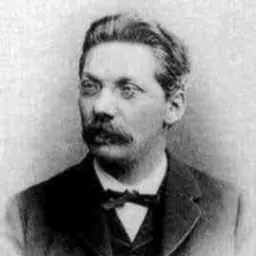
Albert Kluyver
Dutch botanist, microbiologist, and biochemist
About Albert Kluyver
Lived 1888 – 1956 (aged 67). Albert Kluyver was a Dutch botanist, biochemist, microbiologist, university teacher and bacteriologist.
Albert Jan Kluyver ForMemRS
Career In 1926, Kluyver and Hendrick Jean Louis Donker published the now classic paper, "Die Einheit in der Biochemie" ("Unity in Biochemistry"). The paper helped establish Kluyver's vision that, at a biochemical level, all organisms are unified. Kluyver famously expressed the idea with the aphorism: "From elephant to butyric acid bacterium – it is all the same". The paper, and other work from Kluyver's lab, helped support both the concept of biochemical unity as well as the idea of "comparative biochemistry", which Kluyver envisioned as biochemically equivalent to comparative anatomy. The concept established a theoretical basis for studying chemical processes in bacteria and extrapolating those processes to higher organisms.
The concepts of "biochemical unity" and "comparative biochemistry" were both very influential and probably Kluyver's most significant work. Kluyver's best known student, C. B. van Niel, commented on his mentor's scientific influence and noted that by the middle of the 20th century, his work on biochemical unity was no longer cited. His aphorism was sufficiently widespread that in 1961 François Jacob and Jacques Monod paraphrased it, without mentioning Kluyver, as "that old axiom 'what is true for bacteria is also true for elephants'" to justify the genetic code's universality. His career was profoundly influenced by World War II and the Nazi occupation of the Netherlands.
Awards and honours Kluyver is associated with the Delft school of microbiology where he was the successor to Martinus Beijerinck. He is considered the father of comparative microbiology. In 1953, he won the Copley medal.
In 1956, botanist Johannes P. Van der Walt published Kluyveromyces, which is a genus of ascomycetous yeasts in the family Saccharomycetaceae and named in Kluyver's honour. In 1981, the genus Kluyvera comprising bacteria from the former enteric group 8 was named after him.
The Royal Netherlands Society for Microbiology ([]) established an award named after him for microbiologists who have made an exceptional contribution to the field .
Don’t just read it —
keep it.
Full-length biographies made to live with: read them, listen on the way to work, watch them tonight.
- E-book
- Audio
- Video
Instant download · yours to keep · every purchase keeps this site free
Important facts
People in Albert Kluyver's life
Named in this biography and alive at the same time



Related people
Same field, nearest in time


Contemporaries
People whose lives overlapped Albert Kluyver's


Frequently asked questions
Who was Albert Kluyver?
Dutch botanist, microbiologist, and biochemist (1888-1956)
When was Albert Kluyver born?
Albert Kluyver was born on 3 June 1888 in Breda.
When did Albert Kluyver die?
Albert Kluyver died on 14 May 1956 in Delft.
What was Albert Kluyver's occupation?
Albert Kluyver was a botanist, biochemist, microbiologist, university teacher and bacteriologist.
What nationality was Albert Kluyver?
Albert Kluyver was Dutch.
Sources & further reading
Cite this page
APA: Biography.guide. (2026). Albert Kluyver. https://biography.guide/albert-kluyver/
MLA: "Albert Kluyver." Biography.guide, https://biography.guide/albert-kluyver/.
Chicago: "Albert Kluyver." Biography.guide. https://biography.guide/albert-kluyver/.
Data last updated: 2026-09-25 · Spot an error? Report a correction.
Page generated 2026-09-27 05:12 UTC