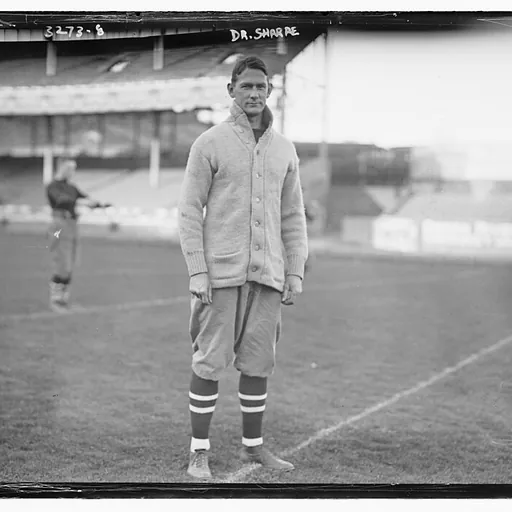
Albert Hayes Sharpe
American football player, coach, official; basketball coach, baseball player and coach; college athletics administrator
About Albert Hayes Sharpe
Lived 1877 – 1966 (aged 88). Albert Hayes Sharpe was an American basketball coach, american football player and physician.
Albert Hayes Sharpe (October 7, 1877 – May 17, 1966) was an All-American football player, coach and athletic director and medical doctor. He played football for Yale University and was selected as a halfback for the 1899 College Football All-America Team. Sharpe was also a star basketball player in the early years of the college game. Sharpe also excelled in baseball, gymnastics, rowing and track. In 1915, Sharpe was selected by one sporting expert as the greatest living athlete in the United States. He later served as a coach and administrator at Cornell University, Yale, the Ithaca School of Physical Education and Washington University in St. Louis.
Athlete at Yale
Football Sharpe began his athletic career as a student at the William Penn Charter School in Philadelphia. In 1899, he was selected as an All-American in football. On the gridiron, Sharpe's "end running and kicking thrilled Yale students." In an October 1900 game against Amherst, Sharpe had one of his best games. A contemporary newspaper account reported: "Sharpe was again the sensational hero of the game. He got Yale's first touchdown by a series of three runs that carried the ball for 85 yards. He got Yale's second touchdown when the first half was almost ended by a 95-yard run that set the grand stand wild."
Basketball pioneer Sharpe was also a pioneer of college basketball. Intercollegiate basketball did not gain traction until the 1900s, but Yale students organized a team in the 1890s. In February 1898, Sharpe led Yale's basketball team to a 27–7 win over New York's Knickerbocker Athletic Club. A newspaper account of the game praised Yale for its "signal work" in passing the ball from one to another without a hitch. Sharpe led all scorers with five goals including a halfcourt shot described as follows:"In the second half Sharp wound up the good work of his team by throwing a goal from the centre of the field on a backward pass from Lockwood. The ball sailed through the air and landed in the basket without touching anything. This was an unusual feat."
In January and February 1899, Sharpe played left forward and center on a Yale basketball team that played games against teams from the New Britain Athletic Club, the Fourth Separate Company of Yonkers, and Trinity College. In December 1899, Sharpe was elected captain of the Yale basketball team. On the day after Christmas 1899, Sharpe led the Yale basketball team on a road trip for a series of seven games against teams from the Midwest, including the Western University of Pennsylvania, Ohio State, a team made up from the Wisconsin Second Regiment of Fond du Lac, Wisconsin. After returning from the Western trip, Sharpe led Yale to a 30–10 victory over the Dreadnought Athletic Club—a New York team considered one of the best in basketball at the time.
All round athlete Sharpe also excelled in other sports. He was referred to in 1919 as "the best all around athlete Yale has produced, having won his varsity letter when at Yale, in three branches of sport—football, baseball and crew." In addition to football and basketball, Sharpe was also a fine baseball player and a skilled gymnast. In 1915, Dr. A.C. May, a noted athletic trainer, rated Sharpe as "the greatest living all round athlete today." May supported his selection as follows:"Look at him once and you will see the reason for his success. He is 6 feet, 1 inch tall and weights 196 pounds. He is evenly proportioned and owes his build, not to athletics, but in gymnastics, and he owed his athletic success not to his build so much as his ability to handle his body, which he developed in the gymnasium. He can handle himself on the bars and rings and other apparatus with as much skill as he can play football or other sports. He can turn a backward and forward flip and he knows the other tricks of a gymnast. ... Sharpe could row, run a fine relay, jump, put the shot, and, in fact, do about anything on the athletic field."
After completing his undergraduate studies, Sharpe attended Yale Medical School and became a medical doctor.
Athletic coach, administrator and official
In 1901, Sharpe accepted a position as the director of physical education at the William Penn Charter School.
During his time at William Penn, Sharpe remained active in college football, serving as an official at important college football games, including the Army–Navy Games. Sharpe also spoke out about various proposals to reform or change the rules of football. He was quoted as saying that young men in the United States needed football, because it was "the only game in which a gentleman can fight."
Sharpe also advocated relaxation on the rule against professionalism. In 1905, amid calls to rid college athletics of professionalism, Sharpe spoke in favor of allowing college baseball players to play summer baseball to earn some money. He proposed that "scholarship, not professionalism, should be the basis of eligibility tests."
Cornell In February 1912, Sharpe was hired by Cornell University where he served as the coach of the football, basketball and baseball teams. In 1915, he coached the first Cornell football team that ranked at the top of the Eastern schools.
Sharpe's six-year record as football coach at Cornell was 34–21–1. His best seasons at Cornell were the three years from 1914 to 1916, when the Big Red football teams were 23–4 and outscored opponents 709 to 177.
Yale In 1919, Sharpe returned to Yale as athletic director and football coach. Sharpe had built a reputation at Cornell as one of the country's best athletic coaches. The Washington Post reported on Sharpe's hiring as follows:"Yale undergraduates and alumni welcome the news that Dr. Albert Sharpe, long athletic coach at Cornell, will return to his alma mater after an absence of sixteen years. Sharpe has made a reputation since he became the dominant figure in Cornell athletics as the greatest all round coach in the country. ... Sharpe's appointment is in keeping with the new athletic .policy of the colleges and universities of the country. As the active director of major sports, he in reality will be a member of the faculty. Instead of being a seasonal coach he will be at New Haven the year round." After a disappointing 5–3 performance by the Yale football team in 1919, Sharpe was replaced as Yale's football coach by Tad Jones. Sharpe remained the athletic director until 1921.
Ithaca College In March 1921, Sharpe announced that he would resign as Yale's athletic director when his contract expired in June. After leaving Yale, Sharpe founded and served as the president of the Ithaca School of Physical Education, later part as Ithaca College. Sharpe remained at the Ithaca School of Physical Education from 1921 to 1927.
Washington University in St. Louis In 1928, Sharpe became the athletic director and head football coach at Washington University in St. Louis. When he was hired at Washington University, sports writer Lawrence Perry wrote: "No athletic director and coach coulc by any possibility have more friends pulling for him than this former Yale backfield star whose character is so outstanding that no young men ever came in contact with him without being better for it." In 1932, Pro Football Hall of Fame inductee Jimmy Conzelman replaced Sharpe as football coach, but Sharpe stayed on as the university's athletic director.
Later years In the 1930s, Sharpe was also the president of the Touchdown Club, an organization of former football players, and an executive with the Red Cross. Sharpe lived in East Aurora, New York in his later years. He died at Buffalo General Hospital in 1966 at age 88.
Head coaching record
Don’t just read it —
keep it.
Full-length biographies made to live with: read them, listen on the way to work, watch them tonight.
- E-book
- Audio
- Video
Instant download · yours to keep · every purchase keeps this site free
Important facts
People in Albert Hayes Sharpe's life
Named in this biography and alive at the same time



Related people
Same field, nearest in time

Contemporaries
People whose lives overlapped Albert Hayes Sharpe's




Frequently asked questions
Who was Albert Hayes Sharpe?
American football player, coach, official; basketball coach, baseball player and coach; college athletics administrator (1877-1966)
When was Albert Hayes Sharpe born?
Albert Hayes Sharpe was born on 7 October 1877.
When did Albert Hayes Sharpe die?
Albert Hayes Sharpe died on 17 May 1966 in Buffalo.
What was Albert Hayes Sharpe's occupation?
Albert Hayes Sharpe was a basketball coach, american football player and physician.
What nationality was Albert Hayes Sharpe?
Albert Hayes Sharpe was American.
Sources & further reading
· Wikipedia: Albert Hayes Sharpe
· DBpedia: Albert Sharpe (American football)
Cite this page
APA: Biography.guide. (2026). Albert Hayes Sharpe. https://biography.guide/albert-hayes-sharpe/
MLA: "Albert Hayes Sharpe." Biography.guide, https://biography.guide/albert-hayes-sharpe/.
Chicago: "Albert Hayes Sharpe." Biography.guide. https://biography.guide/albert-hayes-sharpe/.
Data last updated: 2026-09-22 · Spot an error? Report a correction.
Portrait: Wikimedia Commons · author & licence
Page generated 2026-09-27 05:01 UTC