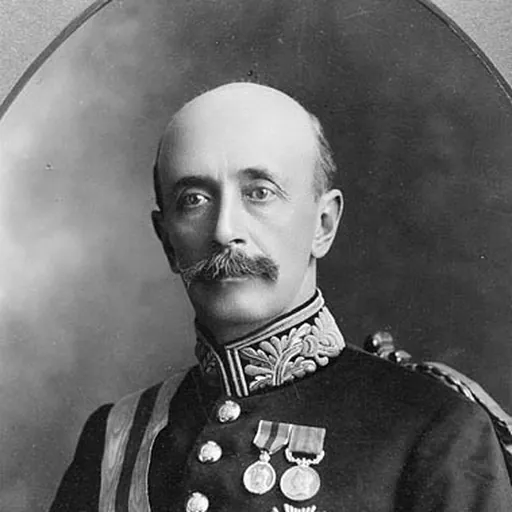
Albert Grey, 4th Earl Grey
British politician and Governor General of Canada
About Albert Grey, 4th Earl Grey
Lived 1851 – 1917 (aged 65). Albert Grey, 4th Earl Grey was a British politician, association football player and aristocrat.
Albert Henry George Grey, 4th Earl Grey (28 November 185129 August 1917) was a British peer and politician who served as Governor General of Canada from 1904 to 1911, the ninth since Canadian Confederation. He was a radical Liberal aristocrat and a member of a string of liberal high society clubs in London. An active and articulate campaigner in late Victorian England, he was associated with many of the leading Imperialists seeking change.
Albert Grey was born into a noble and political family, though at birth not in direct line to inherit the earldom. His father, General Charles Grey, was a younger brother of the 3rd Earl, who died without issue. As General Grey was deceased, the titles descended to his eldest living son Albert, then in his forties. Albert was educated at Harrow School before going up to Trinity College, Cambridge, where he graduated MA and LLM. His grandfather was the 2nd Earl Grey, who served as prime minister of the United Kingdom in the 1830s, whose name is connected to Earl Grey tea.
In 1878, Albert Grey entered into politics as a member of the Liberal Party and, after relinquishing a tied vote to his opponent, eventually won a place in the British House of Commons in 1880. In 1894 Grey inherited an earldom from his uncle, the third Earl, and thereafter took his place in the House of Lords, while simultaneously undertaking business ventures around the British Empire as Director of the British South Africa Company from 1898, he managed a steep learning curve during high level tension between the colonial administration and Boers, prior to the outbreak of the Second Boer War. As administrator in Rhodesia he was directly responsible to Cecil Rhodes for conduct of the colony's business from 1894 to 1897. On his return in 1899 he was appointed Lord Lieutenant of his native Northumberland.
Grey was appointed as Governor General of Canada by King Edward VII in 1904, on the recommendation of Prime Minister of the United Kingdom Arthur Balfour, to replace the Earl of Minto as viceroy and occupied that post until succeeded by Prince Arthur, Duke of Connaught and Strathearn, in 1911. Grey travelled extensively in Canada and was active in Canadian political affairs, including efforts to secure national unity. He built several legacies, the most prominent being the Grey Cup awarded to the national champion of Canadian football.
Youth, education, and early career
Grey was the younger and only surviving son of General Sir Charles Grey—a younger son of former British prime minister the second Earl Grey and later the private secretary to Prince Albert and later still to Queen Victoria—and his wife, Caroline Eliza Farquhar, eldest daughter of Sir Thomas Harvie Farquhar, Bt. He was born at Cadogan House, Middlesex. Many members of the family had enjoyed successful political careers based on reform, including to colonial policies; Grey's grandfather, while prime minister, championed the Reform Act 1832 and in 1846, Grey's uncle, the third Earl Grey, as Secretary of State for War and the Colonies during the first ministry of Lord John Russell, was the first to suggest that colonies should be self-sustaining and governed for the benefit of their inhabitants, instead of for the benefit of the United Kingdom.
Grey was educated at Harrow School and then Trinity College, Cambridge, where he studied history and law. After graduating in 1873, Grey became private secretary to Sir Henry Bartle Frere and, as Frere was a member of the Council of India, Grey accompanied Prince Albert Edward, Prince of Wales, on his tour of India. In 1877, Grey married Alice Holford, daughter of Robert Stayner Holford, the Member of Parliament for East Gloucestershire. Together, they had five children, one of whom died in early childhood. It was not until the general election of 1880 that Grey, the Liberal Party candidate, was elected as a member of parliament (MP) for South Northumberland, a seat he held until it was replaced under the Redistribution of Seats Act 1885 and he moved to be the MP for Tyneside, following that year's election. In 1884 he wrote to the Manchester-based Women's Suffrage Journal declaring his support for women's suffrage, writing that "here are no questions which receive so little attention, or which, in my opinion, so urgently call for the close and serious consideration of social reformers, as those affecting the condition of women. The possession of a vote by women who are heads of households will lead to the formation of associations and unions for the protection and advancement of the interests of their sex."
Another reform he supported was electoral reform, favouring proportional representation and Single transferable voting. He was active in the Proportional Representation Society of Britain. (At the time of his passing, he was its president). He organised a model STV election in Northumberland in 1885, remarkably using untrained coal miners as staff to conduct it successfully.
Inspired by the theories of Giuseppe Mazzini, Grey became an advocate of imperialism and was one of the founders of the Imperial Federation League, which sought to transform the British Empire into an Imperial Federation. Grey thus split with Prime Minister William Gladstone in 1886 over Irish home rule and became a Liberal Unionist, but the shift was short-lived as Grey failed to retain his seat in the 1886 general election.
Eight years later, in October 1894, Hubert Hervey, who was killed in the Second Matabele War.
Governor General of Canada
In office On 4 October 1904 announcement made that King Edward VII had, by commission under the royal sign-manual and signet, approved the recommendation of his British prime minister, Arthur Balfour, to appoint Grey as his representative to Canada, replacing Grey's brother-in-law, the Earl of Minto. (Minto was married to Grey's sister, Mary Caroline Grey.) The appointment came at a good time for Grey, as a series of failed investments in South Africa had left him penniless; a gift from his wife's aunt, Lady Wantage (widow of the Lord Wantage), was used to supplement his salary as governor general.
On 16 June 1905 Grey was designated as "Governor General of Canada and Commander-in-Chief of the Dominion of Canada," which followed on the passing of the Militia Act in 1904. At the request of Sir Robert Baden-Powell, Grey also undertook the role of Chief Scout of Canada.
During the time Grey occupied the viceregal office (1904–1911) Canada experienced large-scale immigration, industrialisation, and economic development, and secured increased independence from the United Kingdom. The Governor General, writing to the King at the time, stated "[each one] a new leaf in Your Majesty's Maple Crown."
As Governor General, he travelled extensively around the growing country. He journeyed abroad to the Dominion of Newfoundland (then not yet a part of Canada) and several times to the United States to visit President Theodore Roosevelt, with whom Grey developed a strong bond. His past calls for political equality for Irish Catholics were relevant to Canada's internal politics, divided as the population was between Catholics and Protestants, Francophones and Anglophones. Shortly after his installment as Governor General, his office sent out inquiries to provincial legislatures as to what legislative measures had been taken on the principle of PR.
As governor General, Grey also encouraged his prime minister, Sir Wilfrid Laurier, to support the Imperial Federation he had long championed, but Laurier was uninterested. Grey suggested the construction of a railway hotel in the federal capital - the outcome was the palatial Château Laurier, completed in 1912.
Legacy
Throughout his tenure as governor general, Grey supported the arts and, when he departed Canada in 1911, he left behind him the Grey Competition for Music and Drama, first held in 1907. Grey also donated trophies to the Montreal Horse Show and for figure skating. and added a study and conservatory to Rideau Hall, the sovereign's and governor general's Ottawa residence; the latter was torn down in 1924.
4. Public House Trust [temperance refreshment houses], which is "a necessary adjunct to the first two items of his programme."
On 28 March 1916, he was appointed by King George V as Chancellor of the Order of St. Michael and St. George.
Grey died in August 1917 at his family residence. (On his deathbed, he penned a "stirring" letter to the editor of the London Times on the need to retain the adoption of proportional representation in the Electoral Reform Bill, being debated by British Parliament at the time.)
Family
Grey married Alice Holford (d. 22 September 1944), daughter of Robert Stayner Holford, of Westonbirt House (Gloucestershire) and Dorchester House (London) on 9 June 1877 and had five children, one of whom died in early childhood: Lady Victoria Mary Sybil Grey (9 June 1878 – 3 February 1907) married Lt-Col. Arthur Morton Grenfell, of Wilton Park in 1901, and had children. Charles Robert Grey, 5th Earl Grey (15 December 1879 – 2 April 1963), who had two daughters by his wife Lady Mabel Laura Georgiana Palmer, daughter of William Palmer, 2nd Earl of Selborne. The elder daughter Mary (1907–2002) married the 1st Baron Howick of Glendale. Lady Sybil Grey (15 July 1882 – 4 June 1966) O.B.E. married Lambert William Middleton (1877–1941) of Lowood House, Melrose, Scottish Borders, nephew of Sir Arthur Middleton, 7th Baronet and Frederick Edmund Meredith. She was invested as an Officer, Order of the British Empire in 1918, having served as the Commandant of the Dorchester House Hospital for Officers. She was well known for her work with the Red Cross in Russia during WWI, and for her work with tuberculosis sufferers (founding the Lady Grey Society). She was an amateur photographer and filmmaker of note, and recorded village life at Darnick and St. Boswells. After her husband died she sold Lowood House and moved to Burley, Hampshire. They had a son and a daughter. Lady Evelyn Alice Grey (14 Mar 1886–15 Apr 1971) married Sir Lawrence Evelyn Jones, 5th Bt. M.C., grandson of Sir Willoughby Jones. Lady Lillian Winifred Grey (11 June 1891 – 7 April 1895)
Ancestry
Honours
Appointments 13 March 189922 January 1901: Her Majesty's Lieutenant and Custos Rotulorum of the County of Northumberland 22 January 190113 December 1904: His Majesty's Lieutenant and Custos Rotulorum of the County of Northumberland 28 March 191629 August 1917: Chancellor of the Most Distinguished Order of Saint Michael and Saint George (KCMG) 29 June 190929 August 1917: Member of His Majesty's Most Honourable Privy Council (PC) 3 March 191029 August 1917: Knight of Grace of the Most Venerable Order of the Hospital of Saint John of Jerusalem (KStJ) 18 March 191029 August 1917: Honorary Colonel of the Northumberland Fusiliers 6th Battalion 23 October 191129 August 1917: Knight Grand Cross of the Most Honourable Order of the Bath (GCB)
Medals 1902: King Edward VII Coronation Medal 1911: King George V Coronation Medal
Honorary military appointments 10 December 190413 October 1911: Colonel of the Governor General's Horse Guards 10 December 190413 October 1911: Colonel of the Governor General's Foot Guards 10 December 190413 October 1911: Colonel of the Canadian Grenadier Guards
Honorific eponyms
Geographic locations Saskatchewan: Earl Grey British Columbia: Mount Earl Grey British Columbia: Earl Grey Pass
Schools Manitoba: Earl Grey Public School, Winnipeg Saskatchewan: Earl Grey School, Earl Grey Ontario: Earl Grey Senior Public School, Toronto
Arms
Don’t just read it —
keep it.
Full-length biographies made to live with: read them, listen on the way to work, watch them tonight.
- E-book
- Audio
- Video
Instant download · yours to keep · every purchase keeps this site free
Important facts
Family & relationships
People in Albert Grey, 4th Earl Grey's life
Named in this biography and alive at the same time








Related people
Same field, nearest in time


Contemporaries
People whose lives overlapped Albert Grey, 4th Earl Grey's


Frequently asked questions
Who was Albert Grey, 4th Earl Grey?
British politician and Governor General of Canada (1851-1917)
When was Albert Grey, 4th Earl Grey born?
Albert Grey, 4th Earl Grey was born on 28 November 1851 in St James's Palace.
When did Albert Grey, 4th Earl Grey die?
Albert Grey, 4th Earl Grey died on 29 August 1917 in London.
What was Albert Grey, 4th Earl Grey's occupation?
Albert Grey, 4th Earl Grey was a politician, association football player and aristocrat.
What nationality was Albert Grey, 4th Earl Grey?
Albert Grey, 4th Earl Grey was British.
Sources & further reading
· Wikipedia: Albert Grey, 4th Earl Grey
· DBpedia: Albert Grey, 4th Earl Grey
Cite this page
APA: Biography.guide. (2026). Albert Grey, 4th Earl Grey. https://biography.guide/albert-grey-4th-earl-grey/
MLA: "Albert Grey, 4th Earl Grey." Biography.guide, https://biography.guide/albert-grey-4th-earl-grey/.
Chicago: "Albert Grey, 4th Earl Grey." Biography.guide. https://biography.guide/albert-grey-4th-earl-grey/.
Data last updated: 2026-09-22 · Spot an error? Report a correction.
Portrait: Wikimedia Commons · author & licence
Page generated 2026-09-27 05:01 UTC