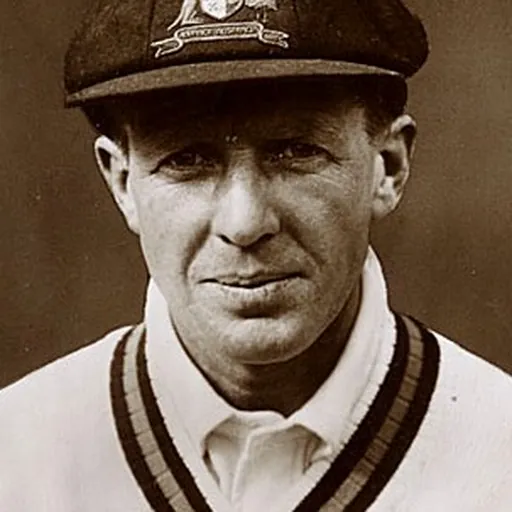
About Alan Kippax
Lived 1897 – 1972 (aged 75). Alan Kippax was an Australian cricketer.
Alan Falconer Kippax (25 May 1897 – 5 September 1972) was a cricketer for New South Wales (NSW) and Australia. Regarded as one of the great stylists of Australian cricket during the era between the two World Wars, Kippax overcame a late start to Test cricket to become a regular in the Australian team between the 1928–29 and 1932–33 seasons. A middle-order batsman, he toured England twice, and at domestic level was a prolific scorer and a highly considered leader of NSW for eight years. To an extent, his Test figures did not correspond with his great success for NSW and he is best remembered for a performance in domestic cricket—a world record last wicket partnership, set during a Sheffield Shield match in 1928–29. His career was curtailed by the controversial Bodyline tactics employed by England on their 1932–33 tour of Australia; Kippax wrote a book denouncing the tactics after the series concluded.
Kippax was an "impeccably correct and elegant batsman, [with] an upright, easy stance at the wicket; like his schoolboy idol Victor Trumper, he rolled his sleeves between wrist and elbow and excelled with the late cut", who was probably at his peak during the 1920s. His omission from the 1926 team to tour England caused great controversy at the time—especially as he hit a brilliant 271 not out against Victoria on the eve of selection. Kippax was well into his thirties by the time he became a consistent selection for the Test team. Highly regarded by both fellow players and spectators, Kippax's innings of 83 in the Lord's Test of 1930 induced Neville Cardus to comment that, "he pleased the eye of the connoisseur all the time."
Early years The third son of Arthur Percival Howell Kippax and his wife Sophie Estelle (née Craigie), Alan Kippax was born in the inner-city Sydney suburb of Paddington. At this stage, first-class cricket was suspended because of World War I, but when competition resumed in the 1918–19 season he made his debut for New South Wales (NSW). However, the state possessed much batting talent, which was supplemented by the return to Australia of the Australian Imperial Forces cricket team that played in England after the armistice. In the 1922–23 season, Kippax became a regular for NSW, scoring 631 runs at 90.14. and led the side's first-class averages. The next season, he hit 248 in only 316 minutes against South Australia at the Sydney Cricket Ground (SCG), then toured New Zealand with the NSW team skippered by Charlie Macartney. Kippax made two centuries in his 461 runs (average 92.2) on the tour.
He quickly won the respect of his fellow players and the spectators for his approach to the game. Alan McGilvray describes Kippax's demeanour and presence on the field: ... meticulous in his dress and his life, a man with a squeaky-clean image who would never raise his voice or allow his emotions to run away with him ... His shirt would always be buttoned the same way, the crease would always be sharp in his trousers, no hair would ever be out of place. He was an admirable engaging man.
Journalists employed many superlatives to describe the Kippax style. Ray Robinson thought that Kippax's batting "had a silky quality not seen in any other player of his time or since"; he captivated the crowds with his late cut when he, "made a lissom bow over the ball and stroked it away with the bat's face downward, as if to squeeze the ball into the ground". His favourite hook shot propelled the ball "with such unhurried ease that the punishing power of the stroke was revealed only in the way the ball smacked against the fence." Donald Bradman believed him to be the best exponent of the hook shot in the game.
International career Kippax plays his famed late cut shot against Clarrie Grimmett in a Sheffield Shield match at the SCG. Kippax began the 1924–25 summer with 115 for NSW against an Australian XI at the SCG. In the Sheffield Shield he had scores of 127, 122 and 31, 212 not out and 40, earning him a first Australian cap (at the age of 27) in the final Test of the Ashes series against England at Sydney. Sharing a 105 run partnership with Bill Ponsford in the first innings, Kippax impressed with a score of 42 from number seven. Wisden commented that the partnership "turned the fortunes of the game", and Australia went on to victory.
Shock omission Another 585 runs at 83.57 in the 1925–26 season looked likely to win Kippax a place in the team to tour England in 1926. He failed in the Test-trial match staged in early December, but made the highest score of the Sheffield Shield competition, 271 not out (in 423 minutes) against Victoria at the SCG, which effectively steered NSW to the title. The subsequent omission of Kippax from the touring team is a famous blunder in Australian cricket history. His omission is usually attributed to "interstate parochialism" and was a "triumph of dullness over batting artistry." thus creating an opportunity for Kippax.
Captain of NSW Installed as leader of NSW, Kippax earned a reputation as one of Australia's leading batsmen over the next three years. His captaincy "welded with wit, kindness and some practical joking a raw team into a formidable unit, nurturing such youngsters as Archie Jackson, Stan McCabe and (Sir) Donald Bradman". Kippax ended the season with 926 runs at an average of 84.18.
The Test selectors still had Kippax under consideration and during March 1928, he again toured New Zealand with an Australian second team, but failed to pass 40 in the seven innings he played. Restored to the Test team for the beginning of the 1928–29 Ashes series, Kippax made just 50 runs in four innings. Australia slipped to two heavy defeats and Kippax's place was not in jeopardy.
During the second Test at Sydney, Kippax was the central figure in the most controversial incident of the summer. Early in Australia's first innings, Kippax had nine runs on the board, when:
At the conclusion of the Test, Kippax travelled to Melbourne where he led NSW in a Sheffield Shield match beginning on 22 December. At stumps on the second day, NSW was staring at defeat as they were seven for 58 in pursuit of Victoria's first innings of 376. When play resumed on Christmas Day, NSW slipped to nine for 113, with Kippax 20 not out. However, the number eleven batsman Hal Hooker stuck with his captain as the score gradually mounted and the opposition's frustrations grew. By the end of play, Kippax was well beyond his double century. The following day, when the stand was finally broken after 307 runs had been added in 304 minutes, Kippax stood on 260 not out. This "most remarkable of all world batting records," still stands today as the highest last-wicket partnership in first-class cricket.
Retaining his place for the third Test that started just days later on the same ground, Kippax maintained his superb form and hit his maiden Test century in Australia's first innings. With Australia struggling against the pace of England's Harold Larwood, Kippax steadied the innings and then launched an assault on Larwood, hooking him for four boundaries. Journalist Ray Robinson pointed out that before Kippax's flurry of fours, Larwood had taken 14 wickets at 18.3 runs in the series. After, he managed only four wickets for 472 runs. Nevertheless, Kippax had another outstanding domestic season in 1929–30, hitting four centuries in his 744 runs, at an average of 62. This time, he was one of the first picked to go to England.
Test regular
The 1930 tour of England was dominated by the emergence of Don Bradman. Kippax finished second to Bradman in the first-class averages and aggregates, scoring 1451 runs at 58.04. He hit a century in each innings of the match with Sussex. In the Tests, Kippax passed fifty four times in seven innings, without going on to a hundred. He shared two big partnerships with Bradman: 192 in the second Test at Lord's and 229 in the third Test at Leeds. However, Wisden rated his 64 not out on a wet wicket in the first Test at Nottingham as his best effort and summarised his tour thus: Essentially a stylist, Kippax was in every sense a great batsman, for he could suit his game to the needs of the occasion. A beautiful driver to the off, he cut at times in delightful fashion, the slower wickets of England affecting his abilities in that direction in only the slightest degree. In the 1930–31 home series against the West Indies, Kippax began with what was to be his highest score in Test cricket (146 in under four hours) in the first Test at the Adelaide Oval. This was the first Test century in matches between the two teams. He made 84 in the third Test at Brisbane, sharing a partnership of 193 with Bradman. However, Wisden called Kippax's knock "unsteady" and he failed in his remaining three Test innings. For NSW, he hit two centuries in the Sheffield Shield.
The next season began badly for Kippax. Playing in a minor match at Parkes (in rural NSW) on a matting wicket, he had his nose broken by a delivery that bounced erratically – it hit a peg accidentally left under the mat when it was laid out. On 6 November 1931, during NSW's first match of the season at Brisbane, he was struck a severe blow to the temple by a rising ball from fast bowler Pud Thurlow. Taken to hospital, he retired from the match, but was selected for the first Test against South Africa, but scored only one run. He missed the second Test through injury, while his replacement Keith Rigg scored an impressive century on debut.
Kippax came back for the third Test at Melbourne and rewarded the faith of the selectors by scoring 52 and 67, his two highest first-class innings of the season. However, his best knock of the summer came on another rain-affected pitch at Melbourne in the final Test. He batted "serenely" to top score with an elegant 42. As compensation for his lack of runs, Kippax led NSW to victory over Victoria in late January, which clinched the Sheffield Shield title for the state. During the winter of 1932, Kippax joined a private team that toured Canada and the USA, a tour organised by ex-Test bowler Arthur Mailey. Teammates noticed that his confidence was shaken by the blows to the head, and he no longer employed his famous hook shot. Bodyline was used against all the Australian batsmen. Kippax and the other Australian batsmen were adept at playing long innings and supporting Bradman in big partnerships—in Tests, Kippax had, in the past, featured in three stands of over 100 with Bradman—so the English were looking to undermine his confidence as well. Selected for the first Test at Sydney, Kippax looked very uncomfortable in losing his wicket twice to the spearhead of the Bodyline attack, Harold Larwood. After batting at number four in the first innings, Kippax was demoted to bat behind his NSW understudy Stan McCabe in the second innings; McCabe had scored a brilliant 187 not out in the first innings, defying Bodyline with aggressive hook shots. Irrespective of the change, Australia collapsed for 164, leaving England needing just one run for victory in their second innings. In the dressing room, Kippax commented of Larwood, "he's too bloody fast for me". Larwood was more succinct: "Kippax was scared stiff and he let you see it". Employed as a radio commentator, Kippax spent the remainder of the series covering the Tests, and he also delivered a ten-minute round up of each day's play for the BBC, broadcast in England through its Empire short wave service.
Outspoken in his criticism of Bodyline, Kippax combined with the cricketer and physician Eric Barbour to write the book Anti Body-Line, released just months after the tour ended. A short, polemical work aimed at an English readership, the book warned of the danger to the game if Bodyline was allowed as a legitimate tactic. Although the book kept the controversy raging, it was "calmly expressed' and "reasonable".
After several seasons of struggling for runs, Kippax returned to form in 1933–34. Against Queensland at New Year, he hit 125 and shared a stand of 363 in only 135 minutes with Bradman. Altogether, he made four centuries and averaged almost 72 to earn selection for the 1934 tour of England. Passed over for the vice-captaincy of the team in favour of Bradman, Kippax had the confidence of knowing that the Australian Board of Control had reached an agreement with the MCC that the Australians would not have to face Bodyline during the tour.
Final tour Beginning the tour with a duck, Kippax recovered with 89 at Leicester before contracting a heavy dose of influenza that forced him to miss the next four matches. On his return, he struggled for form, and was not chosen for the first Test. Kippax was the third selector on tour, and was out-voted by his fellow selectors, so the press speculated that the decision caused disharmony within the team. Australia won the game and Kippax failed in the next two tour matches, so he missed out on the next Test at Lord's, which was lost.
Struck down by serious illness again, Kippax was hospitalised with a (wrongly) suspected case of diphtheria and forced to miss the drawn Tests at Old Trafford and Leeds. His 6,096 runs (at 70.06) for NSW in Sheffield Shield matches contributed to five title-winning campaigns. In addition to his 12,792 first-class runs, Kippax scored over 7,000 runs at an average of 53 for his grade club Waverley.
Kippax captained NSW in 45 first-class matches, winning 19, drawing 17 and losing only nine.
Personal life After a period working as a clerk, Kippax opened a sports store in Martin Place, Sydney during 1926. It became a very profitable business. Two years later, on 20 April 1928 at St Stephen's Presbyterian Church, he married Mabel Charlotte Catts. The New South Wales Cricket Association elected him a life member in 1943–44. In later years, Kippax was an A-grade golfer at The Lakes course in Sydney and a club champion lawn bowler at Double Bay. He was as elegant off the field as he was on; the cricket writer David Frith recorded that, "to visit him in his Bellevue Hill home was to be transported into a calm 1930s world of silk smoking jacket, cigarette holder and art deco trimmings." Kippax died of heart disease at his home in Bellevue Hill on 5 September 1972. Kippax Fair in the Canberra suburb of Holt is named after him.
Don’t just read it —
keep it.
Full-length biographies made to live with: read them, listen on the way to work, watch them tonight.
- E-book
- Audio
- Video
Instant download · yours to keep · every purchase keeps this site free
Important facts
People in Alan Kippax's life
Named in this biography and alive at the same time





Related people
Same field, nearest in time


Contemporaries
People whose lives overlapped Alan Kippax's


Frequently asked questions
Who was Alan Kippax?
Australian cricketer (1897-1972)
When was Alan Kippax born?
Alan Kippax was born on 25 May 1897 in Paddington.
When did Alan Kippax die?
Alan Kippax died on 5 September 1972 in Bellevue Hill.
What was Alan Kippax's occupation?
Alan Kippax was a cricketer.
What nationality was Alan Kippax?
Alan Kippax was Australian.
Sources & further reading
Cite this page
APA: Biography.guide. (2026). Alan Kippax. https://biography.guide/alan-kippax/
MLA: "Alan Kippax." Biography.guide, https://biography.guide/alan-kippax/.
Chicago: "Alan Kippax." Biography.guide. https://biography.guide/alan-kippax/.
Data last updated: 2026-09-23 · Spot an error? Report a correction.
Portrait: Wikimedia Commons · author & licence
Page generated 2026-09-27 05:08 UTC