
About Charlie Macartney
Lived 1886 – 1958 (aged 72). Charlie Macartney was an Australian cricketer.
Charles George Macartney (27 June 1886 – 9 September 1958) was an Australian cricketer who played in 35 Test matches between 1907 and 1926. He was known as "The Governor-General" in reference to his authoritative batting style and his flamboyant strokeplay, which drew comparisons with his close friend and role model Victor Trumper, regarded as one of the most elegant batsmen in cricketing history. Sir Donald Bradman—generally regarded as the greatest batsman in history—cited Macartney's dynamic batting as an inspiration in his cricket career.
He started his career as a bowling all-rounder. He made his Test debut in 1907, primarily as a left arm orthodox spinner who was considered to be a useful lower-middle order right-hand batsman. As Macartney was initially selected for his flexibility, his position in the batting order was frequently shuffled and he was largely ineffective. His most noteworthy Test contribution in his early career was a match-winning ten wicket haul at Headingley in 1909, before being dropped in the 1910–11 Australian season. It was around this time that Macartney befriended Trumper and began to transform himself from a bowler who batted in a defensive and technically correct manner, into an audacious attacking batsman. He reclaimed his Test position and made his maiden Test century in the same season, before establishing himself as the leading batsman in the team.
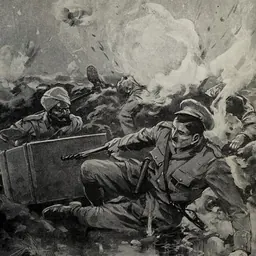
The First World War stopped all first-class cricket and Macartney enlisted in the Australian Imperial Force. Upon the resumption of cricket, Macartney stamped himself as one of the leading batsmen in the world with his performances during the 1921 Ashes tour. Macartney produced an Australian record score in England of 345 against Nottinghamshire. The innings was the fastest triple century in first-class cricket and the highest score made by a batsman in a single day of play. He reached 300 in 205 minutes and the innings took less than four hours. Macartney topped the batting averages and run-scoring aggregates, which saw him named as one of the five Wisden Cricketers of the Year in 1922. Wisden said that he was, "by many degrees the most brilliant and individual Australian batsman of the present day". After missing the 1924–25 series due to mental illness or a recurrence of war injuries, Macartney departed international cricket at the peak of his powers on the 1926 tour of England. He became the second Australian to score a century in the first session of a Test match, and did so on a sticky wicket conducive to bowling. This was part of a sequence of three consecutive Test centuries as he led the batting charts. Macartney was posthumously inducted into the Australian Cricket Hall of Fame in 2007.
Style
Macartney's flair was compared to that of Victor Trumper, and his determination to that of Don Bradman, who is generally regarded as the finest batsman in cricketing history.
Macartney was a short man, standing 160 cm (5" 3). When batting, he would unconventionally attempt to leg glance yorkers pitched on middle stump down to fine-leg, and often lost his wicket in so doing. He was known for preferring his team-mates to give him candid criticism rather than praise. Sir Neville Cardus wrote that "there was always chivalry in his cricket, a prancing sort of heroism. The dauntlessness of his play, the brave beauty and the original skill bring tears to my eyes yet." "Those sentiments", wrote former Australian Test batsman Jack Fingleton, "summed up the cricket story of C. G. Macartney". The famed cricket writer RC Robertson-Glasgow said
As a bowler, Macartney delivered the ball at a relatively fast pace for a left-arm orthodox spinner, comparable in speed to Derek Underwood.
In 1909, Australian team-mate Trumper moved from Paddington, a suburb on Sydney's south shore to Chatswood on the northern side of the harbour, where Macartney lived. Macartney and Trumper played together for Gordon Cricket Club on the north shore and became close friends. Macartney regularly practised on the Trumper family's backyard turf pitch. Trumper's relocation made more frequent meetings possible, since the Sydney Harbour Bridge was not to open until 1932, and the only way of travelling between either side of the bay was by ferry. Trumper was regarded as the "crown prince of the golden age of cricket", Macartney revered Trumper as both a cricketer and a person, and was to be a pall bearer when Trumper died in 1915 at the age of 37.
Early years Macartney was born on 27 June 1886 in West Maitland, New South Wales, son of Joseph Belton Macartney, house-painter and later motor mechanic, and his wife Mary Anne, nee Moore. He was taught to play cricket as a child by his maternal grandfather George Moore, a slow roundarm bowler who represented New South Wales in three first-class matches against Victoria. The equipment consisted of small hand-crafted bat made from cedar, and apples from the family orchard used as balls. It was during his school career that Macartney was noticed by incumbent Australian captain Monty Noble, who heaped praise on him in a newspaper article. At this stage in his career, he possessed a copybook technique and defensive style, something he was to discard for an audacious, self-styled and attacking outlook.
In 1902, Macartney joined North Sydney Cricket Club in the first division of Sydney Grade Cricket and then moved to the Gordon club in the outer northern suburbs when it was formed during the 1905–06 season. He played regularly for Gordon until 1933–34 when he was 47, amassing 7648 runs at an average of 54.62. He was known for his dominant status at the Chatswood Oval. In one match, he lofted a ball out of the ground, over the railway line and onto a lawn bowling green, forcing the players to take evasive action. He took one wicket, that of leading English batsman Wilfred Rhodes. He returned to the middle order in the second innings to score 54 and took a total of 1/55 as England squared the series with a narrow one wicket victory. He tasted victory, with Australia taking the series 4–0. His highest score of the season was 96 against England in a later match for New South Wales. The hosts were 12 runs short of victory with one wicket in hand when time ran out. Largely due to his efforts at Headingley, his bowling figures were more impressive; he ended the Tests with 16 wickets at 16.13. The period was unsuccessful for Otago—all three matches were lost—but Macartney was prolific as an individual. He took match figures of 7/68 against Canterbury and 7/81 in the first innings of a game against Australia, removing Test teammates Warwick Armstrong and Warren Bardsley. as Australia completed a seven-wicket win.
Omission and recall in 1912
Macartney's omission was part of the most infamous disputes in Australian cricket history and led to a fracas. Australian captain and selector Clem Hill wanted to include Macartney for the Third Test, but another member of the panel, former player Peter McAlister objected and said that Hill should omit himself if he wanted Macartney to play. Tensions between the two selectors were high, and came to a head in a selection meeting ahead of the Fourth Test. McAlister criticised Hill's tactics and policies towards his bowlers, provoking an exchange of insults regarding the other's leadership ability. Hill then bloodied McAlister with a powerful blow to the nose and the ensuing brawl lasted between 10 and 20 minutes.
Macartney then toured England for the 1912 Triangular Test Tournament, which also included South Africa.
Macartney scored 84 but the tourists started on a bad note, losing to Nottinghamshire. with Macartney taking a total of 2/67 and scoring four and 30. Macartney was one of only four players to accept the guaranteed tour fee of 400 pounds; the others signed up to a percentage share of the profits and the commercial failure of the tour left them with less than half of the flat fee. Macartney played in only five first-class matches and scored two centuries in these fixtures. In two non-first-class matches, he took 11/23 and 10/29 in an innings.
Despite his success on the field, Macartney still had a regular job outside of cricket, as with most cricketers of the era. In 1914, he left his job on the Sydney wharves and joined the staff of New South Wales Railways & Tramways in the Chief Mechanical Engineer's Office at Redfern. The death of his father later in the year led to his repatriation from Britain and prevented his appearance with the AIF cricket team. However, he only played in two of the Tests due to illness and injury. Eight decades later, Bradman recalled the innings, "as if it were yesterday", Macartney has amassed 821 runs at 68.42 for the season. had a chance to rectify his poor batting performances of his pre-war tours of England. He scored 87 against Surrey, 51 against Combined Services and 77 against Oxford University in the next seven matches leading up to the start of the Tests, with a total of 539 runs at 53.90 under his belt. after managing only 31 and eight in the eight-wicket win in the Second Test, hit three consecutive centuries. Macartney took only 135 minutes and hit 31 fours as Australia added more than 300 in just over two hours of batting. However, his most famed innings was yet to come. The cricket writer Sumner Reid described Macartney's innings as:
the most destructive innings I ever saw in England or Australia. Not Trumper at his brilliant best, nor even Bradman in his calculated genius, ever performed with more unadulterated, murderous power and masterful technique.
In the space of four days, Macartney had scored 538 runs, and for the month of June, he had totalled 913 runs at 91.30. but helped Australia to victory by 191 runs and an unassailable 3–0 series lead.
Macartney had a quiet time over the next month, passing fifty only once in the next eight innings in seven matches. He also ended his wicket-taking drought, claiming six in three matches after almost two months without success. He took only eight wickets at 32.63 for the entire tour. Macartney then scored 59 and 116 in an aggressive display in the First Test in Durban, which was drawn, with the hosts hanging on with only three wickets in hand. He then took 3/21 and 4/57 as Australia beat Hampshire to record their first win of the season.
The First Test at Trent Bridge was washed out, with England scoring 0/32 in the only innings of the match. Australia were 5/194 when the match ended, and were it not for Macartney's effort could have been bowled out. Macartney strode to the crease, surveyed the fielding positions and called down the wicket to the bowler Maurice Tate "Let's have it!" Macartney's innings allowed Australia to accumulate a healthy first innings total of 494. He then took 2/51, removing Carr and Fender as England made 294 and were forced to follow on; however, the Australians could not dismiss the hosts for a second time and the match ended in a draw. He scored 114 in his opening first-class match of the season, and took wickets in each of his four matches. Macartney totalled 243 runs at 40.50 and took 11 wickets at 17.82. Thus, while the Test team were in South Africa,
Macartney wrote for several Sydney newspapers, and between 1936 and 1942 regularly produced pieces for the Sydney Morning Herald. In 1930 he published the autobiographical My Cricketing Days. During the Second World War, he was a lieutenant in the amenities service of the Australian Defence Force, and afterwards was a personnel officer at Prince Henry Hospital.
Test match performance Batting Bowling Opposition Matches Runs Average High Score 100 / 50 Runs Wickets Average Best (Inns) 26 1,640 43.15 170 5/7 908 33 27.51 7/58 9 491 37.76 137 2/2 332 12 27.66 5/44 Overall 35 2,131 41.78 170 7/9 1,240 45 27.55 7/58
Don’t just read it —
keep it.
Full-length biographies made to live with: read them, listen on the way to work, watch them tonight.
- E-book
- Audio
- Video
Instant download · yours to keep · every purchase keeps this site free
Important facts
People in Charlie Macartney's life
Named in this biography and alive at the same time




Related people
Same field, nearest in time




Contemporaries
People whose lives overlapped Charlie Macartney's



Frequently asked questions
Who was Charlie Macartney?
Australian cricketer (1886-1958)
When was Charlie Macartney born?
Charlie Macartney was born on 27 June 1886 in Maitland.
When did Charlie Macartney die?
Charlie Macartney died on 9 September 1958 in Little Bay.
What was Charlie Macartney's occupation?
Charlie Macartney was a cricketer.
What nationality was Charlie Macartney?
Charlie Macartney was Australian.
Sources & further reading
· Wikipedia: Charlie Macartney
Cite this page
APA: Biography.guide. (2026). Charlie Macartney. https://biography.guide/charlie-macartney/
MLA: "Charlie Macartney." Biography.guide, https://biography.guide/charlie-macartney/.
Chicago: "Charlie Macartney." Biography.guide. https://biography.guide/charlie-macartney/.
Data last updated: 2026-09-26 · Spot an error? Report a correction.
Page generated 2026-09-27 05:14 UTC