
About Al-Tighnari
Lived 1100 – 1200. Al-Tighnari was a botanist, known for Agronomics, Botany and Medicine.
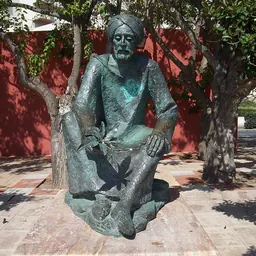
Al-Tighnari (; in full Abu Abdullah Muhammad ibn Malik al-Murri al-Tighnari al-Gharnati; ) was an Arab Muslim agronomist, botanist, poet and traveler from Al-Andalus, who may also have been a physician. He wrote a treatise on agronomy, Zuhrat al-Bustan wa-Nuzhat al-Adhhan , which he dedicated to the Almoravid governor of Granada.
Before writing it he traveled through al-Andalus and North Africa to Egypt and the Levant, and probably performed the Hajj. The treatise records what he observed at each stop, and he meant to apply the farming and irrigation methods he saw there to conditions in al-Andalus. Only part of it survives: the original manuscript, in Algiers, runs to less than half the work. Expiración García Sánchez considers it the most systematic of the Andalusian treatises on agriculture, while Karl Butzer judged it narrower in scope than was usual for the genre.
Biography Al-Tighnari was born into an Arab family in the now-vanished village of Tignar, in the province of Granada, Al-Andalus (now Spain).
Al-Tighnari was a man of letters and a poet, and lived under the Zirid ruler Abdallah ibn Buluggin. Ibn al-Khatib gives him the title of vizier. He was one of many Granadan figures who moved to the Taifa of Almería, probably because of disagreements with the ruler. He was part of a group of poets and scientists at the royal court of the Banu Sumadih. He carried out agricultural experiments in the gardens of the royal residence, al-Sumadihiyya.
Al-Tighnari moved to Seville after the Almoravids conquered Granada. By his own account he was studying in Seville under Abu l-Hasan Sihab in 1100, and possibly also under Ibn al-Lunquh, or Ibn Luengo, a physician from Toledo and a disciple of Ibn Bassal. for the Almoravid prince Tamim, son of Yusuf ibn Tashfin, who was then governor of Granada. According to Ibn Luyun, who owned a copy, it ran to 12 books and 360 chapters . Eleven copies of an abridgement also survive, and these supply the first part, which the original lacks. Its contents largely resemble other Andalusian works on agriculture.
García Sánchez considers the treatise probably the most systematic of the Andalusian works on agriculture, and on many points more detailed and precise than the others. She calls it both highly original and a "specifically Andalusian text", for the local material it carries on agricultural practice and on the plants found across the regions of al-Andalus.
Don’t just read it —
keep it.
Full-length biographies made to live with: read them, listen on the way to work, watch them tonight.
- E-book
- Audio
- Video
Instant download · yours to keep · every purchase keeps this site free
Important facts
Related people
Same field, nearest in time





Contemporaries
People whose lives overlapped Al-Tighnari's




Frequently asked questions
Who was Al-Tighnari?
Muslim Spanish agronomist, botanist, biologist, farmer and author
When was Al-Tighnari born?
Al-Tighnari was born in 1100 in Albolote.
When did Al-Tighnari die?
Al-Tighnari died in 1200 in Granada.
What was Al-Tighnari's occupation?
Al-Tighnari was a botanist.
What was Al-Tighnari known for?
Al-Tighnari was known for Agronomics, Botany, Medicine and Poetry.
Sources & further reading
Cite this page
APA: Biography.guide. (2026). Al-Tighnari. https://biography.guide/al-tighnari/
MLA: "Al-Tighnari." Biography.guide, https://biography.guide/al-tighnari/.
Chicago: "Al-Tighnari." Biography.guide. https://biography.guide/al-tighnari/.
Data last updated: 2026-09-20 · Spot an error? Report a correction.
Page generated 2026-09-27 05:16 UTC