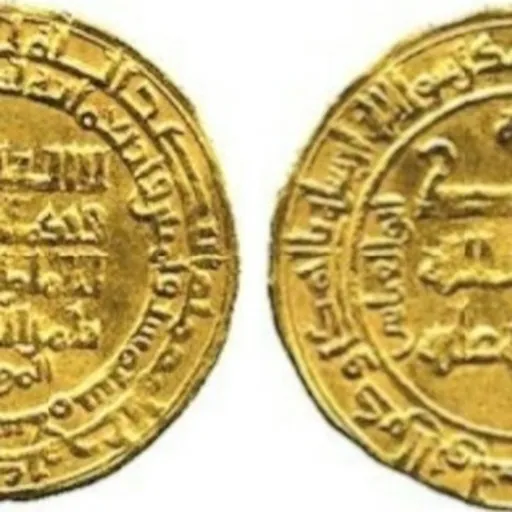
About Al-Muqtadi
Lived 1056 – 1094 (aged 37). Al-Muqtadi was an Arab poet, politician and caliph.
Abū'l-Qasim ʿAbd Allāh ibn Muhammad ibn al-Qa'im (Arabic: أبو القاسم عبد الله بن محمد بن القائم) better known by his regnal name al-Muqtadi (Arabic: المقتدي 'the follower'; 1056 – February 1094) was the Abbasid caliph in Baghdad from 1075 to 1094. He succeeded his grandfather caliph al-Qa'im in 1075 as the twenty-seventh Abbasid caliph.
Biography He was born to Muhammad Dhakirat al-Mulk, the son of caliph Al-Qa'im, and an Armenian slave girl named Urjuman also known as Qurrut al-Ayn. His full name was ʿAbd Allāh ibn Muhammad ibn al-Qa'im and his Kunya was Abū'l-Qasim. He was born on 24 July 1056.
When al-Qa'im was on his deathbed in 1075, Fakhr ad-Dawla took charge of his personal care - al-Qa'im did not want bloodletting but Fakhr ad-Dawla had it done anyway.
Mah-i Mulk Khatun depicted in the center of a procession from Isfahan to Baghdad, for her upcoming marriage to Muqtadi in 1087. Nizam al-Mulk is also depicted accompanying the procession. Folio from a manuscript of Nigaristan, Iran, probably Shiraz, dated 1573–74.
Meanwhile, Amid ad-Dawla had left for Isfahan once he heard of Nizam al-Mulk's plans.
Religious policy At the request of the caliph al-Muqtadi, Sultan Malik Shah decided to launch an expedition against the Qarmatian militant religious sect. In 1075, Malik-Shah sent an army under the command of Hajib Kichkine against the Qarmatians. Before embarking on the campaign, Hajib Kiçkine made several agreements and formed an alliance. The Seljuk army under the command of Hajib Kiçkine left Isfahan and arrived in Basra. Shortly thereafter, they were joined by Gevherayin the Military administrator of Baghdad and Seljuk army set out for Qatif. During this journey, the Qays and Qubas tribes in the region launched plundering attacks against the Seljuk army. In the ensuing battle between the two sides, the Seljuk army was victorious. When the Seljuk army approached Qatif, he sent a message to the city's ruler, Yahya ibn Abbas. However, Yahya ibn Abbas, citing his war with the Qays and Qubas tribes as justifications, refused to honor previous agreements and threatened the Seljuks. Consequently, Yahya ibn Abbas was defeated in the ensuing battle. Later, Yahya ibn Abbas made an agreement with the Qays and Qubas tribes, attacked the Seljuk army, and plundered its supplies and logistics. The hardship left Hajib Kiçkine and the Seljuk army weakened. A sudden raid by Yahya ibn Abbas and his allies later disintegrated the Seljuk army under Hajib Kiçkine. The Seljuk forces retreating towards Basra returned without the opportunity to fight the Qarmatians.
Following the failure of Hajib Kiçkine, Sultan Malik-Shah assigned a 7,000-strong Seljuk army under the command of Artuk Bey to launch an expedition against the Qarmatians. The Seljuk army under Artuk Bey first marched to Qatif. Hearing of the Seljuks arrival, Yahya ibn Abbas fled to Bahrain, and the Seljuks captured Qatif. The Seljuks then attacked the Qarmatians in Ahsa and besieged them in their castle. After the Qarmatians requested peace and an agreement was reached, Artuk Bey lifted the siege. Following this, he launched a successful attack on the Qarmatians in Bahrain and brought them under his control. Following these campaigns, Artuk Bey went to Baghdad, the capital of Abbasids, leaving a 200-man detachment under his brother Alpkuş as his proxy. Supported by the Arab tribes of Azd and Amir Rebia, the Qarmatians, emboldened by Artuk Bey's departure from Ahsa with a large portion of his army, attacked the Seljuks and their allies. In a battle fought between the two sides near Beyberrahbeteyn, the Qarmatians were defeated. The Seljuk allies captured the fortress of Ahsa, but they refused to allow the Seljuk army to enter. After this defeat, the Qarmatians launched an attack with their allies. In the battle between the two sides near Ahsa, the Qarmatians and their allies were defeated and suffered heavy losses. A dispute later arose between Abdullah ibn Ali and Alpkuş. Abdullah ibn Ali killed Alpkuş. Artuk Bey, upon hearing of his brother's death, marched with his army and besieged the fortress of Ahsa, where Abdullah ibn Ali was stationed. After a fierce siege, Artuk captured Abdullah ibn Ali's son in exchange for his brother and lifted the siege.
Obadiah the Proselyte, who lived in Baghdad towards the end of al-Muqtadi's reign, records: Al-Muqtadi told Abu Shuja, his vizier, to mark the Jews dwelling in the city of Baghdad with distinctive dress, and he sought many times to destroy them, but the God of Israel thwarted his intent and hid them from his wrath. [Abu Shuja] put a yellow sign upon the head of each Jew and a silvermithqal of lead on the neck of each Jew, which was inscribed "dhimmi"—for the Jews were to be taxed. He also required the Jews to wear [yellow] girdles. Abu Shuja had two signs placed upon the Jewish women: the shoes belonging to each woman had to be one red and the other black, and each woman had to wear a small brass bell on her shoe or neck, in order by their sound to distinguish between Jewish and gentile women. He further appointed cruel men over the Jewish men, and cruel women over the Jewish women, to oppress them with every kind of curse, spite, and shame. The gentiles would mock them, and the am ha'aretz and their children would strike the Jews in all the areas of the city. Now this was the tax which [Al-Muqtadi] ordered to be levied over the Jews. . .
Also during Ramadan of 1078 (March–April), Fakhr ad-Dawla had a minbar (pulpit) made at his expense and bearing the titles of al-Muqtadi. and Aden for a short while. This led to recovery of the two Holy Cities from the Fatimids and initial revival of the religious–political supremacy of Abbasid Caliph within Fatimid Egypt.
Family Al-Muqtadi's first wife was Sifri Khatun. She was the daughter of Sultan Alp Arslan. In 1071–72, his father Al-Qa'im sent his wazir Ibn Al-Jahir to ask her hand in marriage, to which demand the Sultan agreed. His second wife was Mah-i Mulk Khatun, daughter of Sultan Malik-Shah I. In March 1082, Al-Muqtadi sent Abu Nasr ibn Jahir to Malik Shah in Isfahan to ask for her hand in marriage. Her father gave his consent, and the marriage contract was concluded. She arrived in Baghdad in March 1087. The marriage was consummated in May 1087. She gave birth to Prince Ja'far on 31 January 1088. But then Al-Muqtadi began to avoid her, and she asked permission to return home. She left Baghdad for Khurasan on 29 May 1089, accompanied by her son. Subsequently, news of her death reached Baghdad. Her ailing father brought her son back to Baghdad in October 1092. Prince Ja'far was taken back to the Caliphal Palace, where he remained until his death on 21 June 1093. He was buried near the caliphal tombs in the Rusafah Cemetery. One of Al-Muqtadi's concubines was Kalbahaar or Jalb'har, also known as Tayf al-Khayal. She was a Turkish and was the mother of caliph Al-Mustazhir.
Succession Al-Muqtadi died in 1094 at the age of 37–38. He was succeeded by his 16-year-old son Ahmad al-Mustazhir as Caliph.
Don’t just read it —
keep it.
Full-length biographies made to live with: read them, listen on the way to work, watch them tonight.
- E-book
- Audio
- Video
Instant download · yours to keep · every purchase keeps this site free
Important facts
Family & relationships
People in Al-Muqtadi's life
Named in this biography and alive at the same time

Related people
Same field, nearest in time


Contemporaries
People whose lives overlapped Al-Muqtadi's



Frequently asked questions
Who was Al-Muqtadi?
Abbasid Caliph in Baghdad (r. 1075–1094)
When was Al-Muqtadi born?
Al-Muqtadi was born on 24 July 1056 in Baghdad.
When did Al-Muqtadi die?
Al-Muqtadi died on 3 February 1094 in Baghdad.
What was Al-Muqtadi's occupation?
Al-Muqtadi was a poet, politician and caliph.
What nationality was Al-Muqtadi?
Al-Muqtadi was Arab.
Sources & further reading
Cite this page
APA: Biography.guide. (2026). Al-Muqtadi. https://biography.guide/al-muqtadi/
MLA: "Al-Muqtadi." Biography.guide, https://biography.guide/al-muqtadi/.
Chicago: "Al-Muqtadi." Biography.guide. https://biography.guide/al-muqtadi/.
Data last updated: 2026-09-23 · Spot an error? Report a correction.
Portrait: Wikimedia Commons · author & licence
Page generated 2026-09-27 05:07 UTC