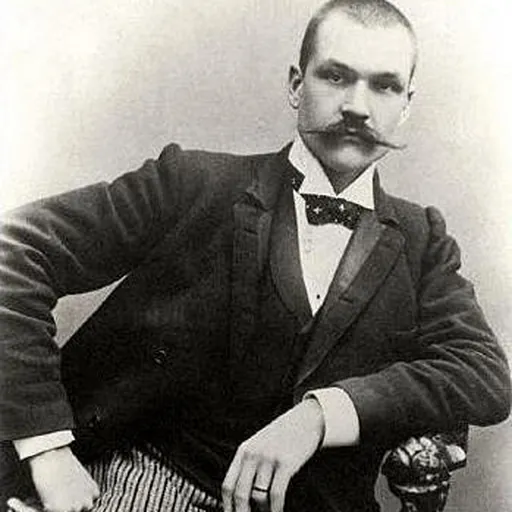
About Akseli Gallen-Kallela
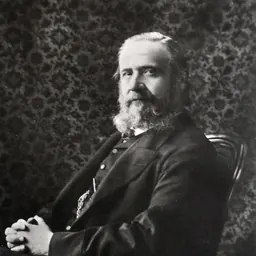
Lived 1865 – 1931 (aged 65). Akseli Gallen-Kallela was a Finnish painter, printmaker, illustrator, architect, designer and graphic artist.
Akseli Gallen-Kallela (born Axel Waldemar Gallén; 26 April 1865 – 7 March 1931) was a Finnish painter and a leading figure of Finnish romantic nationalism around the turn of the 20th century. He is considered a pioneer of a distinctly Finnish national art, and his work is regarded as a very important aspect of Finnish national identity.
Gallen-Kallela began his career as a realist painter influenced by Jules Bastien-Lepage before turning, in the 1890s, towards symbolism and a stylised national-romantic idiom. He is best known for his depictions of the Kalevala, the Finnish national epic, including The Defense of the Sampo, Lemminkäinen's Mother and the Aino Triptych, as well as for his illustrations to the Kalevala and to Aleksis Kivi's novel Seven Brothers. He was also active as a graphic artist, designer and fresco painter, executing monumental works for the Finnish pavilion at the Paris World Fair of 1900 and the Jusélius Mausoleum in Pori. He finnicized his name from Gallén to Gallen-Kallela in 1907.
Life and career Early life Gallen-Kallela was born on 26 April 1865, in Pori, to a Swedish-speaking family. His father, Peter Wilhelm Gallén, worked as police chief, lawyer, and bank cashier. His mother was Anna Mathilda Wahlroos, daughter of the sea captain and shipowner Bror Mathias Wahlroos from Pori. The Gallén family traces its origins to Kallela farm in the parish of Lemu, near Turku. Gallen-Kallela was the third of what would become twelve siblings. His mother was an enthusiastic amateur painter who took an active interest in her son's artistic ambitions.
Gallen-Kallela was raised in Tyrvää, where the family had moved in 1867 after his father had bought a farm there. Gallen-Kallela was educated at home until 1876, when he, at the age of 11, was sent to Helsinki to study at the Swedish Normal Lyceum, together with two of his brothers, because his father opposed his ambition to become a painter. He studied concurrently at the evening programme of the Finnish Art Society's drawing school (1878–1881) and at the School of Arts and Crafts (1880–1881). After completing his studies at the lyceum, he began full-time studies at the Finnish Art Society's drawing school in autumn 1881, receiving private instruction from Sigrid August Keinänen (1881–1882) and Albert Edelfelt (1883–1884), and later studied privately under Adolf von Becker (1882–1884). Between 1911 and 1913, he designed and built a studio and house for his family at Tarvaspää, approximately 10 km northwest of the centre of Helsinki.
Independent Finland
The family moved back from Tarvaspää to Kalela in 1915 to escape the turmoil of the First World War. In 1918, Gallen-Kallela and his son Jorma took part in the fighting at the front of the Finnish Civil War. When the regent, General Mannerheim, heard about that, he invited Gallen-Kallela to design the flags, official decorations and uniforms for the newly independent Finland. For the flag, Gallen-Kallela proposed a white-blue cross flag, with colors inverted (white cross on blue), but it was considered too similar to the Swedish flag and particularly the era's Greek flag. In 1919, he was appointed aide-de-camp to Mannerheim. In 1920, he made an agreement with the publishing company WSOY for the eventual publication of Great Kalevala, with the less decorative Koru-Kalevala being published first in 1922. He was granted a professorship in 1919, and from 1919 to 1931 he was the Vice-Chairman of the Kalevala Society.
New Mexico, later life, and death
In December 1923, he moved to the United States, where his family followed him in autumn 1924. He first spent time in Chicago, and an exhibition of his work toured several cities. In Chicago, he was impressed by Native American art and moved to Taos, New Mexico, at the art colony there to study it further. During his time in the United States, he began sketching out the Great Kalevala in much more detail. In May 1926, the family returned to Finland. In 1924, Gallen-Kallela had published Kallela-kirja. 1. Iltapuhde-jutelmia, which was translated into Swedish by Bertel Gripenberg in 1932. In 1928, together with his son Jorma he painted the Kalevala frescoes at the lobby of the National Museum of Finland. In 1930, he made an agreement to paint a gigantic fresco for the bank Kansallis-Osake-Pankki, but on 7 March 1931, while returning from a lecture in Copenhagen, he suddenly died of pneumonia in Stockholm.
Legacy Gallen-Kallela is regarded as one of the most important Finnish artists of his era and a pioneer of a distinctly Finnish national art. The national-romantic style is essentially considered his creation, and his Kalevala imagery has decisively shaped the visual identification of the epic in Finland. He was also a forerunner in graphic art and applied arts, and his work brought new impulses to Finnish architecture and design.
His reputation was contested in the 1920s, when modernist critics did not share the nationalist circles' view of him as the greatest Finnish artist. His standing has since been re-evaluated, first for his realist works and later for his symbolist production, and he is today appreciated above all for his versatility and for shaping the national-romantic style.
His studio and house at Tarvaspää was opened as the Gallen-Kallela Museum in 1961 and houses some of his works and research facilities on him.
Don’t just read it —
keep it.
Full-length biographies made to live with: read them, listen on the way to work, watch them tonight.
- E-book
- Audio
- Video
Instant download · yours to keep · every purchase keeps this site free
Important facts
more
Aksel' Gallén, Akseli Gallèn-Kallela, Akseli Gallén- Kallela, Akseli Valdemar Gallen- Kallela, Axel Waldemar Gallen, Axel Gallen, Axel Gallen-Kallela, Akseli Gallen- Kallela, A. Gallen-Kallela, Akseli Gallén, A. Gallén, Axel Waldemar Gallen-Kallela, A. W. Gallen-Kallela, A. W. Gallén, Axeli Gallen-KallelaPeople in Akseli Gallen-Kallela's life
Named in this biography and alive at the same time



Related people
Same field, nearest in time

Contemporaries
People whose lives overlapped Akseli Gallen-Kallela's



Frequently asked questions
Who was Akseli Gallen-Kallela?
Finnish painter (1865-1931)
When was Akseli Gallen-Kallela born?
Akseli Gallen-Kallela was born on 26 April 1865 in Pori.
When did Akseli Gallen-Kallela die?
Akseli Gallen-Kallela died on 7 March 1931 in Stockholm.
What was Akseli Gallen-Kallela's occupation?
Akseli Gallen-Kallela was a painter, printmaker, illustrator, architect, designer and graphic artist.
What nationality was Akseli Gallen-Kallela?
Akseli Gallen-Kallela was Finnish.
Sources & further reading
· Wikipedia: Akseli Gallen-Kallela
· DBpedia: Akseli Gallen-Kallela
Cite this page
APA: Biography.guide. (2026). Akseli Gallen-Kallela. https://biography.guide/akseli-gallen-kallela/
MLA: "Akseli Gallen-Kallela." Biography.guide, https://biography.guide/akseli-gallen-kallela/.
Chicago: "Akseli Gallen-Kallela." Biography.guide. https://biography.guide/akseli-gallen-kallela/.
Data last updated: 2026-09-22 · Spot an error? Report a correction.
Portrait: Wikimedia Commons · author & licence
Page generated 2026-09-27 05:02 UTC