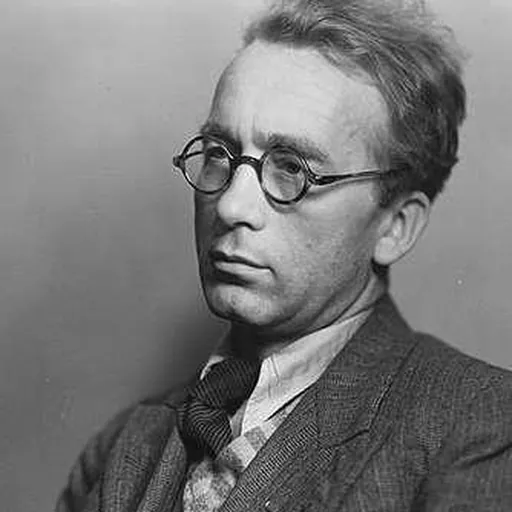
About Aksel Sandemose
Lived 1899 – 1965 (aged 66). Aksel Sandemose was a Danish and Norwegian writer, journalist, novelist and satirical novelist.
Aksel Sandemose (originally Axel Nielsen; 19 March 1899 – 6 August 1965) was a Danish-Norwegian writer whose works frequently elucidate the theme that the repressions of society lead to violence.
Biography Axel Nielsen was born at Nykøbing Mors on the island of Mors in Denmark. His parents were Jørgen Nielsen (1859–1928) and Amalie Jacobsdatter (1861–1926). His father was a factory foreman. He was the second youngest of nine children. He attended Staby vinterlærerskole 1915–1916. His mother was originally from Sandermosen at Maridalen in Aker Municipality, Norway. He changed his surname to Sandemose in 1921.
Sandemose boarded a schooner for Norway at the age of seventeen. He was a sailor and lumberjack in Newfoundland. He worked as a teacher at Nykøbing in 1916 and at Glyngøre in Skive Municipality during 1917. In 1930, Sandemose moved to Norway, and lived in Nesodden Municipality south of Oslo. After the Nazi German occupation of Norway during World War II, he fled to Sweden in 1941 due to his peripheral association with the Norwegian resistance movement. After the liberation of Norway, he moved back and settled in Søndeled Municipality.
Sandemose published his first book in Denmark during 1923. His most notable work was En flyktning krysser sitt spor (1933). The novel was translated into English and published under the title A Fugitive Crosses His Tracks in 1936 by Alfred A. Knopf. In this satirical novel about Danish village life, Sandemose introduced the concept of the Law of Jante, a listing of ten cultural rules which describe a pattern of group behaviour towards individuals said to be common to Nordic countries. But the author himself considered in a foreword to a later edition the Law to be universal, and more common in Brooklyn than in his own hometown.
He was also an essayist and journalist. For a number of years he had a regular column in the weekly magazine Aktuell. Sandemose was awarded the Dobloug Prize during 1959 and was one of six finalists for the Nobel Prize in Literature in 1963.
Personal life Sandemose first married in 1921 Dagmar Ditlevsen (1896–1984); their marriage was dissolved in 1944. He married Eva Borgen (1906–1959) in 1944. After Eva's death he married Hanne Holbek in 1962. Sandemose fathered five children over his lifetime. He was the grandfather of illustrator and children's writer Iben Sandemose. Sandemose died in Copenhagen in 1965 and was buried at Vestre gravlund in Oslo.
Don’t just read it —
keep it.
Full-length biographies made to live with: read them, listen on the way to work, watch them tonight.
- E-book
- Audio
- Video
Instant download · yours to keep · every purchase keeps this site free
Important facts
People in Aksel Sandemose's life
Named in this biography and alive at the same time




Related people
Same field, nearest in time


Contemporaries
People whose lives overlapped Aksel Sandemose's

Frequently asked questions
Who was Aksel Sandemose?
Danish-Norwegian author (1899–1965)
When was Aksel Sandemose born?
Aksel Sandemose was born on 19 March 1899 in Nykøbing Mors.
When did Aksel Sandemose die?
Aksel Sandemose died on 6 August 1965 in Copenhagen.
What was Aksel Sandemose's occupation?
Aksel Sandemose was a writer, journalist, novelist and satirical novelist.
What nationality was Aksel Sandemose?
Aksel Sandemose was Danish and Norwegian.
Sources & further reading
Cite this page
APA: Biography.guide. (2026). Aksel Sandemose. https://biography.guide/aksel-sandemose/
MLA: "Aksel Sandemose." Biography.guide, https://biography.guide/aksel-sandemose/.
Chicago: "Aksel Sandemose." Biography.guide. https://biography.guide/aksel-sandemose/.
Data last updated: 2026-09-22 · Spot an error? Report a correction.
Portrait: Wikimedia Commons · author & licence
Page generated 2026-09-27 04:57 UTC