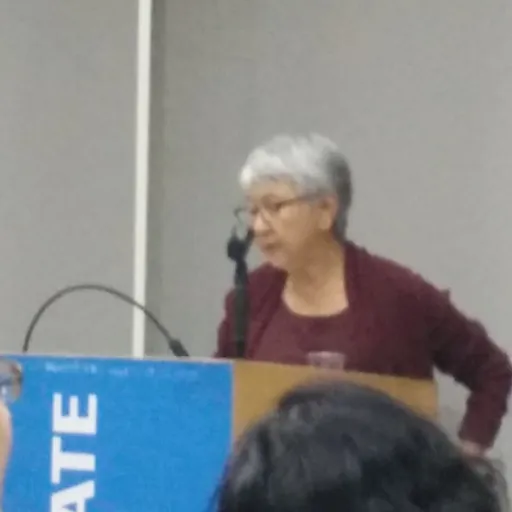
About Aihwa Ong
Born 1950. Aihwa Ong is a Malaysian anthropologist.
Life and career Ong was born in Penang, Malaysia to a Straits Chinese family in 1950. She received her B.A. in anthropology (1974) from Barnard College and earned her Ph.D. (1982) in anthropology from Columbia University. Her older brother, Nai Phuan Ong also went to Columbia University, earned a Ph.D. in physics at UC Berkeley, and is currently a Professor of Physics at Princeton University. Aihwa Ong started her career as a visiting lecturer at Hampshire College (1982–84) before joining the Department of Anthropology at the University of California Berkeley (1984 – present) where she is now Professor Emerita. She was the Chair of the Center for Southeast Asian Studies, Berkeley (1999–2001), Visiting Professor at City University of Hong Kong (2001), Visiting Professor at Yonsei University (2011), and a senior researcher at the Asia Research Institute of the National University of Singapore (2010).
Ong was awarded a MacArthur Fellowship for the study of sovereignty and citizenship (2001-2003) and has been awarded grants from the National Science Foundation and the Sloan Foundation for the Social Science Research Council. She received the Cultural Studies Book Award for Flexible Citizenship (1999) from the Association for Asian American Studies as well as a prize from the American Ethnological Society. In addition, she received honorable mention for Buddha is Hiding (2003) from the Society for Urban, National, and Transnational Anthropology.
In 2007, Ong was invited to the World Economic Forum in Davos. , and was named Robert H. Lowie Distinguished Chair in Anthropology in 2015. She continues to teach, publish, and lecture internationally.
Her first book, Spirits of Resistance & Capitalist Discipline: Factory Women in Malaysia (1986; second edition 2010) is widely considered a classic in the study of female factory workers in multinational companies. From the novel freedoms and accompanying restrictions experienced by Malaysian female workers in multinational factories to the accumulative strategies of Asian entrepreneurs in relocating family and capital overseas; from the disciplining of Cambodian refugees towards an embrace of American values to the neoliberal reasoning and graduated modes of governing at work; from the transformation of cities to the rise of contemporary art in Asia; Ong's work tracks the interplay of global forces and everyday practices as they crystallize into myriad and uneven contexts for human living and belonging in modernity.
Her current work focuses on regimes of governing, technology, and culture that shape new meanings and practices of the human in an emerging global region. Her field research shifts between Singapore and China in order to track emerging global hubs for biotechnical experiments with genomic science in contemporary East Asia.
Work Overview
Global Capitalism & Labor
Spirits of Resistance & Capitalist Discipline: Factory Women in Malaysia (1986; second edition 2010)
Citizenship
Flexible Citizenship (1999) is an innovative approach that links global flows to changing notions of citizenship. With China’s opening to market capitalism, the Chinese business elite seek economic opportunities and political safety by skillfully navigating the immigration rules of advanced economies. In response to this entrepreneurial influx, liberal citizenship eases rules in order to capture the flight of Pacific rim capital, human skills and knowledge. Global flows instigate the embedding of neoliberal values in citizenship.
Global Assemblages: Technology, Politics, and Ethics as Anthropological Problems (2005)
This book argues that emerging global milieus are reinforced through the intersecting of global and local systems. Ong argues that different systems that emerge as a result of capitalism, technology, and science that proliferate Asia.
Neoliberalism as Exception: Mutations in Citizenship and Sovereignty (2006)
This book explores the application of uneven neoliberal strategies by Asian states as a mode of thinking and practicing governing for optimal outcomes. In particular, Ong uses the example of the development of free trade zones to attract capital flows, describing it as a method of "graduated sovereignty".
Asian Biotech: Ethics and Communities of Fate (2010)
This book shows us a glimpse of the emerging biosciences landscape in Asia. Ong provided a collection of case studies on biotech topics including genetically modified foods, clinical trials, blood collection, stem cell research etc. These are studies conducted all over Asia in countries such as Singapore, China and India.
Worlding Cities: Asian Experiments with the Art of Being Global (2011)
Worlding Cities (2011) presents studies of emerging cities that challenge Western narratives of “the global city.” Diverse examples from East Asia and the Middle East highlight various aspirations, strategies, and speculations to raise their urban profiles and styles of being distinctive and global.
Publications
Books and edited volumes
Fungible Life: Experiment in the Asian City of Life, Duke University Press, 2016. Worlding Cities: Asian Experiments with the Art of Being Global, ed. with Ananya Roy, Wiley-Blackwell, 2011. Asian Biotech: Ethics and Communities of Fate, ed. with Nancy N. Chen, Duke University Press, 2010. Privatizing China, Socialism from Afar, ed. with Li Zhang, Cornell University Press, 2008. Neoliberalism as Exception: Mutations in Citizenship and Sovereignty, Duke University Press, 2006 [Italian, Japanese]. Global Assemblages: Technology, Politics, and Ethics as Anthropological Problems, ed. with Stephen J. Collier, Blackwell Publishers, 2005. Buddha is Hiding: Refugees, Citizenship, the New America, University of California Press, 2003 [Italian]. Flexible Citizenship: The Cultural Logics of Transnationality, 1999 [German]. Recipient of the Cultural Studies Book Award by the Association of Asian American Studies in 2001. Ungrounded Empires: The Cultural Politics of Modern Chinese Transnationalism, ed. with Donald Nonini, Routledge, 1997. Bewitching Women, Pious Men: Gender and Labor Politics in Southeast Asia, ed. with Michael Peletz, University of California Press, 1995. Spirits of Resistance and Capitalist Discipline: Factory Women in Malaysia, State University of New York Press, 1987 .
Selected articles and chapters
"A Questionnaire on Diaspora and the Modern," October, 186: 69–75, 2023. "Buoyancy: Blue Territorialization of Chinese Power," in Voluminous States, edited by Franck Bille, Duke University Press, pp. 191–203, 2020.
"Citizenship: Flexible, Fungible, and Fragile," Citizenship Studies, DOI: 10.1080/13621025.2022.2091244, 2022
"Why Singapore Trumps Iceland: Gathering Genes in the Wild," Journal of Cultural Economy, vol. 8, no. 3, 2015. "A Milieu of Mutations: The Pluripotency and Fungibility of Life in Asia," East Asian Science, Technology and Society, 7, (2013). "What Marco Polo Forgot: Asian Art Negotiates the Global," Current Anthropology, vol. 53, no. 4 (2012). "Hyperbuilding: Spectacle, Speculation, and the Hyperspace of Sovereignty," in Worlding Cities eds. Ananya Roy and Aihwa Ong, Wiley-Blackwell, 2011. "The Human and Ethical Living," in Globalizing the Research Imagination, Jane Kenway and Johannah Fahey eds. pp. 87–100. London: Routledge (2008). "Neoliberalism as a Mobile Technology," Transactions of the Institute of British Geographers, vol. 32, no. 3 (2007). "Please Stay: Pied-a-Terre Subjects in the Megacity," Citizenship Studies, vol. 11, no. 1 (2007). "Mutations in Citizenship," Theory, Culture, and Society, vol. 22, no. 3, (2006). "Experiments with Freedom: Milieus of the Human," American Literary History , vol. 8, no. 2 (2006). "(Re)Articulations of Citizenship," Political Science and Politics, vol. 38, no. 4 (2005). "The Chinese Axis: Zoning Technologies and Variegated Sovereignty," Journal of East Asian Studies, vol. 4, no. 1 (2004). "Cyberpublics and Diaspora Politics among Transnational Chinese," Interventions, vol. 5, no. 1 (2003). "A Higher Learning: Educational Availability and Flexible Citizenship in Global Space," in Diversity and Citizenship Education, ed. James Banks, Wiley, 2003. "Graduated Sovereignty in Southeast Asia," Theory, Culture, and Society, vol. 17, no. 4 (2000). "Muslim Feminists in the Shelter of Corporate Islam," Citizenship Studies, vol. 3, no. 3 (1999). "Strategic Sisterhood or Sisters in Solidarity? Questions of Communitarianism and Citizenship in Asia," Indiana Journal of Global Legal Studies, vol. 4, no. 1 (1996). "Cultural Citizenship as Subject-Making: New Immigrants Negotiate Racial and Ethnic Boundaries," Current Anthropology, vol. 37, no. 5 (1996). "On the Edge of Empires: Flexible Citizenship among Chinese in Diaspora," Positions, vol. 1, no. 3 (1995). "The Gender and Labor Politics of Postmodernity," Annual Review of Anthropology, vol. 20 (1991). "State versus Islam: Malay Families, Women's Bodies, and the Body Politic in Malaysia," American Ethnologist, vol. 17, no. 2 (1991). "The Production of Possession: Spirits and Multinational Corporation in Malaysia," American Ethnologist, vol. 15, no. 1 (1988).
Don’t just read it —
keep it.
Full-length biographies made to live with: read them, listen on the way to work, watch them tonight.
- E-book
- Audio
- Video
Instant download · yours to keep · every purchase keeps this site free
Important facts
People in Aihwa Ong's life
Named in this biography and alive at the same time




Related people
Same field, nearest in time



Contemporaries
People whose lives overlapped Aihwa Ong's



Frequently asked questions
Who is Aihwa Ong?
Malaysian sociocultural anthropologist
When was Aihwa Ong born?
Aihwa Ong was born on 1 February 1950 in Penang.
What is Aihwa Ong's occupation?
Aihwa Ong is an anthropologist.
What nationality is Aihwa Ong?
Aihwa Ong is Malaysian.
Sources & further reading
Cite this page
APA: Biography.guide. (2026). Aihwa Ong. https://biography.guide/aihwa-ong/
MLA: "Aihwa Ong." Biography.guide, https://biography.guide/aihwa-ong/.
Chicago: "Aihwa Ong." Biography.guide. https://biography.guide/aihwa-ong/.
Data last updated: 2026-09-23 · Spot an error? Report a correction.
Portrait: Wikimedia Commons · author & licence
Page generated 2026-09-27 05:06 UTC