
About Ahmed Tidiane Souaré
Born 1951. Ahmed Tidiane Souaré is a politician and minister.
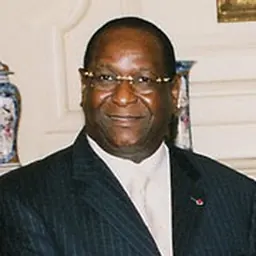
Ahmed Tidiane Souaré (born 1951 ) is a Guinean political figure who was the Prime Minister of Guinea from May 2008 to December 2008, when he was replaced by Kabine Komara following a military coup d'état.
Career in state administration and the government From 1989 to 1990, Souaré was a member of the monitoring committee for the implementation of economic, financial and administrative reforms at the Presidency of the Republic. He was then coordinator of the office for monitoring, evaluation, and control at the Presidency of the Republic from 1990 to 1994; he was also president of the committee for the importation of petroleum products, rapporteur of the state commission for the liquidation of ONAH-ASP , and vice-president of the technical committee on re-evaluation of state immovable assets (COTERI) at the Presidency of the Republic. and while serving in that position he was also appointed as Chairman of the Board of Directors of Compagnie des Bauxites de Guinée (CBG). He was subsequently moved to the post of Minister of State for Higher Education and Scientific Research on May 29, 2006 and served in that post until March 2007, when an entirely new government under Prime Minister Lansana Kouyaté was appointed. Souaré was also President of the Guinean National Commission for UNESCO.
In an audit made under Kouyaté into the government's financial management during the previous ten years, Souaré's name was included on a list of officials who were considered to be associated with the mismanagement of resources.
As Prime Minister
In a decree read on state television on May 20, 2008, President Lansana Conté dismissed Kouyaté and appointed Souaré to replace him as Prime Minister. Souaré, a technocrat, was seen as being close to Conté, in contrast to Kouyaté, who had been appointed to appease striking trade unions in 2007 and had a difficult relationship with Conté, Speaking on this occasion, he said that he would "undertake large structural reforms, which will take into account the great changes within our society and in the world, but also the aspirations of the Guinean people".
In response to the unrest, Souaré's government promised to pay the soldiers. Souaré called for calm, noting that the government had agreed to meet most of the soldiers' demands. The soldiers began receiving their backpay on May 30, and Conakry was reportedly calm by May 31.
Souaré met with representatives of political parties of both the presidential majority and the opposition on May 28 to discuss the formation of a national unity government. The opposition Union of Democratic Forces of Guinea (UFDG) and the Union for the Progress of Guinea (UPG) expressed their willingness to work with the government; however, another opposition party, the Rally of the Guinean People (RPG), chose not to attend the meeting. The RPG said that positive change would not come as long as Conté remained in power, regardless of who was Prime Minister, and it refused to participate in Souaré's government.
Souaré's government was appointed by Conté on June 19, 2008. The government, which included 34 ministers and two secretaries-general, had members of Conté's party, the Party of Unity and Progress (PUP), filling some key posts. It also included three opposition parties—the UFDG, the UPG, and the Union for Progress and Renewal (UPR)—each holding one position in the government. The RPG and the Union of Republican Forces (UFR) were not included. With 36 members, it was markedly larger than Kouyaté's 22-member government. Four women were included in Souaré's government. In early August, it was reported that Souaré planned to establish a Minimum Emergency Programme, which was designed to improve security, services, and youth employment, reduce food prices, and repair infrastructure. This programme was expected to cost about 75 billion Guinean francs.
December 2008 coup In the early hours of 23 December 2008, Aboubacar Somparé, the President of the National Assembly, announced on television that Conté had died on the previous day "after a long illness." According to the Constitution, the President of the National Assembly was to assume the Presidency in the event of a vacancy, and a new presidential election was to be held within 60 days. Souaré and General Diarra Camara, the head of the army, stood alongside Somparé during his announcement. Declaring 40 days of national mourning for Conté, Souaré urged "calm and restraint". He told the army to secure the borders and maintain calm within the country "in homage to the memory of the illustrious late leader". a statement was read on state radio announcing a military coup d'état. on behalf of a group called the National Council for Democracy and Development (CNDD),
The extent of the CNDD's control remained unclear on the next day, 24 December; although Souaré had gone into hiding, he insisted that the government had not been toppled. Souaré described Camara as "an unknown captain [who] doesn't control the army" and argued again that most troops were loyal, while attributing the "disorder" to "one little group".
Shortly after the CNDD ordered all members of the government and army officers to go to the Alpha Yaya Diallo military camp within 24 hours, with the threat of "a sweep of the entire national territory" if they did not, Souaré went to the camp and turned himself in on 25 December, together with all the members of his government except for two ministers who were, according to Souaré, on official missions abroad. Camara met with Souaré and stressed that the CNDD was now in power, but he said that Souaré and his government could "go back to business". During the meeting, Souaré expressed his government's willingness to serve under the CNDD,
An interrogation of Souaré, along with three other former mining ministers, was broadcast on state television on the night of 7 March 2009. According to an official audit committee, the four of them were guilty of embezzlement during their tenures at the head of the Ministry of Mines and they collectively owed the government about 5.3 million in US dollars; Souaré was accused of stealing nearly half of the total. Speaking on the radio the next day, Souaré said that the allegedly misappropriated money had merely been used as a matter of necessity to fund the ministry's operations. Souaré was arrested on 23 March. He was later released, but on 30 June 2009 he was arrested again after failing to make sufficient repayments of the money (12 billion Guinean francs) that was allegedly stolen. He had been ordered to pay back the money in quarterly installments, but he said that he could not do so and only had 100 million of the three billion Guinean francs necessary for one quarterly payment. He was consequently arrested after going to a government office to pay the 100 million Guinean francs.
Don’t just read it —
keep it.
Full-length biographies made to live with: read them, listen on the way to work, watch them tonight.
- E-book
- Audio
- Video
Instant download · yours to keep · every purchase keeps this site free
Important facts
People in Ahmed Tidiane Souaré's life
Named in this biography and alive at the same time



Related people
Same field, nearest in time




Contemporaries
People whose lives overlapped Ahmed Tidiane Souaré's



Frequently asked questions
Who is Ahmed Tidiane Souaré?
Prime Minister of Guinea
When was Ahmed Tidiane Souaré born?
Ahmed Tidiane Souaré was born in 1951 in Mali.
What is Ahmed Tidiane Souaré's occupation?
Ahmed Tidiane Souaré is a politician and minister.
What nationality is Ahmed Tidiane Souaré?
Ahmed Tidiane Souaré's recorded nationality: Guinea.
Sources & further reading
· Wikipedia: Ahmed Tidiane Souaré
· DBpedia: Ahmed Tidiane Souaré
Cite this page
APA: Biography.guide. (2026). Ahmed Tidiane Souaré. https://biography.guide/ahmed-tidiane-souare/
MLA: "Ahmed Tidiane Souaré." Biography.guide, https://biography.guide/ahmed-tidiane-souare/.
Chicago: "Ahmed Tidiane Souaré." Biography.guide. https://biography.guide/ahmed-tidiane-souare/.
Data last updated: 2026-09-20 · Spot an error? Report a correction.
Page generated 2026-09-27 05:25 UTC