
About Ahmadullah Shah
Lived 1787 – 1858 (aged 70–71). Ahmadullah Shah was a revolutionary, known for Indian Rebellion of 1857.
Ahmadullah Shah (1787 – 5 June 1858) famous as the Maulvi of Faizabad, was a famous freedom fighter and leader of the Indian Rebellion of 1857. Maulavi Ahmadullah Shah was known as the lighthouse of the rebellion in the Awadh region. British officers like George Bruce Malleson and Thomas Seaton made mentions about the courage, valour, personal and organizational capabilities of Ahmadullah. G. B. Malleson mentions Ahmadullah repeatedly in the History of Indian Mutiny, a book written in 6 volumes covering Indian revolt of 1857. Thomas Seaton describes Ahmadullah Shah as:
Being a practicing Muslim, he was also an epitome of religious unity and Ganga-Jamuna culture of Faizabad. In the rebellion of 1857, royals like Nana Sahib and Khan Bahadur Khan fought alongside Ahmadullah.
The British could never catch the Maulvi alive. The price of 50,000 pieces of silver was announced to capture him. Finally the king of Powayan, Raja Jagannath Singh killed Maulvi, beheaded him and presented his head to the British for which Raja Jagannath was paid the announced prize.
Arrest at Patna According to G. B. Malleson, when the Maulvi was in Patna, suddenly with no previous notice or intimation, an officer arrived at Patna from Punjab. He is referred as Lt. Thursbern in a book by Rashmi Kumari on Ahmadullah Shah. With a warrant in his pocket, he walked into Sadiqpur, a quarter in Patna. He entered the house of Ahmadullah Shah, and with the help of the police arrested him.
Ahmadullah Shah also led an attack on Beligarad. The writer Kaisar-ut-tawarikh states that it was a huge victory for the rebels.
Maulavi fought with great courage and chivalry in real sense, and for that he succeeded in pushing the British to Beligarad. And then a big house of "Machchhi Bhavan" was also blown up.
After Lucknow was captured by the rebels, Birjis Qadr, the ten-year-old son of Wajid Ali Shah and Begum Hazrat Mahal was declared the king. The Maulvi resisted being part of a new administration. He left the palace politics and established his camp with Ghamandi Singh and 1000 soldiers of Subedar Umrao Singh at Badshah Bagh across the Gomti River.
On 6 March 1858, British forces attacked Lucknow again under the leadership of Sir Colin Campbell, a reputed British army official. The rebel army was led by Begum Hazrat Mahal. With the capture of Lucknow by the British, the rebels escaped on 15 and 16 March through a road leading to Faizabad. The last rebels, 1,200 men under Ahmadullah Shah were driven from a fortified house in the centre of the city on 21 March. The city was declared cleared on this date.
After the fall of Lucknow, the Maulvi shifted his base to Shahjahanpur in Rohilkhand. In Shahjahanpur the forces of Nana Sahib and Khan Bahadur Khan joined the Maulvi in attacking the Britishers.
Colin Campbell departed from Shahjahanpur on 2 May towards Bareilly. The Maulvi, with the King of Mohammadi and several thousand soldiers attacked Shahjahanpur. The British Army was informed and General Brigadier John reached Shahjahanpur on 11 May. Jones could not muster the courage to attack the Maulvi and kept waiting for reinforcements from Bareilly. George Bruce Malleson writes that:
Maulavi was the only one who could have dared to defeat Sir Colin Campbell twice.
The fierce battle took place on 15 May 1858 between a platoon of the rebels and the regiment of General Brigadier Jones. Both sides had to bear heavy losses but the rebels still managed to capture Shahjahanpur. Colin reached Shahjahanpur on 20 May, and attacked it from all sides. This battle continued all night long. Maulavi and Nana Sahib left Shahjahanpur. It is said that Colin himself followed Maulvi but couldn't capture him. After the fall of Shahjahanpur, the Maulvi left for Powayan which was 18 miles to the north of Shahjahanpur.
Death The British could never catch the Maulvi alive. They announced 50,000 pieces of silver as a prize to capture the Maulvi. Maulvi Ahmadullah Shah wanted to induce the king of Powayan, Raja Jagannath Singh to revolt against Britishers, but the latter did not give into the Maulvi's wishes. When the Maulvi reached gates of his palace on his war elephant, the king attacked him by firing a cannon shot. This killed the Maulvi who came down falling from his elephant. G. B. Malleson describes his death as:
Thus died the Maulvi Ahmadullah Shah of Faizabad. If a patriot is a man who plots and fights for independence, wrongfully destroyed, for his native country, then most certainly, the Moulvee was a true patriot. The head of the Maulvi was hanged at Kotwali the next day. Another revolutionary of 1857, Fazl-e-Haq Khairabadi witnessed the death of the Maulvi.
Legacy
The to-be-constructed mosque in Ayodhya as per the verdict of the Supreme Court of India in the Babri Masjid demolition case, will be named after Ahmadullah Shah.
Don’t just read it —
keep it.
Full-length biographies made to live with: read them, listen on the way to work, watch them tonight.
- E-book
- Audio
- Video
Instant download · yours to keep · every purchase keeps this site free
Important facts
People in Ahmadullah Shah's life
Named in this biography and alive at the same time

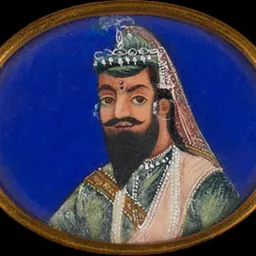




Related people
Same field, nearest in time


Contemporaries
People whose lives overlapped Ahmadullah Shah's



Frequently asked questions
Who was Ahmadullah Shah?
leader of the Indian Rebellion of 1857 (1787-1858)
When was Ahmadullah Shah born?
Ahmadullah Shah was born in 1787 in Faizabad.
When did Ahmadullah Shah die?
Ahmadullah Shah died on 5 June 1858 in Shahjahanpur.
What was Ahmadullah Shah's occupation?
Ahmadullah Shah was a revolutionary.
What was Ahmadullah Shah known for?
Ahmadullah Shah was known for Indian Rebellion of 1857.
Sources & further reading
Cite this page
APA: Biography.guide. (2026). Ahmadullah Shah. https://biography.guide/ahmadullah-shah/
MLA: "Ahmadullah Shah." Biography.guide, https://biography.guide/ahmadullah-shah/.
Chicago: "Ahmadullah Shah." Biography.guide. https://biography.guide/ahmadullah-shah/.
Data last updated: 2026-09-20 · Spot an error? Report a correction.
Page generated 2026-09-27 05:23 UTC