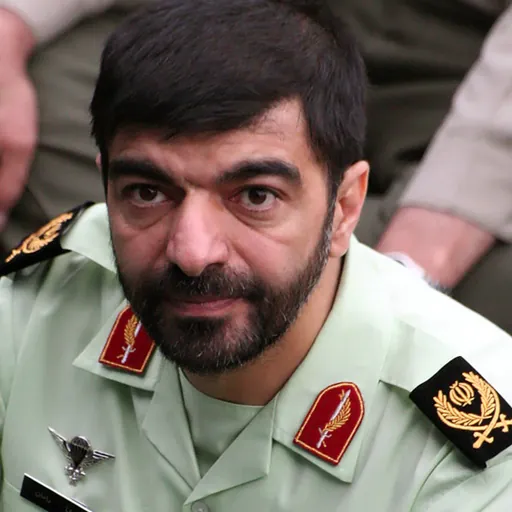
About Ahmad-Reza Radan
Born 1963. Ahmad-Reza Radan is an Iranian military personnel.
Ahmad-Reza Radan (; born 1963) is an Iranian military officer who has served as Iran's Chief of police, the chief commander of the Police Command of the Islamic Republic of Iran since January 2023. He is known for pursuing the implementation of Islamic Sharia law and for the suppression of the 2009 Iranian protests.
He was deputy commander of the Police Command of the Islamic Republic of Iran and Tehran's police chief, infamous for his crackdown on "un-Islamic" hair and dress styles.
He headed the Iranian police during the 2025-2026 Iran protests in which between 30,000 and 35,000 protestors were killed by Iranian security forces.
Career Radan started his career as a member of the Iranian Revolutionary Guards during the Iran–Iraq War. Radan held various posts in the Islamic Republic of Iran Police (IRIP), including police commander of Razavi Khorasan Province.
In 2007, in commanding the morality police of Tehran he said "police will start early next week a drive against women who wear improper dress." He said that "Tight trousers tucked inside long boots while wearing short overcoats are against Islamic codes," as well as "Wearing a hat or cap instead of scarves is also against Islamic dress codes."
The United States has designated Radan as a person who is, "among other things, responsible for or complicit in, or responsible for ordering, controlling, or otherwise directing, the commission of serious human rights abuses against citizens of Iran or their family members."
He was the head of Iranian police during the 2025-2026 Iranian protests in which it is estimated between 30,000 and 35,000 protestors were killed by Iranian security forces.
Public Security Plan and Moralization Campaign In 2007, Radan launched a "Public Security Plan". The police arrested dozens of "thugs" to increase public security. These individuals were sometimes beaten on camera in front of neighborhood inhabitants, or forced to wear hanging watering cans used for lavatory ablutions around their necks.
Among those arrested was Meysam Lotfi, a young Iranian who had previously been arrested during the Iran student riots in July 1999 and jailed for six months. According to his parents, he has never had any criminal record or background of illegal activities and had never been arrested or jailed before, except for the 1999 riots. Lotfi was listed for execution, a sentence that was later changed to a three-year prison sentence after media coverage and the efforts of his parents, as well as human rights activists. His former lawyer was Abdolfattah Soltani.
Syria In 2011, Radan traveled to Damascus to support Syrian security services in their crackdown on protests in Syria.
Disappearance On 19 May 2024, Radan disappeared in the Tehran's Narmak neighborhood. Rumours alleged that he was killed in an armed attack. An Ahmed Reza Radan had claimed to be alive on 29 May although his whereabouts are still unknown.
A year later, he reappeared on live TV on occasion of the 13 June attacks.
Sanctions In October 2010, the United States Treasury Department sanctioned Radan for human rights violations. According to their statement, Radan, while serving as deputy commander of the police force, was responsible for the beatings, murders, and detentions of protesters during the protests following the 2009 Iranian presidential election.
On 13 April 2011, Radan was sanctioned by the European Union for widespread and severe violations of the rights of Iranian citizens, and for a series of murders. According to the EU statement, he, as deputy commander of the police force, was involved in "beatings", "murders", "arbitrary detentions," and "arrests of protesters" by the police during the 2009 post-election protests.
On 18 September 2024, the Canadian government sanctioned Radan, in addition to four other officials of the Islamic Republic who are directly responsible for implementing oppressive and discriminatory policies against women, girls, and minorities. The sanctions regulations prohibit transactions with the listed individuals, freeze their assets in Canada, and make any immigration to Canada of these individuals prohibited and inadmissible under Canadian immigration law.
Radan claimed that being sanctioned by the US and EU was an honor for himself and all military commanders. He stated that "becoming a martyr and being sanctioned are equally enjoyable" to him. Radan views these sanctions as a "badge of honor", comparing them to an honorary medal for serving the Islamic Republic.
2025-2026 protests Following the 2025-2026 Iranian protests, the massacres and Internet blackout, he stated on 19 January 2026 that those protestors that were “deceived” into taking part in the demonstrations, or “riots” as the government defines them, have three days to turn themselves in.
Don’t just read it —
keep it.
Full-length biographies made to live with: read them, listen on the way to work, watch them tonight.
- E-book
- Audio
- Video
Instant download · yours to keep · every purchase keeps this site free
Important facts
People in Ahmad-Reza Radan's life
Named in this biography and alive at the same time

Related people
Same field, nearest in time



Contemporaries
People whose lives overlapped Ahmad-Reza Radan's



Frequently asked questions
Who is Ahmad-Reza Radan?
Iranian military commander
When was Ahmad-Reza Radan born?
Ahmad-Reza Radan was born in 1963 in Isfahan.
What is Ahmad-Reza Radan's occupation?
Ahmad-Reza Radan is a military personnel.
What nationality is Ahmad-Reza Radan?
Ahmad-Reza Radan is Iranian.
Sources & further reading
Cite this page
APA: Biography.guide. (2026). Ahmad-Reza Radan. https://biography.guide/ahmad-reza-radan/
MLA: "Ahmad-Reza Radan." Biography.guide, https://biography.guide/ahmad-reza-radan/.
Chicago: "Ahmad-Reza Radan." Biography.guide. https://biography.guide/ahmad-reza-radan/.
Data last updated: 2026-09-22 · Spot an error? Report a correction.
Portrait: Wikimedia Commons · author & licence
Page generated 2026-09-27 05:04 UTC