About Agustín Farfán
Lived 1532 – 1604 (aged 71–72). Agustín Farfán was a Spanish physician and friar.
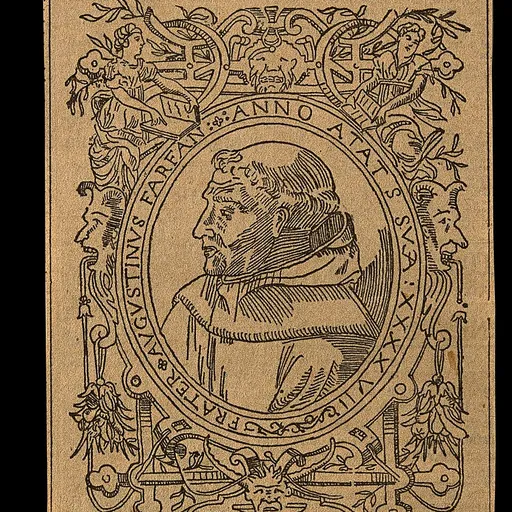
Portrait of Agustin Farfán, as depicted in a woodcut from 1914. Pedro Garcia Farfán (1532–1604), better known as Agustín Farfán, was a Spanish medical missionary who studied medicine in Seville, Spain, initially serving as a physician for King Phillip II before moving to New Spain with his family in 1557, where he continued his studies and became one of the first to receive a medical degree from the National Autonomous University of New Spain. Upon the death of his wife in 1568, Farfán joined the Order of Saint Augustine and became a prominent figure in the Augustinian order, contributing to the construction and maintenance of convents there.
Farfán went on to perform therapeutic experiments in the Hospital Real de Naturales and serve as protomedic for New Spain, devising one of the earliest medical manuals there. He incorporated both European and indigenous medical knowledge into a treatise that would be published a total of three times, first as Tratado breve de anathomía y chirugía in 1579, and then Tratado Breve de Medicina in 1592, before his work was posthumously updated in 1610. Farfán is commemorated as a revolutionary doctor and surgeon who was endorsed by the viceroy of New Spain at the time for his ability to offer alternative treatments and medical knowledge accessible to a wide audience, including back in Europe.
Family history and personal life Pedro Garcia Farfán was born in 1532 to Pedro Farfán and Lorenza Getil of Lejalde in Seville, Spain. He moved to New Spain (present-day Mexico) with his wife Margarita de Vergara y Fuentes and daughter Francisca, in 1557, likely to join his relatives there. He had two more daughters in Mexico, all joined religious orders under the Regina Monastery of Mexico. Upon the death of his wife, Farfán joined the Order of Saint Augustine in 1568 and thus adopted the name Friar Agustín Farfán, the name by which he is most commonly referred to. He first resided in the province of Oaxaca due to its proximity to the Agustinian priory there and then Mexico City until his passing in 1604.
Education Farfán studied medicine in the University of Alcalá de Henares and chamber physician of the Spanish Royal Court to King Phillip II. one of the first medical manuals of New Spain. and sometimes uses his religious authority to substantiate claims.
Aside from the discoveries made by him and his colleagues, Farfán also derived his findings for the book on surgery from Greek, barbarian, and 'modern' scholars; notably, he quotes Aristotle, Hippocrates, and Guy de Chauliac. His extensive use of different sources therefore revealed the availability of medical literature in Mexico to him. He also reflects in the book on his own experiences, either expanding upon the aforementioned scholars, comparing their experiences to his, or contesting them altogether. Farfán sought to reach as wide of an audience as possible with the publication; he lists a multitude of alternative treatments for readers with a lack of access to metropolitan centers, European-trained practitioners, and access to indigenous marketplaces instead. As a result, more Spanish settlers moved into indigenous spaces in Mexico, given their confirmed accessibility to medical treatments. including roots, plants, and animals, providing an alternative option for those with a lack of access to competent care.
In the second edition, Farfán also challenges doctors of the time, directing them to the last two books in the treatise—anatomy and surgery—and advising them to learn anatomy to avoid making nearly as many mistakes as they were. He notes smallpox as a lethal disease affecting the indigenous peoples, offering speculated causes along with treatments, such as bloodletting, in response.
He observed the widespread medicinal use of local flora, citing chili peppers, rhubarb, and vanilla as purgatives, alongside warm chocolate as a laxative.
Cocoa Through his Tratado Breve de Medicina, Farfán was the first to introduce cocoa, derived from cacao (native to New Spain), to Europe. In fact, especially after chocolate developed as a widespread Mesoamerican remedy, its medical uses became popularized in Europe. Even through the 17th and 18th centuries, doctors affirmed the healthy effects of chocolate, consequently boosting the import of chocolate and introducing its consumption in the Old World.
Legacy Luis de Velasco, viceroy of Mexico, endorsed Farfán's efforts at publishing his book, officially legitimizing Farfán's work through the government. even after Farfán's death, the attorney general of the Augustinian Order requested an extension from Velasco to reprint it.
The third copy of Tratado Breve de Medicina is currently being preserved by The United States National Library of Medicine.
Don’t just read it —
keep it.
Full-length biographies made to live with: read them, listen on the way to work, watch them tonight.
- E-book
- Audio
- Video
Instant download · yours to keep · every purchase keeps this site free
Important facts
People in Agustín Farfán's life
Named in this biography and alive at the same time
Related people
Same field, nearest in time


Contemporaries
People whose lives overlapped Agustín Farfán's


Frequently asked questions
Who was Agustín Farfán?
Spanish medical missionary
When was Agustín Farfán born?
Agustín Farfán was born in 1532 in Seville.
When did Agustín Farfán die?
Agustín Farfán died on 28 March 1604 in New Spain.
What was Agustín Farfán's occupation?
Agustín Farfán was a physician and friar.
What nationality was Agustín Farfán?
Agustín Farfán was Spanish.
Sources & further reading
Cite this page
APA: Biography.guide. (2026). Agustín Farfán. https://biography.guide/agustin-farfan/
MLA: "Agustín Farfán." Biography.guide, https://biography.guide/agustin-farfan/.
Chicago: "Agustín Farfán." Biography.guide. https://biography.guide/agustin-farfan/.
Data last updated: 2026-09-21 · Spot an error? Report a correction.
Portrait: Wikimedia Commons · author & licence
Page generated 2026-09-27 04:59 UTC