
About Agrippina the Elder
Lived 14 BC – AD 33 (aged 45–46). Agrippina the Elder was a Roman politician.
(Vipsania) Agrippina the Elder (also, in Latin, , To distinguish Agrippa and Julia's daughter from their granddaughter Julia Agrippina, historians refer to this daughter as "Agrippina the Elder" (Latin: Agrippina Maior). Likewise, Agrippina's daughter is referred to as "Agrippina the Younger" (Minor). Like her father, Agrippina the Elder avoided her nomen and has not been found to have used "Vipsania" in inscription. An inscription in Rhodiapolis records her with the nomen "Julia", although this appears to be a mistake.
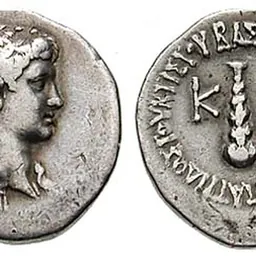
Background A denarius depicting Agrippa wearing a combination of the corona muralis and the corona rostalis.
Marcus Vipsanius Agrippa was an early supporter of Augustus (then "Octavius"). He was a key general in Augustus' armies, commanding troops during the wars against Sextus Pompey and Mark Antony. From early in the emperor's reign, Agrippa was trusted to handle affairs in the eastern provinces and was even given the signet ring of Augustus, who appeared to be on his deathbed in 23BC, a sign that he would become princeps were Augustus to die. It is probable that he was to rule until the emperor's nephew, Marcus Claudius Marcellus, came of age. However, Marcellus died that year of an illness that became an epidemic in Rome.
Now, with Marcellus dead, Augustus arranged for the marriage of Agrippa to his daughter Julia the Elder, who was previously the wife of Marcellus. Agrippa was given tribunicia potestas ("the tribunician power") in 18 BC, a power that only the emperor and his immediate heir could hope to attain. The tribunician power allowed him to control the Senate, and it was first given to Julius Caesar. Agrippa acted as tribune in the Senate to pass important legislation and, though he lacked some of the emperor's power and authority, he was approaching the position of co-regent.
Early life and family
Agrippina was born in 14 BC to Marcus Vipsanius Agrippa and Julia the Elder, before their return to Rome in 13 BC. She had several siblings, including half-sisters Vipsania Agrippina, Vipsania Attica, Vipsania Marcella and Vipsania Marcellina (from her father's marriages to Pomponia Caecilia Attica and Claudia Marcella Major); and four full siblings, with three brothers; Gaius, Lucius, and Postumus Agrippa (all were adopted by Augustus; Gaius and Lucius were adopted together following Lucius' birth in 17 BC; Postumus in AD 4), and a sister Julia the Younger.
She was a prominent member of the Julio-Claudian dynasty. On her mother's side, she was the younger granddaughter of Augustus. She was the Stepdaughter of Tiberius by her mother's marriage to him, and sister in law of Claudius, the brother of her husband Germanicus. Her son Gaius, better known as "Caligula", would be the third emperor, and her grandson Nero would be the last emperor of the dynasty.
In 13 BC, her father returned to Rome and was promptly sent to Pannonia to suppress a rebellion. Agrippa arrived there that winter (in 12 BC), but the Pannonians gave up that same year. Agrippa returned to Campania in Italy, where he fell ill and died soon after. After her father's death, she spent the rest of her childhood in Augustus' household where access to her was strictly controlled.
Some of the currency issued in 13–12 BC, the aurei and denarii, make it clear that her brothers Gaius and Lucius were Augustus' intended heirs. Their father was no longer available to assume the reins of power if the Emperor were to die, and Augustus had to make it clear who his intended heirs were in case anything should happen. Lucius' and Gaius' military and political careers would steadily advance until their deaths in AD 2 and 4, respectively.
The death of her brothers meant that Augustus had to find other heirs. Although he initially considered Agrippina's second cousin Germanicus a potential heir for a time, Livia convinced Augustus to adopt Tiberius, Livia's son from her first marriage with Tiberius Claudius Nero. Although Augustus adopted Tiberius, it was on condition that Tiberius first adopt Germanicus so that Germanicus would become second in the line of succession. It was a corollary to the adoption, probably in the next year, that Agrippina was married to Germanicus.
By her husband Germanicus, she had nine children: Nero Julius Caesar, Drusus Julius Caesar, Tiberius Julius Caesar, a child of unknown name (normally referenced as Ignotus), Gaius the Elder, the Emperor Caligula (Gaius the Younger), the Empress Agrippina the Younger, Julia Drusilla, and Julia Livilla. Only six of her children came of age; Tiberius and Ignotus died as infants, and Gaius the Elder in his early childhood.
On 18 May AD 14, her one-year-old son Gaius was sent by Augustus from Rome to join her in Gaul. She was pregnant at the time and, while Germanicus was collecting taxes across Gaul, she remained at an unspecified separate location, presumably for her safety. Augustus sent her a letter with her son's party, which read:
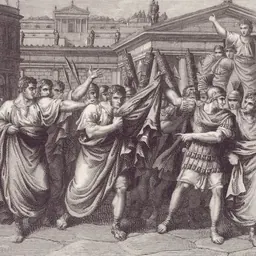
Later that year, on 19 August, Augustus died while away in Campania. As a result, Tiberius was made princeps. While Germanicus was administering the oath of fealty to Tiberius, a mutiny began among the forces on the Rhine. During the mutiny, Agrippina brought out their sixth child, Gaius, and made preparations to take him away to a safer town nearby. He was in a full army outfit including the legionary hobnailed boots (caligae). These military-booties earned Gaius the nickname "Caligula" (lit. "little boots"), and garnered sympathy for Agrippina and the child among the soldiery. Tacitus attributes her actions as having quelled the mutiny (Tacitus, Annals 1.40–4).
Once the mutiny was put to an end, Germanicus allowed the soldiers to deal with the ringleaders, which they did with brutal severity. He then led them against the Germanic tribes, perhaps in an effort to prevent future mutiny. Germanicus would remain in Gaul fighting against the Germanic tribes until AD 16, at which time he was recalled to Rome by Tiberius. His campaigns won him much renown among the Roman people, and he was awarded a triumph on 26 May AD 17.
Widowhood Benjamin West, Agrippina Landing at Brundisium with the Ashes of Germanicus (1768), oil on canvas. Yale University Art Gallery, New Haven. In AD 18, Agrippina left for the eastern provinces with her family. Germanicus was sent the east to govern the provinces, the same assignment her father was given years earlier. Agrippina was pregnant on their journey east and, on the way to Syria, she gave birth to her youngest daughter Julia Livilla on the island of Lesbos. Inscriptions celebrating her fertility have been found on the island.
Tiberius sent Gnaeus Calpurnius Piso to assist her husband, naming him governor of Syria. During their time there, Germanicus was active in his administration of the eastern regions. Rumours spread of Piso poisoning her husband on the emperor's orders. Her marriage to Germanicus had served to unite the imperial family. Agrippina may have suspected Tiberius' involvement in the death of her husband and, with Germanicus dead, she no longer had any familial ties to the emperor. Historian Richard Alston says it is likely that either Tiberius or Livia were behind the exile of Agrippina's sister Julia the Younger and the death of Postumus. He notes the death of Agrippina's mother, who starved herself to death amidst her exile in AD 14, linking her death to Tiberius' disdain for her.
Agrippina was vocal about her feelings claiming that Germanicus was murdered to promote Drusus the Younger as Tiberius' heir, and worried that the birth of the Younger Drusus' twin sons would displace her own sons in the line of succession.
At about this time, Tiberius' Praetorian Prefect Sejanus was becoming powerful in Rome and began feuding with Drusus the Younger. While the exact causes of the feud are unknown, it ended when the Younger Drusus died of seemingly natural causes on 14 September AD 23. After the death of Tiberius' son, Agrippina wanted to advance the careers of her sons, who were all potential heirs for Tiberius. It has been suggested that to achieve this, Agrippina commissioned the Great Cameo of France and presented it to Tiberius as a personalized gift that positioned the family of Germanicus around the emperor. The work was designed to convince Tiberius to choose her children as his heirs.
Ultimately, the death of Tiberius' son elevated her own children to the position of heirs. Her sons were the logical choice, because they were the sons of Germanicus and Tiberius' grandsons were too young. Nero was becoming popular in the Senate due in part, Tacitus says, to his resemblance with his father. The rise of her children was threatening to Sejanus' position. Resultantly, Sejanus began spreading rumors about Agrippina in the imperial court. The coming years were marked with increasing hostility between Sejanus and Agrippina and her sons. This effectively caused factions to rise in the aristocracy between her family and Sejanus.
Political rivalry Bronze sestertius of Caligula with Agrippina on the obverse, minted circa AD 37. On New Year's Day, AD 24, Sejanus had the priests and magistrates add prayers for the health of Nero and Drusus in addition to those normally offered to the emperor on that day. Tiberius was not happy with this and he voiced his displeasure in the Senate. In addition, he questioned the priests of the Palatine. Some of the priests who offered the prayers were relatives of Agrippina and Germanicus. This made Tiberius suspicious of her and marked a change in his attitude toward her and her older sons, but not Caligula.
In AD 25, Sejanus requested Livilla's hand in marriage. Livilla was a niece of the emperor, which would have made him a member of the imperial family. While this did make his ambitions clear, his request was denied. The loss may have been huge for Sejanus had the dissensions in the imperial household not been deteriorating. Relations were so bad that Agrippina refused to eat at Tiberius' dinner parties for fear of being poisoned. She also asked Tiberius if she could be allowed to remarry, which he also refused.
Downfall With Tiberius away from Rome, the city would see a rise of politically motivated trials on the part of Sejanus and his supporters against Agrippina and her associates. Many of her friends and associates were subsequently accused of maiestas ("treason") by the growing number of accusers. It was also common to see charges of sexual misconduct and corruption. In AD 27, Agrippina found herself placed under house arrest in her suburban villa outside Herculaneum.
In AD 28, the Senate voted that altars to Clementia (mercy) and Amicitia (friendship) be raised. At that time, Clementia was considered a virtue of the ruling class, for only the powerful could give clemency. The altar of Amicitia was flanked by statues of Sejanus and Tiberius. By this time, his association with Tiberius was such that there were those in Roman society who erected statues in his honor and gave prayers and sacrifices to Sejanus. Sejanus' birthday was honored as if he were a member of the imperial family. According to Richard Alston, "Sejanus' association with Tiberius must have at least indicated to the people that he would be further elevated." Cinerary urn of Agrippina which now rests in the Palazzo dei Conservatori of the Capitoline Museums near the Tabularium. Her son Drusus was later also exiled on charges of sexual misdemeanors. Sejanus remained powerful until his sudden downfall and summary execution in October AD 31, just after the death of Nero, the exact cause for which remains unclear. Alston suggests that Sejanus may have been acting in Tiberius' favor to remove Germanicus' family from power, noting that Agrippina and Nero's brother Drusus were left in exile even after Sejanus' death.
The deaths of Agrippina's older sons elevated her youngest son Caligula to the position of successor and he became princeps when Tiberius died in AD 37. Drusus the Younger's son Tiberius Gemellus was summoned to Capri by his grandfather Tiberius, where he and Caligula were made joint-heirs. When Caligula assumed power he made Gemellus his adopted son, but Caligula soon had Gemellus killed for plotting against him. According to Philo, Caligula's pretended reason was a conspiracy.
After he became emperor, Caligula took on the role of a dutiful son and brother in a public show of pietas ("piety"). He went out to the islands of Pontia and Pandateria in order to recover the remains of Agrippina and Nero. It was not easy to recover Nero's bones as they were scattered and buried. Moreover, he had a stormy passage; however, the difficulty in his task made his devotion seem even greater. The ashes were brought to Ostia, from where they were carried up the Tiber and brought to the Campus Martius, from where equestrians placed them on briers to join the ashes of Germanicus in the mausoleum of Augustus. The move was reminiscent of when Agrippina carried the ashes of her husband just over 17 years earlier. Agrippina's funerary urn still survives .
The tablet made of marble reads: "OSSA AGRIPPINAE M AGRIPPAE F DIVI AVG NEPTIS VXORIS GERMANICI CAESARIS MATRIS C CAESARIS AVG GERMANICI PRINCIPIS"
which translates as "Bones of Agrippina; daughter of Marcus Agrippa, granddaughter of Divus Augustus, wife of Germanicus Caesar, mother of Princeps Gaius Caesar Germanicus".
Personality Agrippina was fiercely independent, a trait she shared with her mother. Dio described her as having ambitions to match her pedigree. However, Anthony A. Barrett notes that Agrippina was fully aware that a woman in ancient Rome could not hold power in her own right. Instead, Agrippina followed the model of Livia in promoting the careers of her children.
Tacitus also records serious tension between Agrippina and Livia. He describes Livia as having visited "stepmotherly provocations" on Agrippina. He says of Agrippina: "were it not that through her moral integrity and love for her husband she converted an otherwise ungovernable temper to the good" (Tacitus, Annals 1.33).
Tacitus
The Annals of Tacitus is a history of the Julio-Claudian dynasty beginning with the death of Augustus. In it, he portrays women as having a profound influence on politics. The women of the imperial family in particular are depicted by Tacitus as having a notable prominence in the public sphere as well as possessing a ferocity and ambition with which they pursue it. Tacitus presents them as living longer than the imperial men and thus being more wise as they advance in age. Among the most broad of his portrayals is that of Agrippina. He emphasizes their role in connecting genetically back to Augustus, a significant factor in the marriages of the emperors and princes of the dynasty. The Annals repeatedly has Agrippina competing for influence with Tiberius simply because she is related to Augustus biologically.
Tacitus presents Agrippina as being kindred to aristocratic males,
Using the above epithet, "(femina) ingens animi" ("..[a woman], great for her courage"), he assigns a haughty attitude to Agrippina that compels her to explore the affairs of men. He records her as having reversed the natural order of things when she quelled the mutiny of the Rhine in AD 14. In so doing, he describes her as having usurped her husband's power, a power rightfully belonging only to a general.
Portraiture The Gemma Claudia (AD 50) depicting Claudius (front left), Agrippina the Younger (back left), Germanicus (front right), and Agrippina the Elder (back right).
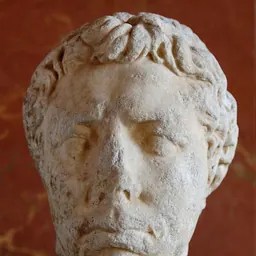
Portraits of Roman women from the Julio-Claudian dynasty display a freer hair treatment than those of traditional Roman men and are more keen on the sensitivity of recording on different textures. These changes in style served to make reproducing them more popular in the mid-first-century AD. Reproductions of her image would continue to be made into that period. In the portrait, she is given a youthful face despite the fact that she lived to middle age. Agrippina's hair is a mass of curls that covers both sides of her head and is long going down to her shoulders. Her portraiture can be contrasted with that of Livia who had a more austere Augustan hairstyle.
There are three different periods during the first-century AD when portraits were created for Agrippina: at the time of her marriage to Germanicus (which made her the mother of a potential emperor); when her son Caligula came into power in AD 37, and collected her ashes from the island of Pandateria for relocation to the Mausoleum of Augustus; and at the time of Claudius' marriage to Agrippina the Younger, who wanted to connect himself to the lineage of Augustus by evoking Agrippina's image. Coins and inscriptions cannot act as a method of discerning her age, because her hairstyle remains unchanged in all the representations.
The easiest phase of portraits to identify are those dating to the time of Caligula, when a fair abundance of coins were minted with an image of his mother on them. It is a posthumous portrait of her with idealized features. In the phase following Claudius' marriage, her features are made to more closely resemble those of her daughter. The goal was to strengthen Agrippina the Younger's connection with her mother. Finally, the portraits of her dating to the time of Tiberius are still idealized, but not as much as those from the period of Caligula's reign. Images of Agrippina from this period are the most lifelike.
She is also remembered in De Mulieribus Claris, a collection of biographies of historical and mythological women by the Florentine author Giovanni Boccaccio, composed in 136162. It is notable as the first collection devoted exclusively to biographies of women in Western literature. Other notable works of which include: Agrippina Mourning over the ashes of Germanicus (1775), an etching by Scottish painter Alexander Runciman. The Caesars (1968), a television series by Philip Mackie for Granada TV. She was played by Caroline Blakiston. I, Claudius (1976), a television series by Jack Pulman for the BBC. She was played by Fiona Walker.
Don’t just read it —
keep it.
Full-length biographies made to live with: read them, listen on the way to work, watch them tonight.
- E-book
- Audio
- Video
Instant download · yours to keep · every purchase keeps this site free
Important facts
Family & relationships
People in Agrippina the Elder's life
Named in this biography and alive at the same time


Related people
Same field, nearest in time


Contemporaries
People whose lives overlapped Agrippina the Elder's



Frequently asked questions
Who was Agrippina the Elder?
Member of Julio-Claudian dynasty (c. 14 BC–AD 33)
When was Agrippina the Elder born?
Agrippina the Elder was born in 14 BC in Athens.
When did Agrippina the Elder die?
Agrippina the Elder died on 18 October AD 33 in Ventotene.
What was Agrippina the Elder's occupation?
Agrippina the Elder was a politician.
What nationality was Agrippina the Elder?
Agrippina the Elder was Roman.
Sources & further reading
· Wikipedia: Agrippina the Elder
· DBpedia: Agrippina the Elder
Cite this page
APA: Biography.guide. (2026). Agrippina the Elder. https://biography.guide/agrippina-the-elder/
MLA: "Agrippina the Elder." Biography.guide, https://biography.guide/agrippina-the-elder/.
Chicago: "Agrippina the Elder." Biography.guide. https://biography.guide/agrippina-the-elder/.
Data last updated: 2026-09-20 · Spot an error? Report a correction.
Page generated 2026-09-27 05:31 UTC