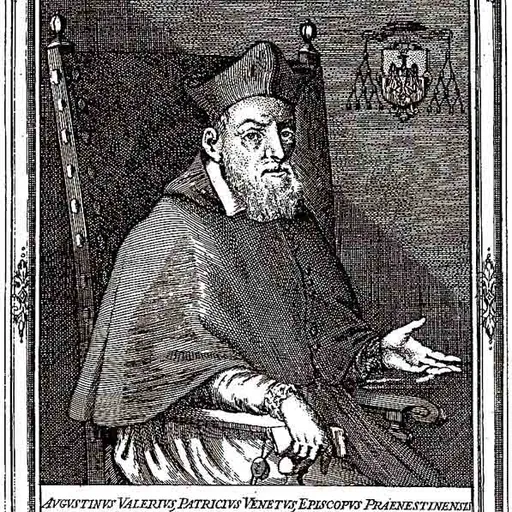
About Agostino Valier
Lived 1531 – 1606 (aged 75). Agostino Valier was an Italian catholic priest, philosopher and christian minister.
Agostino Valier (7 April 1531 – 24 May 1606), also Augustinus Valerius or Valerio, was an Italian cardinal and bishop of Verona. He was a reforming bishop, putting into effect the decisions of the Council of Trent by means of administrative and disciplinary measures. He was one of the Christian humanist followers of Filippo Neri.
Life He was born in Venice on 7 April 1531. He became a doctor of canon law.
Valier took part in the intellectual life of his time. In Venice, around the year 1560, he was associated with the Academy of Fame of Federico Badoer; he later also took part in the Noctes Vaticanae. As a dedicatee of one of the works of Jacopo Zabarella he may have been a patron.
Agostino was the nephew of Cardinal Bernardo Navagero (1507 – 1565), and assumed his position as bishop when his uncle died. Valier as bishop from 1565 was influenced by his reforming predecessor at Verona, Gian Matteo Giberti, as well as the Council of Trent, and his association with Carlo Borromeo. He followed Borromeo's Milan model but not slavishly, working within local tradition, while also handling the Venetian dominance in a diplomatic fashion.
In 1576, he requested that the Jesuits be called to Verona to found a school.
Valier died in Rome on 24 May 1606.
Works
Valier wrote a biography of Carlo Borromeo shortly after his death in 1584, and a history of Venice to 1580. He later became prefect of the Congregation of the Index. The atmosphere of close scrutiny of works is thought to have affected his wish for publication in his own lifetime. One work left unpublished was Philippus sive de laetitia Christiana, referencing Filippo Neri in its title, and dwelling on Carlo Borromeo and his nephew Federigo Borromeo, whom Valier had mentored, in a neostoic vein.
Rhetorica Ecclesiastica (1570) in Latin, a work based on mission work in the Veneto. This work by Valier employing classical rhetoric as a resource for preaching, with subsequent works by Luis de Granada and Diego de Estella, is considered a significant development in the Catholic tradition. A French translation by , La rhétorique du prédicateur, was published in 1750. Instruttione delle donne maritate (1575), a book for wives, in the form of a letter to his married sister. De cautione adhibenda in edendis libris (1719).
Don’t just read it —
keep it.
Full-length biographies made to live with: read them, listen on the way to work, watch them tonight.
- E-book
- Audio
- Video
Instant download · yours to keep · every purchase keeps this site free
Important facts
People in Agostino Valier's life
Named in this biography and alive at the same time


Related people
Same field, nearest in time


Contemporaries
People whose lives overlapped Agostino Valier's





Frequently asked questions
Who was Agostino Valier?
Italian cardinal
When was Agostino Valier born?
Agostino Valier was born on 7 April 1531 in Venice.
When did Agostino Valier die?
Agostino Valier died on 23 May 1606 in Rome.
What was Agostino Valier's occupation?
Agostino Valier was a catholic priest, philosopher and christian minister.
What nationality was Agostino Valier?
Agostino Valier was Italian.
Sources & further reading
Cite this page
APA: Biography.guide. (2026). Agostino Valier. https://biography.guide/agostino-valier/
MLA: "Agostino Valier." Biography.guide, https://biography.guide/agostino-valier/.
Chicago: "Agostino Valier." Biography.guide. https://biography.guide/agostino-valier/.
Data last updated: 2026-09-24 · Spot an error? Report a correction.
Portrait: Wikimedia Commons · author & licence
Page generated 2026-09-27 05:08 UTC