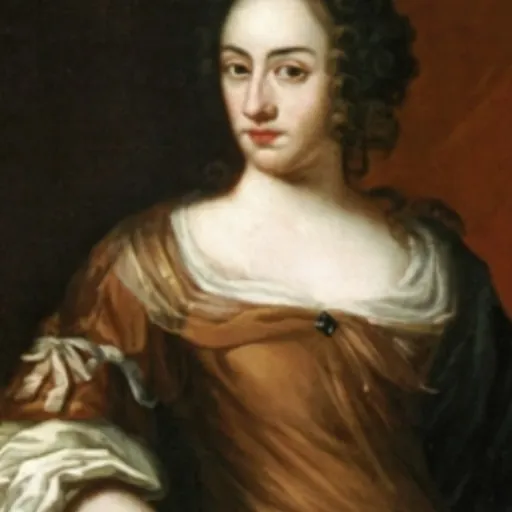
About Agneta Horn
Lived 1629 – 1672 (aged 42). Agneta Horn was a Swedish autobiographer, writer and countess.
Agneta Horn (18 August 1629 – 18 March 1672) was a Swedish writer born to noble parents and a military father. She traveled a great deal throughout Europe in her lifetime as a result of living in a military family and later marrying another soldier. She is most known for writing her autobiography, Agneta Horns leverne (also spelled "lefverne").
Life Agneta Horn was the daughter of Gustav Horn, Count of Björneborg and Kristina Oxenstierna, and the granddaughter of Axel Oxenstierna. She was born on 18 August 1629, in Riga in what is now Latvia, because her father was a Swedish military officer stationed outside of the country at the time of her birth.
Agneta continued to witness Swedish military life as an adult. She had no interest in civilian men and wanted only to marry a soldier; allegedly, she rejected one non-military man by burning his own gloves and dousing him in hot wax. Horn eventually married the "brav soldat" ("strong/brave soldier") Lars Kruus in 1648. As a married couple, they lived together in Poland and Germany. She regarded this time together as a period of "hardships and tribulations". She undertook a project to completely raze and rebuild a church in Björklinge. However, religious leaders in the region (Uppsala) convinced her to be content with a large-scale renovation and remodeling. This theory may be verified by the fact that Horn often glosses over details or background information when writing about a situation. She assumes that her readers are already familiar with the events she describes. Her diary has been considered by some to be the first Swedish novel.
Agneta Horn’s Leverne is broken into several different sections. The last six leaves of the original manuscript are quotes from the Biblical Psalms or Book of Job. Job is a righteous man who endures many trials and sufferings at the hand of God, but he never questions or challenges God's nature. He simply accepts the trials as they come. The primary message from the Book of Job is the question of why the righteous suffer. Given the difficult life Agneta Horn experienced, in her childhood in military camps and with her aunt, and then later as an adult, again living in military camps and experiencing the death of her husband, these introductory quotes are particularly significant. In thirteen instances, Horn changed the quotes to use first person or feminine pronouns, presumably so make the quotes "refer specifically to her . . . [and] to her situation." One can gather that Horn identified strongly with the Biblical Job, and related her own life's struggles to the constant hardships he experienced. Yet quoting Job also demonstrates that she felt the proper response to challenges in her life was to endure and carry on despite suffering. However, as Job experiences physical pain, Horn's strife is mostly related to her emotional pain. She recounts few joyous or happy experiences in her autobiography. Notably missing is an account of her wedding to Kruus.
Horn's work is also regarded as significant because of her unique use of language. For one, she "has no detachment from the characters in her autobiography". She writes about the people in her life "with passion," in a style that is emotional and engaging rather than removed and objective. She "does not seek to explain facts, but to replay and analyze emotions". Her writing is also regarded by as being especially informal and of a "brisk everyday style." This briskness is interspersed with "an almost Biblical style" in the section of her work where she quotes from Job and Psalms. Horn's writing has also been noted for her unique linguistic choices. For instance, in some cases she combined the endings of traditional written and oral Swedish to form new versions of the words.
Leverne is one of the first known written works by a Swedish woman, as well as one of the only published works to date that features a female perspective of the Swedish imperial military. It is the single most comprehensive work about and insight into the life of an individual Swede before the 1700s.
Critical response Though Horn's autobiography is generally well received, some critics have accused her work of being hysterical, base, or gaudy. These critics have ignored Horn's well-deserved place in the history of Swedish prose and autobiographical writing. Other scholars have deemed their criticism misguided, for it inappropriately conflates the writer and the individual. Stephen A. Mitchell writes, "What is so very mistaken about such comments, of course, is that they tend to interpret [Horn’s] actions as the protagonist of the autobiography, rather than examining the delicate balance between the writer and her heroine".
Don’t just read it —
keep it.
Full-length biographies made to live with: read them, listen on the way to work, watch them tonight.
- E-book
- Audio
- Video
Instant download · yours to keep · every purchase keeps this site free
Important facts
People in Agneta Horn's life
Named in this biography and alive at the same time

Related people
Same field, nearest in time



Contemporaries
People whose lives overlapped Agneta Horn's





Frequently asked questions
Who was Agneta Horn?
Swedish countess and writer (1629-1672)
When was Agneta Horn born?
Agneta Horn was born on 18 August 1629 in Riga.
When did Agneta Horn die?
Agneta Horn died on 18 March 1672 in Stockholm City.
What was Agneta Horn's occupation?
Agneta Horn was an autobiographer, writer and countess.
What nationality was Agneta Horn?
Agneta Horn was Swedish.
Sources & further reading
Cite this page
APA: Biography.guide. (2026). Agneta Horn. https://biography.guide/agneta-horn/
MLA: "Agneta Horn." Biography.guide, https://biography.guide/agneta-horn/.
Chicago: "Agneta Horn." Biography.guide. https://biography.guide/agneta-horn/.
Data last updated: 2026-09-21 · Spot an error? Report a correction.
Portrait: Wikimedia Commons · author & licence
Page generated 2026-09-27 05:01 UTC