
About Aglaia Coronio
Lived 1834 – 1906 (aged 71–72). Aglaia Coronio was a British embroiderer, bookbinder and art collector.
Aglaia Coronio portrait by George Frederic Watts circa 1874.Aglaia Coronio (née Ionides; 1834 – 20 August 1906, ) was a British embroiderer, bookbinder, art collector and patron of the arts.
Family life
Of Greek descent, she was the elder daughter of businessman and art collector Alexander Constantine Ionides, who had immigrated to London from Constantinople (present day Istanbul) in 1827.
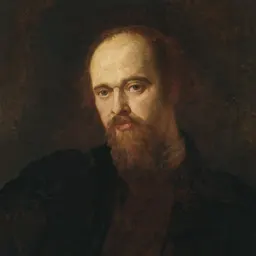
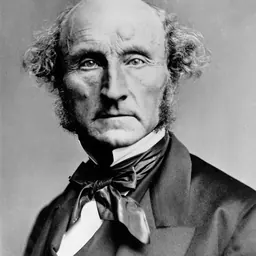
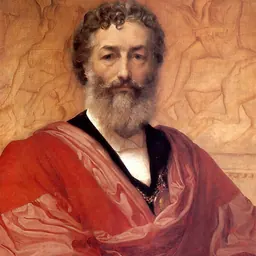
The Ionides family opened their home, 1 Holland Park, to London's artistic and intellectual circles. Aglaia had a friendly personality and kept correspondence with many of these family friends, including Alma Tadema, John Stuart Mill, Ford Maddox Brown, Samuel Butler, Thomas Hood, Ellen Terry, Frederic Leighton, George Sand, William Wordsworth, Sir Edwin Landseer, John Ruskin, Beerbohm Tree, George du Maurier, and Fantin Latour, among others. Along with her cousins, Coronio modeled for many of the Pre-Raphaelite artists including Dante Gabriel Rossetti, Edward Burne-Jones, Holman Hunt, and John Millais. All three cousins are featured in Edward Burne-Jones' The Mill. Being friends with Burne-Jones, Coronio would consult him regarding fashion designs, and he would send her sketches.
Friendship with William Morris Aglaia Coronio had a close, platonic friendship with William Morris, an artist closely connected with the Arts and Craft movement. They wrote many correspondences to each other throughout their lives. Coronio became a confidante to Morris on personal and artistic matters. Morris sought her comfort and sympathy during the most turbulent times in his marriage when his wife, Jane Morris, and Dante Gabriel Rossetti had an affair.
Artistic creator Bookbinder Through her acquaintance with Morris, Coronio learned how to bind books. While none of her books have been recovered, Morris recorded her progress within his letters.
Embroiderer Aglaia Coronio was recognized for her skill as an embroiderer. In partnership with Morris, Coronio worked not only as an artistic consultant but also as an embroiderer of some of his patterns. She contributed to the embroidery of “mediaeval-like curtains which [Morris] designed for the intention of Alexander Ionides’s wife”. Although her embroidery has not been easily located, records report that her work was displayed during the Arts and Craft Exhibition on October 4, 1888 in the New Gallery. Through her family's textile trade, Coronio occasionally provided Morris with rarer wools or dyes.
Art collector In similar fashion to her older brother and father, Aglaia Coronio participated as a patron of the arts while she grew her collection of artwork. She was listed as a collector lender for the 1885 Arab and Persian exhibition. Some scholars attribute William Morris' interest of the Oriental motifs and colors to Coronio's influence.
Don’t just read it —
keep it.
Full-length biographies made to live with: read them, listen on the way to work, watch them tonight.
- E-book
- Audio
- Video
Instant download · yours to keep · every purchase keeps this site free
Important facts
People in Aglaia Coronio's life
Named in this biography and alive at the same time




Related people
Same field, nearest in time

Contemporaries
People whose lives overlapped Aglaia Coronio's



Frequently asked questions
Who was Aglaia Coronio?
British art collector (1834–1906)
When was Aglaia Coronio born?
Aglaia Coronio was born in 1834 in London.
When did Aglaia Coronio die?
Aglaia Coronio died in 1906 in London.
What was Aglaia Coronio's occupation?
Aglaia Coronio was an embroiderer, bookbinder and art collector.
What nationality was Aglaia Coronio?
Aglaia Coronio was British.
Sources & further reading
Cite this page
APA: Biography.guide. (2026). Aglaia Coronio. https://biography.guide/aglaia-coronio/
MLA: "Aglaia Coronio." Biography.guide, https://biography.guide/aglaia-coronio/.
Chicago: "Aglaia Coronio." Biography.guide. https://biography.guide/aglaia-coronio/.
Data last updated: 2026-09-20 · Spot an error? Report a correction.
Page generated 2026-09-27 05:21 UTC