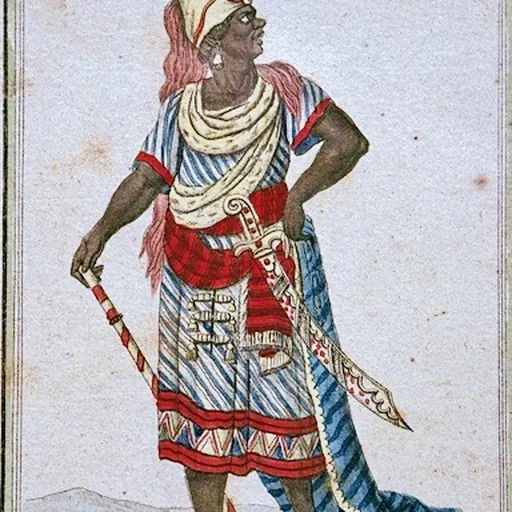
Afonso I of Kongo
Ruler of the Kingdom of Kongo from 1509 to 1542/43
About Afonso I of Kongo
Lived 1456 – 1543 (aged 86–87). Afonso I of Kongo was a monarch and traditional leader or chief.
Biography
Pre-reign Born around 1456 as Mvemba a Nzinga, he was the son of Manikongo (Mwene Kongo) (king) Nzinga a Nkuwu, the fifth king of the Kongo dynasty. The story, first recounted in a letter that was not survived by Afonso himself, is open to many interpretations, and may have been an allegory used to represent a coup launched by Afonso to expel anti-Catholic elements within the royal house. It is also important to notice the parallels with the miracle of Ourique and battle of Clavijo.
Mpanzu a Kitima was killed during the battle, either by falling into a sort of punji trap during his army's rout, or after being captured and then executed. The coat of arms was in use in Kongo until at least 1860.
Reign Having consolidated his power as king, Afonso began a campaign of border expansion and government centralization. Similar to his father's rule, Afonso developed the royal capital at Mbanza Kongo, increasing the influence of the monarchy while also curtailing the power of the rural noble class. Throughout his reign, Afonso launched military campaigns of expansion to the south and east of the Kongo. These campaigns brought new peoples under Kongolese control. Captives taken in the wars were enslaved and forcibly relocated to Mbanza Kongo, while conquered lands paid tribute to Kongo in the form of valuable trade goods (such as iron, palm cloth, and ivory). Afonso also strengthened ties with provincial kingdoms (most notably Sonyo and Mbata) ruled by his kin, helping to secure Kongo's position as the leading power in the region.
Trade between Portugal and Kongo at the start of Afonso's reign mainly consisted of ivory, copper, and palm cloth, but also an increasing trickle of slaves. Afonso and the king of Portugal established a shared monopoly on trade in the "Five Rivers of Guinea" – modern day Benin and the Niger Delta.
Afonso saw benefits from the strengthening ties with Portugal, as his efforts to convert Kongo to Catholicism were aided by the Portuguese. In 1512, Afonso received an official embassy from Portugal and send Kongolese ambassadors to Lisbon. Increased trade led to a flourishing economy centered around the highly-productive royal capital at Mbanza Kongo, which also benefited Afonso's government. These regulatory efforts greatly slowed or ended the enslavement of free Kongolese in the near term,
Significantly, religious brotherhoods (organizations) were founded in imitation of Portuguese practices. The ranks of brotherhoods would be called by different European titles, with the elected leader of each brotherhood having the title "king". To celebrate Pentecost, these brotherhoods organized processions that had the multiple motives of celebrating Saints, the brotherhoods themselves, and allowed the brotherhoods an opportunity to collect money.
Death Toward the end of his life, Afonso's children and grandchildren began maneuvering for the succession, and in 1540 plotters that included Portuguese residents in the country made an unsuccessful attempt on his life. He died toward the end of 1542 or perhaps at the very beginning of 1543, leaving his son Pedro to succeed him. Although his son was soon overthrown by his grandson Diogo (in 1545) and had to take refuge in a church, the grandchildren and later descendants of three of his daughters provided many later kings.
Historical analysis As the ruler of Kongo during a transformative and disruptive period of Kongolese history, Afonso's reign has been the area of historical study.
Virtually all that is known about Kongo in the time of Afonso's reign is known from his long series of letters, written in Portuguese, primarily to the kings Manuel I and João III of Portugal. The letters are often very long and give many details about the administration of the country. Many letters complain about the behavior of several Portuguese officials, and these letters have given rise to an interpretation of Afonso's reign as one in which Portuguese interests submerged Afonso's ambitions.
In Adam Hochschild's 1998 book King Leopold's Ghost, Hochschild characterizes Afonso as a "selective modernizer" because he welcomed European scientific innovation and the church but refused to adopt Portugal's legal code and sell land to prospectors. In fact, Afonso ridiculed the Ordenações Manuelinas (new Portuguese law code) when he read it in 1516, asking the Portuguese emissary de Castro, "What is the punishment, Castro, for putting one's feet on the ground?" No contemporary record mentions anything about land sales, indeed land in Kongo was never sold to anyone.
The precise motivation behind Afonso's campaign of conversion is unclear. "Scholars continue to dispute the authenticity of Kongolese Christian faith and the degree to which the adoption of a new faith was motivated by political and economic realities." Although the degree to which Afonso was purely spiritually motivated is uncertain, it is clear that the Kongo's conversion resulted in the far-reaching European engagement with both political and religious leaders who supported and legitimized the Christian kingdom throughout the rest of its history.
Popular culture
Afonso I (referred to as Mvemba a Nzinga) leads the Kongolese civilization in the 2016 4X video game Civilization VI.
Don’t just read it —
keep it.
Full-length biographies made to live with: read them, listen on the way to work, watch them tonight.
- E-book
- Audio
- Video
Instant download · yours to keep · every purchase keeps this site free
Important facts
Family & relationships
Related people
Same field, nearest in time

Contemporaries
People whose lives overlapped Afonso I of Kongo's


Frequently asked questions
Who was Afonso I of Kongo?
Ruler of the Kingdom of Kongo from 1509 to 1542/43
When was Afonso I of Kongo born?
Afonso I of Kongo was born in 1456 in M'banza-Kongo.
When did Afonso I of Kongo die?
Afonso I of Kongo died in 1543 in M'banza-Kongo.
What was Afonso I of Kongo's occupation?
Afonso I of Kongo was a monarch and traditional leader or chief.
What nationality was Afonso I of Kongo?
Afonso I of Kongo's recorded nationality: Kingdom of Kongo.
Sources & further reading
· Wikipedia: Afonso I of Kongo
Cite this page
APA: Biography.guide. (2026). Afonso I of Kongo. https://biography.guide/afonso-i-of-kongo/
MLA: "Afonso I of Kongo." Biography.guide, https://biography.guide/afonso-i-of-kongo/.
Chicago: "Afonso I of Kongo." Biography.guide. https://biography.guide/afonso-i-of-kongo/.
Data last updated: 2026-09-22 · Spot an error? Report a correction.
Portrait: Wikimedia Commons · author & licence
Page generated 2026-09-27 05:03 UTC