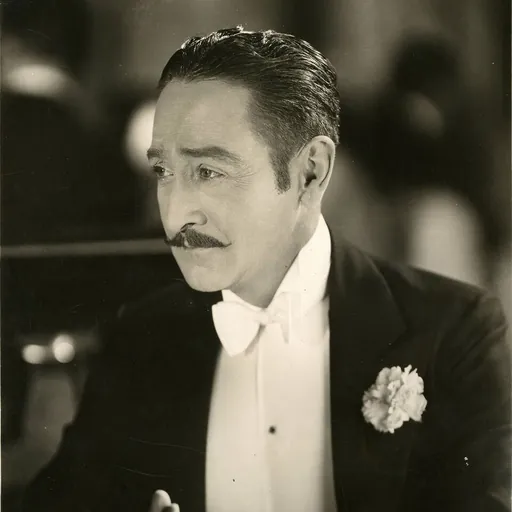
About Adolphe Menjou
Lived 1890 – 1963 (aged 73). Adolphe Menjou was an American character actor, stage actor, film actor, television actor and actor.
Adolphe Jean Menjou [/'ædɒlf 'mɒnʒuː/] (February 18, 1890 – October 29, 1963) was an American actor whose career spanned both silent films and talkies. He became a leading man during the 1920s, known for his debonair and sophisticated screen presence.
He played prominent roles in The Sheik (1921), A Woman of Paris (1923), The Marriage Circle (1924), Morocco (1930), A Farewell to Arms (1932), Morning Glory (1933), and the original A Star Is Born (1937). Mainly a supporting actor after the 1940s, he played a prominent role as the antagonist of Stanley Kubrick's Paths of Glory (1957). In 1960, he received a star on the Hollywood Walk of Fame for his contributions to the motion picture industry. He was noted as an example of a suave type of actor, one who could play lover or villain. In 1929, he attended the preview of Maurice Chevalier's first Hollywood film Innocents of Paris, and personally reassured Chevalier that he would enjoy a great future, despite the mediocre screenplay.
Stardom
Menjou closed the 1920s with star roles such as His Private Life (1928) and Fashions in Love (1929).
The crash of the stock market in 1929 meant that his contract with Paramount was cancelled, but he went on to Metro-Goldwyn-Mayer (MGM) and continued on with films (then talkies) in a variety of ways, with his knowledge of French and Spanish helping at key times. In 1930, he starred in Morocco, with Marlene Dietrich. He was nominated for an Academy Award for The Front Page (1931), after having received the role upon the death of Louis Wolheim during rehearsals. Up to the mid-1930s, he kept being cast as the romantic lead in a variety of productions, starring opposite Irene Dunne in The Great Lover (1931), with Barbara Stanwyck in Forbidden (1932), and opposite Elissa Landi in The Great Flirtation (1934). A variety of supporting roles in this decade were films such as A Farewell to Arms (1932), Morning Glory (1933), and A Star Is Born (1937).
His roles decreased slightly in the 1940s, but he did overseas work for World War II alongside supporting roles in films like Roxie Hart (1942) and State of the Union (1948). Over the course of his career, he bridged the gap of working with several noted directors that ranged from Charlie Chaplin to Frank Borzage to Frank Capra to Stanley Kubrick.
Later career Menjou had just eleven roles in the 1950s, but he managed to snag one last leading role with the film noir The Sniper (1952). In 1955, Menjou played Dr. Elliott Harcourt in "Barrier of Silence", episode 19 of the first season of the television series Science Fiction Theatre. He guest-starred as Fitch, with Orson Bean and Sue Randall as John and Ellen Monroe, in a 1961 episode, "The Secret Life of James Thurber", based on the works of American humorist James Thurber (especially "The Secret Life of Walter Mitty"), in the CBS anthology series The DuPont Show with June Allyson. He also appeared in the Thanksgiving episode of NBC's The Ford Show, Starring Tennessee Ernie Ford, which aired on November 22, 1956. Menjou ended his film career with such roles as French General George Broulard in Stanley Kubrick's film Paths of Glory (1957) and his final film role was that of the town curmudgeon in Disney's Pollyanna (1960).
Political views Menjou was a conservative, who defended leftist writers against being blacklisted. He supported the Hoover administration's policies during the Great Depression.
In 1947, Menjou gave a nuanced testimony at one House Committee on Un-American Activities hearing: "Menjou said he had studied communism and other "isms" extensively. But Menjou was cautious about identifying any individuals definitely as Communists. He said he knew of no members of the Screen Actors Guild who belong to the Communist party, but: "I know a lot of people who act an awful lot like Communists." Most movie producers [however], he said, are patriotic Americans." He actively opposed discriminating against artists based on their political views: "[Menjou] would not go along with the idea that contracts of known Communist actors or writers should not be renewed. Many Communist writers are splendid writers, he said, they "just have to be watched, that's all. (...) I'm not afraid of communism in America if it is out in the open," he explained." He further asserted, "I am not here to smear. I am here to defend the industry in which I have spent the greatest part of my life (...). If we make an anti-Fascist picture, we should make an anti-Communist picture. I'm also anti-Fascist as well as anti-Communist."
Menjou was a member of the Motion Picture Alliance for the Preservation of American Ideals, whose other members included John Wayne, Barbara Stanwyck (with whom Menjou costarred in Forbidden in 1932 and Golden Boy in 1939) and her husband, actor Robert Taylor. It is also well-known that he was, briefly, a member of the John Birch Society -- and that (even after his split with the organization) he still claimed to believe in the society's "principles," until the time of his death.
Personal life
Menjou was married three times. His first marriage, in 1920 to Kathryn Conn Tinsley, ended in divorce. He married Kathryn Carver in 1928; they divorced in 1934. His third and final marriage, to Verree Teasdale, lasted from 1934 until his death on October 29, 1963; they had one adopted son, Peter Menjou. Menjou had adopted Tinsley's son, Harold Lawton Tinsley, but after his death, his will revealed that he had included only Peter Menjou as his heir.
Menjou was an avid golfer, regularly playing with Clark Gable.
In 1948, Menjou published his autobiography, It Took Nine Tailors.
Death
Menjou died on October 29, 1963, of hepatitis in Beverly Hills, California. He is interred beside Verree at Hollywood Forever Cemetery.
Legacy For his contributions to the motion picture industry, Menjou has a star on the Hollywood Walk of Fame at 6826 Hollywood Boulevard.
Salvador Dalí admired Adolphe Menjou. He declared "la moustache d'Adolphe Menjou est surréaliste" and began offering fake mustaches from a silver cigarette case to other people with the words "Moustache? Moustache? Moustache?"
One of the most famous photographs by the avant-garde photographer Umbo is titled "Menjou En Gros" ca. 1928.
Filmography Year Title Role Notes 1914 The Acid Test Extra Short film Lost film 1914 The Man Behind the Door Ringmaster Lost film 1916 A Parisian Romance Julianai 1916 Nearly a King Baron 1916 The Price of Happiness Howard Neal 1916 The Habit of Happiness Society Man 1916 The Crucial Test Count Nicolai Lost film 1916 The Devil at His Elbow Wilfred Carleton 1916 The Reward of Patience Paul Dunstan 1916 Manhattan Madness Minor Role 1916 The Scarlet Runner Lost film 1916 The Kiss Pennington 1916 The Blue Envelope Mystery Lost film 1917 The Valentine Girl Joe Winder 1917 Wild and Woolly 1917 The Amazons Lost film 1917 An Even Break Bit Part 1917 The Moth Teddy Marbridge / The Husband Lost film 1920 What Happened to Rosa Reporter Friend of Dr. Drew 1921 The Faith Healer Dr. Littlefield Lost film 1921 Courage Bruce Ferguson 1921 Through the Back Door James Brewster 1921 The Three Musketeers Louis XIII 1921 Queenie Count Michael Lost film 1921 The Sheik Dr. Raoul de St. Hubert 1922 Head Over Heels Sterling 1922 Arabian Love Captain Fortine Lost film 1922 Is Matrimony a Failure? Dudley King 1922 The Fast Mail Cal Baldwin 1922 The Eternal Flame Duc de Langeais Partly lost film 1922 Pink Gods Louis Barney Lost film 1922 Clarence Hubert Stein 1922 Singed Wings Bliss Gordon 1923 The World's Applause Robert Townsend 1923 Bella Donna Mr. Chepstow 1923 Rupert of Hentzau Count Rischenheim Lost film 1923 A Woman of Paris Pierre Revel 1923 The Spanish Dancer Don Salluste 1924 The Marriage Circle Prof. Josef Stock 1924 Shadows of Paris Georges de Croy Lost film 1924 The Marriage Cheat Bob Canfield Lost film 1924 Broadway After Dark Ralph Norton Lost film 1924 For Sale Joseph Hudley Lost film 1924 Broken Barriers Tommy Kemp Lost film 1924 Sinners in Silk Arthur Merrill Lost film 1924 Open All Night Edmund Durverne 1924 The Fast Set Ernest Steel Lost film 1924 Forbidden Paradise Chancellor 1925 A Kiss in the Dark Walter Grenham Partly lost film 1925 The Swan Albert von Kersten-Rodenfels 1925 Are Parents People? Mr. Hazlitt 1925 Lost: A Wife Tony Hamilton Lost film 1925 The King on Main Street King Serge IV of Molvania 1926 The Grand Duchess and the Waiter Albert Durant 1926 Fascinating Youth Himself Lost film 1926 A Social Celebrity Max Haber Lost film 1926 The Ace of Cads Chappel Maturin Lost film 1926 The Sorrows of Satan Prince Lucio de Rimanez 1927 Blonde or Brunette Henri Martel 1927 Evening Clothes Lucien d'Artois Lost film 1927 Service for Ladies Albert Leroux Lost film 1927 A Gentleman of Paris Marquis de Marignan 1927 Serenade Franz Rossi Lost film 1928 A Night of Mystery Captain Ferreol Lost film 1928 His Tiger Lady Henri Lost film 1928 His Private Life Georges St. Germain Lost film 1929 Marquis Preferred Marquis d'Argenville 1929 Fashions in Love Paul de Remy 1930 Soyons gais Bob Brown 1930 My Childish Father Jérome 1930 Amor audaz Albert d'Arlons 1930 Mysterious Mr. Parkes Courtenay Parkes 1930 Morocco Monsieur La Bessiere 1930 New Moon Governor Boris Brusiloff 1931 The Easiest Way William Brockton 1931 Men Call It Love Tony 1931 The Front Page Walter Burns 1931 The Great Lover Jean Paurel 1931 The Parisian Jérome Rocheville 1931 Friends and Lovers Captain Geoffrey Roberts 1931 Prestige Capt. Remy Bandoin 1931 Wir schalten um auf Hollywood Himself 1932 Forbidden Bob 1932 Wives Beware Maj. Carey Liston First film ever shown at a drive-in 1932 Bachelor's Affairs Andrew Hoyt 1932 Diamond Cut Diamond Dan McQueen 1932 The Night Club Lady Police Commissioner Thatcher Colt 1932 A Farewell to Arms Rinaldi 1933 The Circus Queen Murder Thatcher Colt 1933 Morning Glory Louis Easton 1933 The Worst Woman in Paris? Adolphe Ballou 1933 Convention City T.R. (Ted) Kent Lost film 1934 Easy to Love John 1934 Journal of a Crime Paul Moliet 1934 The Trumpet Blows Pancho Montes / Pancho Gomez 1934 Little Miss Marker Sorrowful Jones 1934 The Great Flirtation Stephan Karpath 1934 The Human Side Gregory Sheldon 1934 The Mighty Barnum Bailey Walsh 1935 Gold Diggers of 1935 Nicolai Nicoleff 1935 Broadway Gondolier Professor Eduardo de Vinci 1935 The Milky Way Gabby Sloan 1936 Sing, Baby, Sing Bruce Farraday 1936 Wives Never Know J. Hugh Ramsey 1936 One in a Million Tad Spencer 1937 A Star Is Born Oliver Niles 1937 Café Metropole Monsieur Victor 1937 One Hundred Men and a Girl John Cardwell 1937 Stage Door Anthony Powell 1938 The Goldwyn Follies Oliver Merlin 1938 Letter of Introduction John Mannering 1938 Thanks for Everything J. B. Harcourt 1939 King of the Turf Jim Mason 1939 Golden Boy Tom Moody 1939 The Housekeeper's Daughter Deakon Maxwell 1939 That's Right—You're Wrong Stacey Delmore 1940 Turnabout Phil Manning 1940 A Bill of Divorcement Hilary Fairfield 1941 Road Show Colonel Carleton Carroway 1941 Father Takes a Wife Senior 1942 Roxie Hart Billy Flynn 1942 Syncopation George Latimer 1942 You Were Never Lovelier Eduardo Acuña 1943 Hi Diddle Diddle Col. Hector Phyffe 1943 Sweet Rosie O'Grady Tom Moran 1944 Step Lively Wagner 1945 Man Alive Kismet 1946 Heartbeat Ambassador 1946 The Bachelor's Daughters Alexander Moody 1947 I'll Be Yours J. Conrad Nelson 1947 Mr. District Attorney Craig Warren 1947 The Hucksters Mr. Kimberly 1948 State of the Union Jim Conover 1949 My Dream Is Yours Thomas Hutchins 1949 Dancing in the Dark Melville Crossman 1950 To Please a Lady Gregg 1951 The Tall Target Colonel Caleb Jeffers Across the Wide Missouri Pierre 1952 The Sniper Police Lt. Frank Kafka 1953 Man on a Tightrope Fesker 1955 Timberjack 'Sweetwater' Tilton 1956 The Ambassador's Daughter Senator Jonathan Cartwright Bundle of Joy J.B. Merlin 1957 The Fuzzy Pink Nightgown Arthur Martin Paths of Glory Major General Georges Broulard 1958 I Married a Woman Frederick W. Sutton 1960 Pollyanna Mr. Pendergast Final film role
Radio appearances Year Program Episode/source 1946 Screen Guild Players Experiment Perilous 1946 This Is Hollywood The Bachelor's Daughters
Don’t just read it —
keep it.
Full-length biographies made to live with: read them, listen on the way to work, watch them tonight.
- E-book
- Audio
- Video
Instant download · yours to keep · every purchase keeps this site free
Important facts
Family & relationships
People in Adolphe Menjou's life
Named in this biography and alive at the same time




Related people
Same field, nearest in time

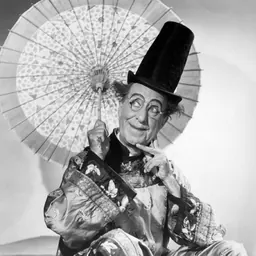

Contemporaries
People whose lives overlapped Adolphe Menjou's


Frequently asked questions
Who was Adolphe Menjou?
American actor (1890–1963)
When was Adolphe Menjou born?
Adolphe Menjou was born on 18 February 1890 in Pittsburgh.
When did Adolphe Menjou die?
Adolphe Menjou died on 29 October 1963 in Beverly Hills.
What was Adolphe Menjou's occupation?
Adolphe Menjou was a character actor, stage actor, film actor, television actor and actor.
What nationality was Adolphe Menjou?
Adolphe Menjou was American.
Sources & further reading
Cite this page
APA: Biography.guide. (2026). Adolphe Menjou. https://biography.guide/adolphe-menjou/
MLA: "Adolphe Menjou." Biography.guide, https://biography.guide/adolphe-menjou/.
Chicago: "Adolphe Menjou." Biography.guide. https://biography.guide/adolphe-menjou/.
Data last updated: 2026-09-22 · Spot an error? Report a correction.
Portrait: Wikimedia Commons · author & licence
Page generated 2026-09-27 05:03 UTC