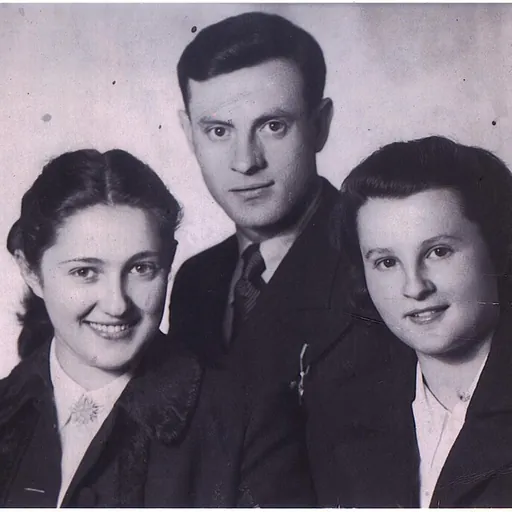
Adolf Liebeskind
Polish activist
About Adolf Liebeskind
Lived 1912 – 1942 (aged 29–30).
Adolf "Dolek" Liebeskind (3 October 1912 – 24 December 1942) was a Polish lawyer and a leader of the Jewish resistance movement within the Kraków Ghetto.
Biography
Early life and education Liebeskind was born on 3 October 1912 in Zabierzów, a village near the city of Kraków. His parents, Igancz Liebeskind and Esther Liebeskind , were religious Zionists. At the age of 14, Liebeskind joined the Kraków branch of Akiva, a religious Zionist youth organisation.
Liebeskind studied law at Jagiellonian University, and was in the process of preparing his doctoral dissertation when World War II broke out in September 1939. Later, He-Chaluc ha-Lochem and other resistance groups operating in the Ghetto, such as Ha-Shomer Ha-Za'ir and Ikra, agreed to join to form the Kraków branch of the Jewish Combat Organization (ŻOB) in August 1942, as had previously occurred in the Warsaw Ghetto a month prior. Other notable ŻOB members in Kraków included Dränger; his wife, Gusta; Hersz Bauminger, the founder of Ha-Shomer Ha-Za'ir; Bernard Halbrajch, Gola Mire; and Abraham Lejbowicz. Fellow resistance fighter Gusta Dawidson Draenger noted at the time that Liebeskind did not believe that the Jews would survive the Ghetto and that they were on the "path of death"; she recorded him as saying that he wanted there to be "three lines in history" that showed that Jews did not "go like sheep to slaughter" but that they had "rose up and fought for their honour".
December 1942 Cyganeria bombing and death In November 1942, police officers unsuccessfully attempted to arrest Liebeskind. A month later, on 22 December 1942, ŻOB, alongside the People's Guard, led a coordinated attack against German targets in Kraków, including throwing grenades at a German Army mess hall, the Zakopianka officers' club, and the Cyganeria and Espalanda cafés. False calls were also made by ŻOB to emergency services to divert them away from the areas where the attack took place. Between seven and 70 German soldiers were reported to have been killed in the attacks.
Aftermath The leadership of Jewish resistance in the Kraków Ghetto ruptured after the deaths of Liebeskind and other leaders including Dränger and Dawidson Draenger. Some captured members shared information about the resistance while being tortured, further weakening the resistance. By March 1943, all the Jews in the Ghetto had been either deported Belzec extermination camp, Auschwitz concentration camp or Kraków-Płaszów concentration camp (where many of them would be murdered), or killed on the strets of the Ghetto Trawniki men.
Liebeskind's wife Rebeka was deported to Auschwitz on 19 January 1943. She did not learn of her husband's death until after her deportation. She survived the war and moved to Kibbutz Maaysan Zvi in Israel, where she remarried. Liebeskind's sister, Miriam ("Mira"), also a member of the resistance, was captured and executed after being caught recruiting to the movement in Radom.
Don’t just read it —
keep it.
Full-length biographies made to live with: read them, listen on the way to work, watch them tonight.
- E-book
- Audio
- Video
Instant download · yours to keep · every purchase keeps this site free
Important facts
People in Adolf Liebeskind's life
Named in this biography and alive at the same time

Contemporaries
People whose lives overlapped Adolf Liebeskind's





Frequently asked questions
Who was Adolf Liebeskind?
Polish activist (1912–1942)
When was Adolf Liebeskind born?
Adolf Liebeskind was born in 1912.
When did Adolf Liebeskind die?
Adolf Liebeskind died in 1942.
Sources & further reading
Cite this page
APA: Biography.guide. (2026). Adolf Liebeskind. https://biography.guide/adolf-liebeskind/
MLA: "Adolf Liebeskind." Biography.guide, https://biography.guide/adolf-liebeskind/.
Chicago: "Adolf Liebeskind." Biography.guide. https://biography.guide/adolf-liebeskind/.
Data last updated: 2026-09-20 · Spot an error? Report a correction.
Page generated 2026-09-27 05:10 UTC