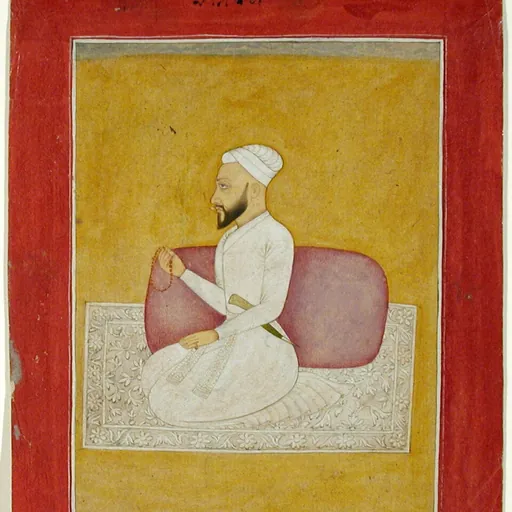
About Adina Beg
Lived 1710 – 1758 (aged 47–48). Adina Beg was a soldier.
Adina Beg Khan (; – 15 September 1758) was a Punjabi general, statesman, and warlord who served as the Nawab of Punjab from April 1758 until his death in September of the same year. He began his career as a patwari (accountant) and later as a sepoy after joining the Mughal army, eventually drawing the attention of the Mughal nobles. After serving through various posts, he was appointed as the Subahdar of the entirety of Punjab by Raghunath Rao on behalf of Rajaram II in 1758 and had earlier been recognised as the Nawab by Emperor Alamgir II during the power vacuum.
Though illiterate, Adina Beg served as the Shiqdar of Sultanpur Pargana, Faujdar of Sirhind Sarkar, Naib Nazim and then Nazim of Bist Doab Sarkar and, later, the Subahdar of the Subahs of Lahore and Multan, though his claim in Multan was disputed. He joined hands with the Sikh leader Jassa Singh Ahluwalia and the Marathas in defeating the Afghans. Despite being short, Adina Beg's reign has often been compared with that of his ideological aftercomer Ranjit Singh by modern historians.
Early life Named Dina at birth, Adina was born into a Punjabi Muslim family of the Arain tribe, in the village of Sharaqpur (now in the Sheikhupura district of Punjab, Pakistan), from Lahore. His father, Channu Arain was professionally a farmer. He was brought up as a soldier in a Mughal family, later becoming collector of revenue.
Rise to power Beg began his career as a domestic servant in the homes of Mughal officials. Proximity to Mughal officers inspired him to join as a soldier in the Mughal army. As a soldier, he was sent to various cities including Illahabad, Kanhapur and Bajwara, however becoming disillusioned with his poor prospects he took up the more lucrative position of patwari in the village of Kang near Sultanpur. He soon came under the patronage of Lala Sri Nivas Dhir, a wealthy Hindu merchant from Sultanpur, and obtained the revenue contracts for all the villages in the territory of Kang. In 1739, aiming to replace the newly deceased district officer of Sultanpur, Adina travelled to Lahore and secured an interview with the Viceroy of the Punjab, Zakariya Khan Bahadur. Impressing in his interview, the viceroy demanded security for his good behaviour, and on being guaranteed by Lala Sri Nivas, Adina was appointed faujdar of Sultanpur. Notably after restoring peace and order in the area, he ignored orders to take decisive steps to crush the Sikhs and instead pursued means of making peace with them. Recognising the decline of his Mughal employers he sought to make alliances with local groups, and granted jagirs to a number of Sikhs whilst also employing many in his armed forces, notably Jassa Singh Ramgarhia.
Imprisonment Nader Shah's invasion resulted in widespread looting, and led to Zakariya Khan being unable to pay his soldiers. After widespread protests by the soldiers, Zakariya Khan ordered his Diwan Lakhpat Rai to make the payments. The Diwan was imprisoned when he refused to do so and his brother Jaspat Rai was then ordered to demand arrears from all the nazims and faujdars in order to raise money. he marched on the capital and installed Sadiq Beg Khan to manage state affairs. This victory was however short lived as the Begum, with the help of the Afghans, drove Sadiq Beg Khan from power and restored Khwaja Abdullah's position. In 1756, the Mughal Wazir used Adina to conduct an intrigue to dispose the Begum from government in Lahore and bring her to Delhi. On completion of the mission, Adina was made subahdar of Lahore and Multan by the Mughal government at Delhi in return for an annual tribute of thirty lakh of rupees. The position was however short lived, as the Afghans successfully marched on Lahore to dispose Adina's deputy Sayyid Jamal-ud-Din and restore Khwaja Abdullah.
In November 1756, following advances from the Begum the Afghans launched a campaign to ransack Delhi. Adina, accompanied by Sadiq Beg and Jamal-ud-Din abandoned his positions and fled to Hansi. The Afghans successfully sacked Delhi in 1757, and the Begum was granted the Doaba and Jammu and Kashmir as a fief. In turn the Begum invited Adina to rule the Doaba on her behalf. The new Viceroy at Lahore, Jahan Khan, then demanded the full obedience of Adina and threatened to lay waste to the Doaba if refused. Adina agreed, however soon disagreement over the payment of tribute to Jahan Khan heightened tensions. Jahan Khan invited Adina to court to discuss ways to subdue the Sikhs, but was rebuffed by Adina who sent agents in his place. A detachment of troops was then sent to arrest Adina, however he retired to the foothills and recruited a large body of Sikh soldiers to counter the detachment. The Sikhs led by Sodhi Bharbag Singh and Jassa Singh Ahluwalia routed the Afghans and looted their luggage. In return Adina granted the Sikhs leave to pillage the Doaba including the city of Jullundur. Amid the looting and Afghan defeat, and anarchy persisted in the Punjab between November 1757 to February 1758.
Afghan expulsion and Maratha alliance In early 1758, Adina sought out allies to expel the Afghans from the Punjab and restore stability. He struck a deal with Sikh leaders Jassa Singh Ahluwalia and Sodhi Vadhbhag Singh, and with their help defeated the Afghans at Mahilpur. By March 1758 he had also enlisted the support of Raghunathrao of the Maratha Empire, and together they expelled the Afghans from Lahore. The Maratha and Sikh forces then gave chase to the retreating Afghans on horseback and were in quick pursuit of them in which they went on to capture Attock and then Peshawar from the Afghans. The Punjab now came under Maratha rule, with Adina appointed subahdar and later Nawab of the Punjab in 1758 in return for a yearly tribute of seventy five lakh of rupees. Raghunathrao and Malhar Rao Holkar, the two commanders-in-chief of the Maratha forces, remained in Lahore for three months after which they retired to the Deccan leaving Adina in sole control. To entrench his position he sought to eliminate his rivals, and declared his erstwhile allies the Sikhs, outlaws. He pursued two expeditions against the Sikhs, including an abortive siege of the mud fort Ram Rauni near Amritsar.
Personal life and death Adina Beg married a tawaif (dancer) in the early years of his career. Despite their estranged relationship, the couple had a son and a daughter who was wed to Khwaja Mirza Khan. After becoming the Nawab, Adina Beg unknowingly married a Sayyid woman. Upon discovering her lineage, he divorced her but gave her maintenance all his life. On 15 September 1758, only a few months after his appointment, Adina Beg died at Khanpur near Hoshiarpur after suffering from a colic attack. The Marathas appointed Sabaji Shinde to succeed him as the governor of the Punjab. A tomb was erected at his grave in Khanpur. His life is described in an unpublished Persian manuscript, the Ahwal-i-Dina Beg Khan.
In popular culture In the 2010 historical TV series Maharaja Ranjit Singh telecasted on DD National, the character of Adina Beg is portrayed by Rajendra Gupta.
Gallery
Don’t just read it —
keep it.
Full-length biographies made to live with: read them, listen on the way to work, watch them tonight.
- E-book
- Audio
- Video
Instant download · yours to keep · every purchase keeps this site free
Important facts
People in Adina Beg's life
Named in this biography and alive at the same time


Related people
Same field, nearest in time




Contemporaries
People whose lives overlapped Adina Beg's




Frequently asked questions
Who was Adina Beg?
Governor of the Punjab
When was Adina Beg born?
Adina Beg was born in 1710 in Sharaqpur, Sheikhupura District.
When did Adina Beg die?
Adina Beg died on 15 September 1758 in Batala, Gurdaspur district.
What was Adina Beg's occupation?
Adina Beg was a soldier.
Sources & further reading
Cite this page
APA: Biography.guide. (2026). Adina Beg. https://biography.guide/adina-beg/
MLA: "Adina Beg." Biography.guide, https://biography.guide/adina-beg/.
Chicago: "Adina Beg." Biography.guide. https://biography.guide/adina-beg/.
Data last updated: 2026-09-20 · Spot an error? Report a correction.
Page generated 2026-09-27 05:10 UTC