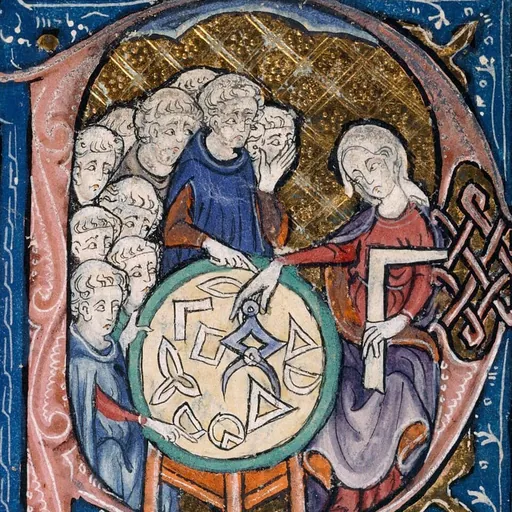
Adelard of Bath
12th-century English natural philosopher
About Adelard of Bath
Lived 1075 – 1160 (aged 84–85). Adelard of Bath was an English philosopher, mathematician, astronomer, translator, writer and astrologer.
Adelard of Bath (; 1080? 1142–1152?) was a 12th-century English natural philosopher. He is known both for his original works and for translating many important Greek scientific works of astrology, astronomy, philosophy, alchemy and mathematics into Latin from Arabic versions, which were then introduced to Western Europe. The oldest surviving Latin translation of Euclid's Elements is a 12th-century translation by Adelard from an Arabic version. He is known as one of the first to introduce the Arabic numeral system to Europe. He stands at the convergence of three intellectual schools: the traditional learning of French schools, the Greek culture of Southern Italy, and the Arabic science of the East.
Background Adelard's biography was incomplete in places, and leaves some aspects open to interpretation. Consequently, much of what is ascribed to Adelard is a product of his own testimony.
Adelard claims to come from the Roman English city of Bath. How he lived is not entirely known. Despite his extensive travels, by the end of his life he is thought to have returned to Bath where he died around 1160 AD.
The parents of the philosopher are not known for sure, but Fastred, a tenant of the Bishop of Wells, is noted by scholars as a possible father. The name Adelard is of Anglo-Saxon origin, which would make him to be of low status in 11th-century England. It is believed that he left England toward the end of the 11th century for Tours, Adelard later taught for a time at Laon, leaving no later than 1109 for travel.
After leaving Laon, Adelard describes himself as travelling to Southern Italy and Sicily no later than 1116. Historians believe that Adelard learned Arabic in Sicily or in Spain during his travels. During Adelard's lifetime in the 11th century it was understandably difficult for him to have achieved his educational pursuits. As printing had not been introduced and the literacy rate was very low, books were rare in medieval Europe, usually held only by royal courts or Catholic monastic communities (Kraye, et al. 1987). Fittingly, Adelard studied with monks at the Benedictine Monastery at Bath Cathedral. The work is modelled on Boethius' Consolation of Philosophy, evident in Adelard's vocabulary and phraseology. Each section of the liberal arts is divided into two parts. Presented first is a description of the allegorical figure representing the art, in which the importance of that art is indicated, followed by a summary of the doctrines of that art, as told by the allegorical figure who is presented as the founder or main proponent of the particular art.
The second of this trio, and arguably Adelard's most significant contribution, was his Questiones Naturales or Questions on Natural Science. It can be dated between 1107 and 1133 as, in the text, Adelard himself mentions that seven years have passed since his lecturing in schools at Laon. Two of the more specific features associated with this text are (1) a preference for reason over authority in matters of science and nature (in other words, seeking solutions via reason and logic rather than through faith) and (2) the use of the literary device of invoking Arab teachings when presenting very controversial topics (e.g. that brute animals may possess knowledge and souls) Adelard didn't think that the use of reason to seek knowledge was in any way contradictory with Christian faith in God. The soul is a large part of the dialogue in this text as On Man discusses a corporeal soul in man, while the final section elaborates on the incorporeal soul of elements and animals.
The final section in his trilogy is a treatise on hawking called De Avibus Tractatus (Treatise on Birds). It is a medical text that addresses disease from head-to-toe.
The remainder of Adelard's original works did not involve the persona of his nephew. He wrote a treatise on the use of the abacus called Regulae Abaci, which was likely written very early in his career because it shows no trace of Arab influence. If you read the source quoted, its obvious Adelard of Bath probably knew who worked at the Exchequer and might have met them at Laon, but what is common among them is that their educations are in Laon! Further evidence for this can be found in the Pipe Roll of Henry I, which shows that he had received a discharge from the "murder fine" (a fine levied on all inhabitants of a certain area based on the murder of a Norman that occurred in a generally accessible field in the area) levied on the community of Wiltshire in 1130, His work in natural philosophy helped lay the foundations for much of the progress that was made in the later centuries after Aristotle. His work surrounding Euclid's Elements provided training in demonstrative and geometrical proofs. While his original writings demonstrate a sincere passion for the seven liberal arts (grammar, rhetoric, logic, mathematics, geometry, music, and astronomy), his work in Quaestiones naturales illustrated a more encompassing dedication to subjects such as physics, the natural sciences, and metaphysics.
His influence is evident in De philosophia mundi by William of Conches, in the work of Hugh of Saint Victor, in Isaac of Stella's Letters to Alcher on the Soul and in Peter Abelard's Hexaemeron.
He introduced algebra to the Latin world and his commentaries in Euclid's Elements were extremely influential in the 13th century.
Don’t just read it —
keep it.
Full-length biographies made to live with: read them, listen on the way to work, watch them tonight.
- E-book
- Audio
- Video
Instant download · yours to keep · every purchase keeps this site free
Important facts
People in Adelard of Bath's life
Named in this biography and alive at the same time




Related people
Same field, nearest in time



Contemporaries
People whose lives overlapped Adelard of Bath's



Frequently asked questions
Who was Adelard of Bath?
12th-century English natural philosopher
When was Adelard of Bath born?
Adelard of Bath was born in 1075 in Bath.
When did Adelard of Bath die?
Adelard of Bath died in 1160 in Bath.
What was Adelard of Bath's occupation?
Adelard of Bath was a philosopher, mathematician, astronomer, translator, writer and astrologer.
What nationality was Adelard of Bath?
Adelard of Bath was English.
Sources & further reading
Cite this page
APA: Biography.guide. (2026). Adelard of Bath. https://biography.guide/adelard-of-bath/
MLA: "Adelard of Bath." Biography.guide, https://biography.guide/adelard-of-bath/.
Chicago: "Adelard of Bath." Biography.guide. https://biography.guide/adelard-of-bath/.
Data last updated: 2026-09-20 · Spot an error? Report a correction.
Portrait: Wikimedia Commons · author & licence
Page generated 2026-09-27 04:57 UTC