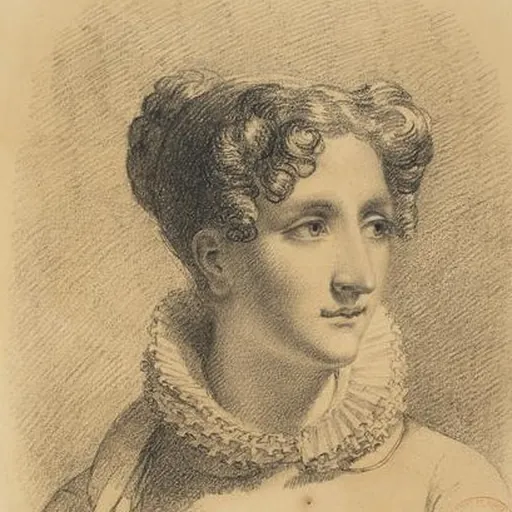
About Adélaïde Ducluzeau
Lived 1787 – 1849 (aged 62). Adélaïde Ducluzeau was a French painter.
Adélaïde Ducluzeau ( Marie-Adélaïde Durand; 15 March 1787– 1 August 1849) was a French porcelain painter, known for her work at the Manufacture nationale de Sèvres and for her master copies on porcelain. Active between 1818 and 1848, the artist also ran a small private art school. She died during the Paris cholera epidemic of 1849.
Early life and training Marie-Adélaïde Durand was born in Paris on 15 March 1787 into a wealthy family. Her father, a building contractor, encouraged her artistic interests, which she shared with her sister Joséphine. At an early age, she trained under the neoclassical painter Jean-Baptiste Regnault, with whom she developed a foundation in academic figure painting.
Initially pursuing art for personal enjoyment, a change in her financial situation led her to turn to the commercial practice of painting on porcelain.
Family
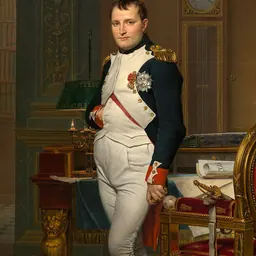
Durand-Ducluzeau married François Ducluzeau, a lawyer in the imperial court. In 1807, they had a daughter, Adélaïde Claire, who later became an artist. The Durand-Ducluzeau couple lived together at 14, rue Neuve-Saint-Roch, near the Louvre in Paris, and jointly owned property in the Charenton and Saint-Maurice area to the south of the city. In 1813 they sold this property to Emperor Napoleon, with the transaction formally accepted by Jean-Baptiste Nompère, Comte de Champagny, a high-ranking official. Records indicate that the couple were judicially separated in later years.
After their separation, Durand-Ducluzeau maintained a close connection to the neighbourhood of Saint-Germain-des-Prés, where she, her daughter and sister Joséphine all lived within a few hundred metres of one another. Joséphine Durand exhibited at the Salon under her married name, Rullier, while Adélaïde Claire used the pseudonym Zodalie-Michel Ducluseau.
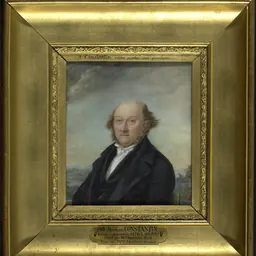
An assessment of Durand-Ducluzeau's work appears in the late 1980s within Jean-Pierre Cuzin's book on Raphaël and French art, which singles her out as one of the most accomplished porcelain painters at Sèvres during the directorship of Alexandre Brongniart, in the company of Victoire Jaquotot and Abraham Constantin. Despite recognition at the Salon and patronage from King Louis-Philippe, contemporaries at Sèvres expressed doubt in her technical abilities.
Brongniart's successor, Jacques-Joseph Ebelmen was supportive of Durand-Ducluzeau's talent, remarking that she stood alone in her ability to reproduce museum paintings on porcelain.
Durand-Ducluzeau's career at Sèvres was curtailed by administrative reforms.
Participation at the Salon Durand-Ducluzeau exhibited regularly at the Paris Salons from 1831 to 1845, receiving official recognition for her work. She was awarded a third-class medal in 1831 and a first-class medal in 1843. 1833: A Holy Trinity (silence) / Une Sainte Famille (Le Silence), after Carrache; Portraits from Life / Portraits d'après nature 1836: Portrait of Van Dyck / Portrait de Van Dyck, after Van Dyck; Set of several portraits done from life, porcelain / Cadre de plusieurs portraits d'après nature 1845: End of the Mass / La fin de la messe; Seven porcelain portraits, including S.A.R. Mgr le duc d'Orléans, prince royal, after Ingres, and S.A.R. Mgr le prince de Joinville, along with five other portraits.
On 8 March 1836, the king commissioned a pair of monumental egg-shaped vases bearing portraits of himself and his daughter, Princess Clémentine. Durand-Ducluzeau's portraits were widely praised, noted as among the finest examples of porcelain portraiture produced by the Manufacture.
Louis-Philippe later commissioned Durand-Ducluzeau to produce a life-size porcelain copy of Jean-Auguste-Dominique Ingres' portrait of the Duke of Orléans. This work was presented at the Exhibition of the Royal Manufactures on 3 June 1844 and subsequently shown at the Salon of 1845. Footed porcelain bowl painted after Alexandre-Évariste Fragonard, designed in 1806 by Brongniart (coupe B). The outer surface features allegories of the Five Senses in sixteenth-century dress, reflecting the period's taste for the picturesque. Porcelain copy of Van Dyck's self-portrait. Begun in March 1833, the first firing in 1834 was judged imperfect. Durand-Ducluzeau repainted it on a new plaque for the 1835 Exhibition of the Royal Manufactures at the Louvre, completing five firings to achieve the final finish. She earned 4,000 francs for her work. Painted panels for a table dedicated to Raphael, designed by A. Chenavard and Combette and executed by Durand-Ducluzeau after Bézard.
Painted porcelain copy of Raphael's work, based on the original in the Louvre (no. 363). Her final work, also considered one of her most important.
Don’t just read it —
keep it.
Full-length biographies made to live with: read them, listen on the way to work, watch them tonight.
- E-book
- Audio
- Video
Instant download · yours to keep · every purchase keeps this site free
Important facts
People in Adélaïde Ducluzeau's life
Named in this biography and alive at the same time


Related people
Same field, nearest in time


Contemporaries
People whose lives overlapped Adélaïde Ducluzeau's

Frequently asked questions
Who was Adélaïde Ducluzeau?
French painter (1787–1849)
When was Adélaïde Ducluzeau born?
Adélaïde Ducluzeau was born on 16 March 1787 in Paris.
When did Adélaïde Ducluzeau die?
Adélaïde Ducluzeau died on 2 August 1849 in Paris.
What was Adélaïde Ducluzeau's occupation?
Adélaïde Ducluzeau was a painter.
What nationality was Adélaïde Ducluzeau?
Adélaïde Ducluzeau was French.
Sources & further reading
· Wikipedia: Adélaïde Ducluzeau
Cite this page
APA: Biography.guide. (2026). Adélaïde Ducluzeau. https://biography.guide/adelaide-ducluzeau/
MLA: "Adélaïde Ducluzeau." Biography.guide, https://biography.guide/adelaide-ducluzeau/.
Chicago: "Adélaïde Ducluzeau." Biography.guide. https://biography.guide/adelaide-ducluzeau/.
Data last updated: 2026-09-24 · Spot an error? Report a correction.
Portrait: Wikimedia Commons · author & licence
Page generated 2026-09-27 05:08 UTC