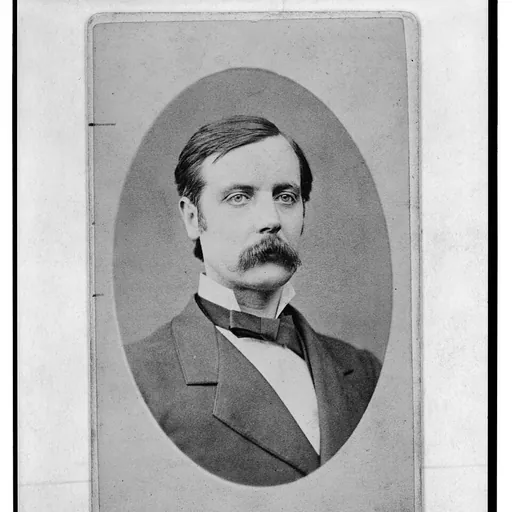
About Addison Clay Harris
Lived 1840 – 1916 (aged 75). Addison Clay Harris was an American diplomat, lawyer, politician and writer.
Addison Clay Harris (October 1, 1840 – September 2, 1916) was a lawyer and civic leader in Indianapolis, Indiana, who served as a Republican member of the Indiana Senate (1876 to 1880) and a U.S. Envoy Extraordinary and Minister Plenipotentiary (ambassador) to Austria-Hungary (1899 to 1901). The Wayne County, Indiana, native graduated from Northwestern Christian University (present-day Butler University) in 1862 and was admitted to the bar in 1865, the same year he established a law partnership with John T. Dye in Indianapolis. Harris was a founding member and president (1883 and 1890) of the Indianapolis Bar Association; a founder and president (1899 to 1904) of the Indiana Law School, which was a forerunner to the Indiana University Robert H. McKinney School of Law in Indianapolis; a presidential elector in 1896; president of the Indiana State Bar Association (1904); a member (1905–1916) and president (1909 to 1916) of Purdue University's board of trustees; and a member of the Indiana Historical Society and the Columbia Club.
Early life and education Addison Clay Harris was born on October 1, 1840, in rural Wayne County, Indiana, and was one of Martha (Young) and Branson Lewis Harris's two sons. Branson Harris, a Wayne County farmer, also served in three sessions of the Indiana House of Representatives (1853, 1875, and 1877). Branson Harris's ancestors came to North America from Cornwall, United Kingdom; his father moved the family of Quakers from North Carolina to settle in Indiana.
Addison Harris received his early education in local Quaker schools near his Wayne County home. He enrolled at North Western Christian University (present-day Butler University) in 1860, and graduated two years later in 1862. After college he read law for three years at the Indianapolis firm of Barbour and Howland and studied under Indiana Supreme Court Justice Samuel E. Perkins. India Harris was active in the Art Association of Indianapolis, the forerunner to the Indianapolis Museum of Art and Indiana University – Purdue University Indianapolis's Herron School of Art and Design. She served on its board of trustees, which including leadership roles as recording secretary (1893–1899) and as its fifth president (1904–1907). The couple had no children.
Addison and India Harris's primary residence was located on North Meridian Street in Indianapolis. Harris and Dye maintained their law practice for fourteen years, but dissolved the partnership in 1879, when Dye went to work for the Big Four Railroad. Afterwards, Harris practiced law alone, mainly focusing on constitutional law and corporate law, his specialty. He supported the concept of workers' compensation and favored the use of arbitration boards to settle labor disputes. Harris also authored Modern Views of Compensation for Personal Injuries (Indianapolis, 1909).
Indiana politician Harris, a member of the Republican Party, was elected to Indiana Senate representing Marion County, Indiana, in 1876. He served in two sessions of the Indiana General Assembly (1877 and 1879) before his term ended in 1880.
Death and legacy Harris suffered a stroke and died in Indianapolis on September 2, 1916.
To save it from demolition the Town (present-day City) of Fishers, Indiana, supervised the move of Harris's summer home in Hamilton County from its original location at 96th Street and Allisonville Road to 106th Street and Eller Road (present-day Heritage Park at White River) in 1996. The West-Harris House (also known as Ambassador House) was listed on the National Register of Historic Places in 1999. The restored home is operated as a local history museum and a site for community events and private rentals.
Honors and tributes At India Crago Harris's bequest, a trust in honor of her husband was established in 1948 to fund a public lecture series. The Addison C. Harris Memorial Lecture brings prominent legal scholars to Indiana to lecture at Indiana University Bloomington's Maurer School of Law. The first lectures in the series were delivered in 1949. More recently, Professor Jack Balkin, Yale Law School, delivered, "The Recent Unpleasantness: Understanding the Cycles of Constitutional Time," on September 13, 2017.
Don’t just read it —
keep it.
Full-length biographies made to live with: read them, listen on the way to work, watch them tonight.
- E-book
- Audio
- Video
Instant download · yours to keep · every purchase keeps this site free
Important facts
Family & relationships
People in Addison Clay Harris's life
Named in this biography and alive at the same time


Related people
Same field, nearest in time


Contemporaries
People whose lives overlapped Addison Clay Harris's

Frequently asked questions
Who was Addison Clay Harris?
American lawyer and politician (1840–1916)
When was Addison Clay Harris born?
Addison Clay Harris was born on 1 October 1840 in Wayne County.
When did Addison Clay Harris die?
Addison Clay Harris died on 2 September 1916 in Indiana, Indianapolis.
What was Addison Clay Harris's occupation?
Addison Clay Harris was a diplomat, lawyer, politician and writer.
What nationality was Addison Clay Harris?
Addison Clay Harris was American.
Sources & further reading
· Wikipedia: Addison Clay Harris
Cite this page
APA: Biography.guide. (2026). Addison Clay Harris. https://biography.guide/addison-clay-harris/
MLA: "Addison Clay Harris." Biography.guide, https://biography.guide/addison-clay-harris/.
Chicago: "Addison Clay Harris." Biography.guide. https://biography.guide/addison-clay-harris/.
Data last updated: 2026-09-22 · Spot an error? Report a correction.
Portrait: Wikimedia Commons · author & licence
Page generated 2026-09-27 05:03 UTC